Affiliate disclosure: Some links on this page are affiliate links. As an Amazon Associate we earn from qualifying purchases, at no extra cost to you.
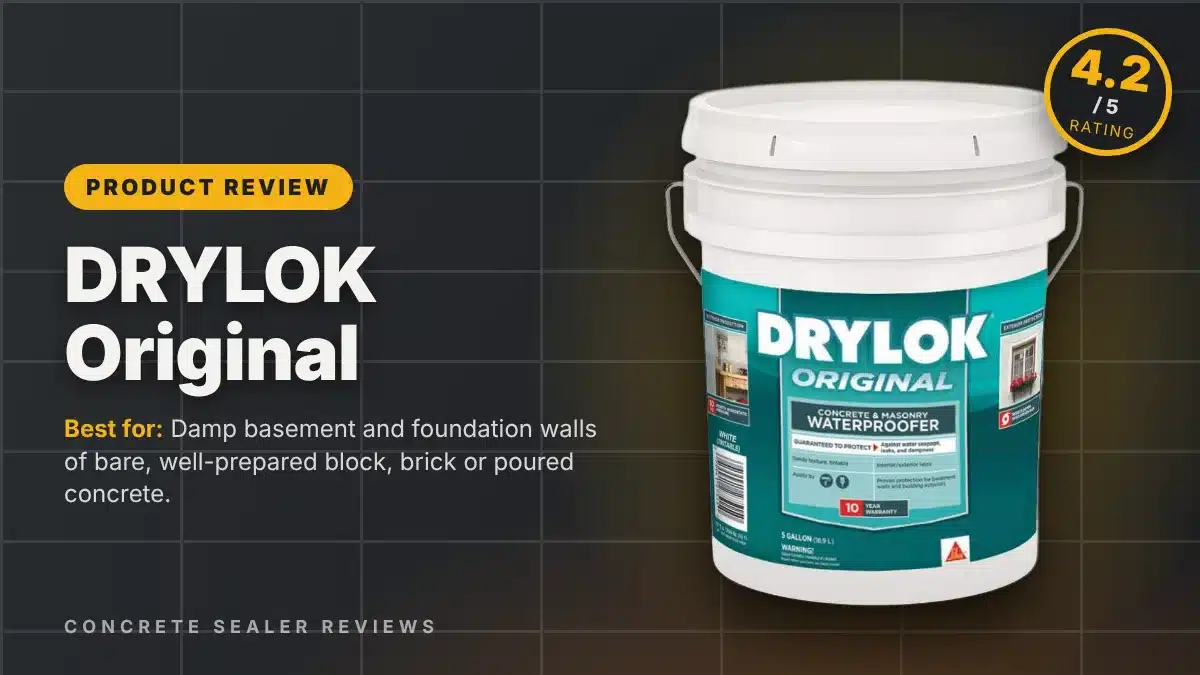
DRYLOK Original Concrete & Masonry Waterproofer is a thick, latex-based coating you brush or roll onto basement walls, foundations and other masonry to stop water seeping through. It’s one of the best-known DIY basement waterproofers, and it’s backed by a 10 psi hydrostatic pressure rating and a 10-year limited warranty. The bottom line: it works well on bare, properly prepared masonry walls, but it’s a wall paint, not a floor sealer, and it can’t fix cracks, drainage problems or water coming in at the floor joint on its own.
| Type | Film-forming masonry waterproofing coating |
| Chemistry | Latex base, about 66% solids by weight; rated below 1 perm |
| Finish | Flat, sandy texture; White or Gray, tintable to light shades |
| Coverage | First coat about 75 sq ft/gal; second coat 75–100 sq ft/gal |
| Coats | 2 minimum |
| Dry/recoat | Touch dry 1.5 hours; recoat in 2–3 hours |
| Cure | Can be topcoated with latex paint after 24 hours |
| Best for | Bare basement walls, foundations, block, brick, stucco, poured concrete walls |
| Not for | Floors or other horizontal surfaces with foot traffic; over existing paint |
| New concrete | Cure 28–30 days or until pH is below 10 |
Watch: DRYLOK Original in 60 seconds
What It Is / How It Works
DRYLOK Original is a heavy-bodied latex coating that fills the pores of masonry and forms a semi-impermeable film. It's still sold under the same name. DRYLOK was originally a United Gilsonite Laboratories (UGL) brand and is now part of Sika, which publishes the current data sheet.
The key numbers from Sika's data sheet: it's rated for 10 psi of hydrostatic pressure, which DRYLOK describes as the equivalent of a 22-foot wall of water (tested to ASTM D7088). It also resisted wind-driven rain at 98 mph and is rated below 1 perm for vapor transmission. That low vapor rating is part of why it works on basement walls, and DRYLOK says it also reduces radon penetration by limiting vapor transfer.
Unlike a clear penetrating sealer, DRYLOK Original changes the look of the wall. It goes on like thick, gritty paint and dries to a flat white or gray finish. You can tint it lightly or topcoat it with latex paint after 24 hours.
Where It Works Best (and where it doesn't)
It's made for vertical masonry, interior or exterior, above or below grade: poured concrete foundation walls, cinder and concrete block, brick and stucco. It's also used on fish ponds and non-potable tanks, per the data sheet. Typical uses are damp basement walls, block crawlspaces and foundation walls with seepage.
It isn't for floors. Sika's data sheet says plainly that it's "not formulated for horizontal surfaces subject to foot traffic" and points to DRYLOK Floor & Wall instead. It shouldn't go over existing paint, and doing so voids the warranty. It also won't seal active cracks, holes or the joint where the wall meets the floor; DRYLOK says to patch those first with a hydraulic cement such as its Fast Plug. If water is pouring in from outside because of grading or gutters, a coating won't solve that. For clear options on exterior slabs, see our best waterproofing concrete sealers.
Pros
- Rated for 10 psi hydrostatic pressure, high for a DIY coating
- 10-year limited warranty that transfers to later owners
- Water-based latex with soap-and-water cleanup
- Brightens basement walls and can be topcoated with latex paint
- Widely available and highly rated by buyers; owners commonly report drier basement walls after heavy rain
Cons
- Low coverage (75–100 sq ft per gallon per coat), so a basement takes a lot of product
- Must go on bare masonry; painted walls need stripping first
- Not for floors or other walked-on surfaces
- Thick, sandy-textured product that has to be brushed or back-brushed into the pores
- Warranty excludes recurring efflorescence and failures from poor prep
- Some owners report needing extra coats over patches or seeing it bleed through
How to Apply It
- Clean the wall. Remove dirt, dust, grease, oil, form release compound and paint. Take off any paint in poor condition. If you're scraping old paint, use a NIOSH-approved respirator and HEPA vacuum in case of lead.
- Patch first. Fill holes, cracks and the floor/wall joint with a hydraulic cement such as DRYLOK Fast Plug.
- Remove efflorescence with an etching solution or muriatic acid. Smooth surfaces need acid etching or mechanical abrasion to a medium-sandpaper texture. For damp walls, DRYLOK recommends its Wet Wall Bonding Primer.
- Check conditions. Air and wall must be 50°F or warmer. Apply to a dry surface during a rain-free period, and test a small area first.
- Stir well and don't thin. Keep stirring during use because the solids settle.
- Apply the first coat at about 75 sq ft per gallon with a DRYLOK brush, nylon brush or 3/4" nap roller. If rolling, back-brush to push it into the pores.
- Apply the second coat after 2–3 hours at 75–100 sq ft per gallon. If any spots still leak, recoat them. You can paint over it with latex after 24 hours.
How It Compares
DRYLOK Extreme is a separate latex masonry waterproofer in the same family, sold alongside Original at home centers. If you're choosing between them, compare the pressure rating, coverage and warranty on each current label rather than assuming they're interchangeable.
Clear silane/siloxane water repellents such as Rust-Oleum OKON S-40 or Rainguard Micro-Seal keep the wall's natural look and stay breathable. They're great on exterior brick and block that gets rained on, but OKON's own data sheet says S-40 doesn't protect against hydrostatic pressure, so they aren't a substitute for DRYLOK on a seeping basement wall.
Exterior excavation and membrane systems or interior drainage handle severe water problems that no coating can. If you have standing water or active leaks, talk to a basement waterproofing contractor first.
FAQ
Does DRYLOK really stop water?
On properly prepared bare masonry with two full coats, DRYLOK rates it to stop water up to 10 psi of hydrostatic pressure. It won't stop water coming through unpatched cracks, the floor/wall joint or from poor drainage outside.
Can I use DRYLOK Original on a basement floor?
No. The data sheet says it isn't formulated for horizontal surfaces with foot traffic. Use DRYLOK Floor & Wall or a floor-rated coating instead.
Can I put DRYLOK over painted walls?
DRYLOK's warranty requires a bare surface, and applying over existing coatings voids it. Remove the paint first so the product can bond with the masonry.
How long does DRYLOK last?
It carries a 10-year limited warranty when two coats go on a properly prepared, bare vertical masonry surface. The warranty covers product replacement or a refund, not labor.
Verdict
DRYLOK Original remains a solid, affordable choice for damp basement and foundation walls. Its 10 psi rating, 10-year warranty and long track record set it apart from clear sealers. Success depends on prep: bare masonry, patched cracks, removed efflorescence and two full coats. Keep it off floors, and fix outside drainage problems first. Full details are on the DRYLOK product page. Our rating: 4.2/5
How we reviewed this product: this is a research-based review built from the manufacturer's technical data sheet and current retail listings. We have not run our own hands-on tests of this product. Details were checked in October 2026; always follow the current label.