
Affiliate disclosure: Some links on this page are affiliate links. As an Amazon Associate we earn from qualifying purchases, at no extra cost to you.
Rust-Oleum OKON S-40 is a water-based silane/siloxane water repellent for porous concrete, block, brick and mortar, both vertical walls and horizontal slabs. It soaks in about 3/8 inch, leaves no film and doesn’t change the look of the surface. The bottom line: it’s one of the better-documented penetrating sealers you can buy at a home center, with real test data and an optional 5-year warranty, but it’s a water repellent, not a fix for hydrostatic pressure or cracks.
| Type | Penetrating water repellent (non-film-forming) |
| Chemistry | Water-based oligomeric siloxane/silane; VOC under 50 g/L |
| Finish | Colorless, non-glossy, non-yellowing; no change in texture |
| Coverage | Horizontal: 100–150 sq ft/gal per coat. Vertical: 40–60 first coat, 60–100 second coat |
| Coats | 1 on dense vertical surfaces; 2 wet-on-wet on textured or horizontal surfaces |
| Dry/recoat | Second coat while the first is still damp; foot traffic 8 hours |
| Cure | Vehicles 24 hours; repellency develops over 24 hours to 5 days |
| Best for | Driveways, sidewalks, garage and parking slabs, block and brick walls |
| Not for | Glazed or sealed surfaces; walls with hydrostatic pressure |
| New concrete | Wait 21 days |
Watch: OKON S-40 in 60 seconds
What It Is / How It Works
OKON S-40 combines silane and siloxane in a water carrier. Silanes are small molecules that travel deep into concrete; siloxanes are larger and help near the surface. Together they react with the substrate to line the pores with a water-repellent layer. The concrete still breathes, so vapor can escape, but liquid water and the salts it carries are kept out.
OKON is now a Rust-Oleum brand, and the product is sold as Rust-Oleum OKON S-40 Water Repellent Sealer in 1-gallon (OK-641) and 5-gallon (OK-640) sizes. Rust-Oleum's technical data sheet lists about 3/8 inch of penetration (substrate dependent), an 88% reduction in absorption, a 100% reduction in water leakage through brick and over 91% through block and mortar, and no change after 1,500 hours of accelerated weathering. It's also listed as paintable after application.
Don't confuse S-40 with OKON Multi-Surface, which is an acrylic/siloxane blend that the same company says is not for driveways. S-40 is the one built for concrete slabs and masonry walls.
Where It Works Best (and where it doesn't)
The data sheet lists a broad range of uses: vertical and horizontal concrete, normal and lightweight block, porous brick, mortar joints, exterior walls, sound barriers, sidewalks, ramps, parking decks, bridge decks and industrial floors. For homeowners, that translates to driveways, walkways, patios, garage aprons and block or brick walls that soak up rain. It's a good fit in snow country, where keeping water and de-icing salt out of the concrete helps limit freeze/thaw damage.
It has clear limits. Rust-Oleum says it doesn't protect against hydrostatic pressure, efflorescence caused by interior moisture, or water that gets in through cracks, expansion joints or joints between different materials. It won't fill large pores or bridge cracks, so seal those first. It isn't for glazed or previously sealed surfaces, and it won't add gloss or color. For more choices in this category, see our best silane-siloxane concrete sealers.
Pros
- Published penetration depth, absorption reduction and weathering data
- Invisible, non-yellowing and breathable
- Water-based, low VOC and nonflammable
- Works on both horizontal slabs and vertical walls
- Paintable, and eligible for a 5-year water repellency warranty on registered projects
- Short 21-day wait on new concrete
Cons
- Doesn't stop hydrostatic pressure or leaks through cracks and joints
- Low coverage on vertical block (40–60 sq ft per gallon on the first coat)
- Water repellency takes up to 5 days to fully develop
- Standard product warranty is only 60 days; the 5-year warranty requires two coats and a verification form, and not all substrates qualify
- Surfaces that were wet-washed need three days to dry before application
- Short 12-month shelf life, even unopened, so don't stock up
How to Apply It
- Wait for new concrete to cure. Rust-Oleum requires 21 days.
- Repair first. Seal cracks and joints, and cap parapet walls. S-40 can't bridge gaps.
- Clean and dry the surface. If you pressure wash, wait three days before applying.
- Check the weather. Apply between 45°F and 90°F with humidity under 85%, and don't apply if rain is expected within 12 hours.
- Do a test area to confirm spread rate and appearance before the full job.
- Apply a saturating coat with a low-pressure sprayer. On slabs, aim for 100–150 sq ft per gallon. On vertical walls, expect 40–60 sq ft per gallon on the first coat.
- Add a second coat while the first is still damp on textured or horizontal surfaces. Dense surfaces may not need one.
- Protect and wait. Keep it dry for 12 hours. Allow foot traffic after 8 hours and vehicles after 24 hours (at 70°F and 50% humidity). Full repellency develops over 1 to 5 days.
How It Compares
Rainguard Micro-Seal is another water-based silane/siloxane that's sold at Home Depot. It has zero VOC, can be used for curing fresh concrete, and its data sheet lists freeze/thaw and chloride test results. It's a close alternative if you want a single product for concrete, brick, stucco and wood.
Valspar Concrete & Masonry Waterproofer at Lowe's is a convenient water-based siloxane, but Valspar publishes far less technical data. S-40's penetration and absorption numbers give you more to go on.
Latex masonry waterproofers like DRYLOK Original are the better choice for a basement wall that seeps under pressure. They form a film and change the look of the wall, but they're rated for hydrostatic pressure, which S-40 isn't. See our best waterproofing concrete sealers for more.
FAQ
Is OKON S-40 waterproof?
It's a water repellent. It greatly reduces water absorption and leakage through the material itself, but Rust-Oleum says it doesn't protect against hydrostatic pressure or water entering through cracks and joints.
Can I use OKON S-40 on a driveway?
Yes. Sidewalks, ramps, parking decks and other horizontal concrete are listed uses. Allow 24 hours before driving on it. (OKON Multi-Surface, a different product, is not for driveways.)
Can you paint over OKON S-40?
Rust-Oleum lists it as paintable, tested to ASTM D3359. As always, test a small area with your chosen paint first.
How long does OKON S-40 last?
The data sheet doesn't give a fixed lifespan. Rust-Oleum offers a possible 5-year water repellency warranty on properly applied, registered projects, which gives a sense of the expected service life. Reapply when water stops beading.
Verdict
OKON S-40 is a solid, well-documented penetrating water repellent for driveways, walks and masonry walls. It's invisible, breathable and backed by real test numbers, which is more than many home-center sealers offer. Just know its limits: it won't stop pressure-driven water or seal cracks, and the 5-year warranty has conditions. See the Rust-Oleum OKON S-40 product page for the current label. Our rating: 4.1/5
How we reviewed this product: this is a research-based review built from the manufacturer's technical data sheet and current retail listings. We have not run our own hands-on tests of this product. Details were checked in October 2026; always follow the current label.
Where to Buy
Check Price on Amazon
Related Guides
Affiliate disclosure: Some links on this page are affiliate links. As an Amazon Associate we earn from qualifying purchases, at no extra cost to you.
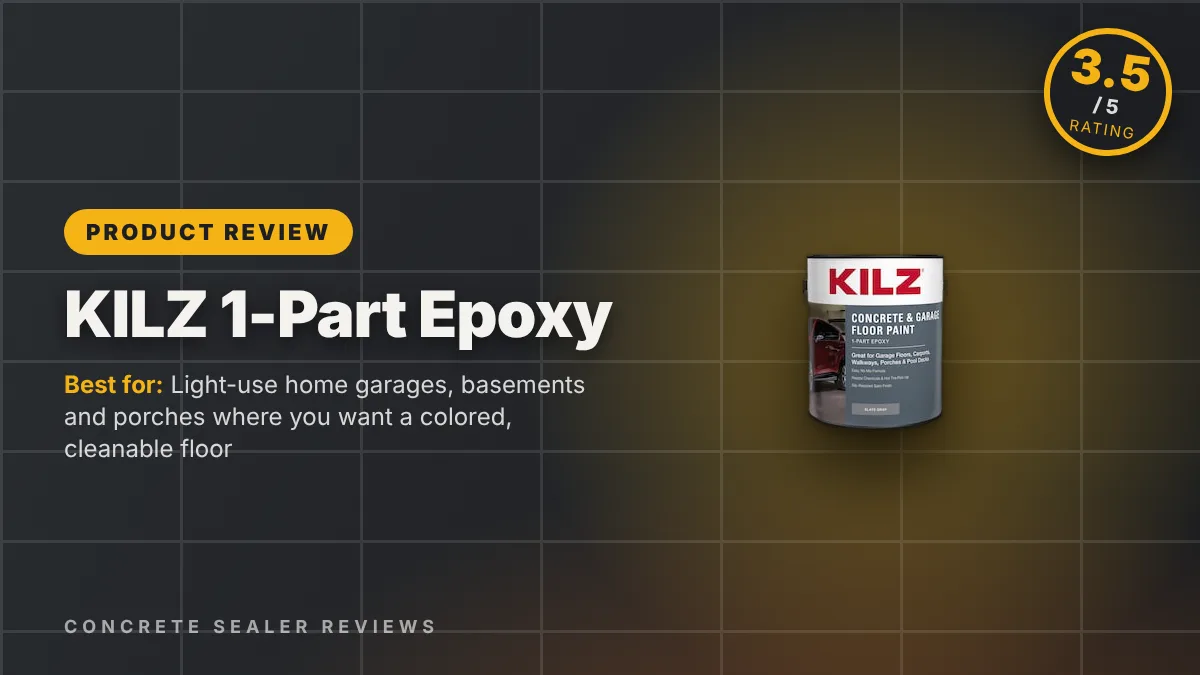
KILZ 1-Part Epoxy is a water-based, single-component floor paint for garages, basements, porches and other horizontal concrete, sold in gallon cans. It is aimed at DIYers who want a colored, cleanable floor without mixing a 2-part kit. The bottom line: it is a capable residential floor paint with solid published specs, but it builds a thin film, needs a separate bonding primer on bare concrete, and is not a substitute for a true epoxy in a hard-working garage.
| Type | Single-component floor paint |
| Chemistry | Water-based acrylic/epoxy; about 31–33% solids by volume |
| Finish | Low sheen (10–20 at 60°); Silver Gray, Slate Gray, white and deep tint bases |
| Coverage | 300–500 sq ft/gal (rough 300–400, smooth 400–500) |
| Coats | 1–2 (no more than 2), over bonding primer on bare concrete |
| Dry/recoat | Dry to touch about 1 hour at 77°F (KILZ’s product page says 2 hours); recoat 4–6 hours |
| Cure | Heavy foot traffic 72 hours; vehicles 7 days; no washing for 30 days |
| Best for | Residential garages with light use, basements, porches |
| Not for | Vertical surfaces, hydrostatic pressure, industrial use, forklifts |
| New concrete | Wait at least 30 days |
Watch: KILZ 1-Part Epoxy in 60 seconds
What It Is / How It Works
KILZ now markets this product as KILZ 1-Part Epoxy Acrylic Concrete & Garage Floor Paint. The added word "Acrylic" is an honest description of what it is: a water-based acrylic floor paint modified with epoxy for hardness and adhesion. There is no hardener to mix and no pot life. You stir and roll.
KILZ publishes more technical detail than most products in this class. The data sheet lists about 33% volume solids (the product page says 31%), under 50 g/L VOC, and a dry film of roughly 1.0 to 1.6 mils per coat depending on spread rate. That film thickness is the key to understanding its limits. A typical 2-part epoxy builds a much thicker film, which is why it resists hot tires, chemicals and abrasion better. KILZ says this paint resists hot-tire pickup, but it gives no rating, and it limits the product to residential use.
Unlike BEHR's current self-priming 1-part epoxy, KILZ calls for a separate primer. On new or uncoated concrete it wants a clean, etched surface followed by KILZ Concrete & Masonry Bonding Primer. That is an extra step and an extra product, but a primer coat is also good insurance for adhesion on a garage floor.
Where It Works Best (and where it doesn't)
Good fits are interior or exterior porous concrete, masonry, stone and brick floors: basements, porches, pool decks, laundry rooms and garages where a car is parked occasionally or tire lanes get a yearly touch-up. KILZ itself recommends planning on an annual touch-up in tire-traffic areas.
Skip it on walls (it is for horizontal surfaces only), slabs with water pushing up from below, shops with forklifts or heavy equipment, and any commercial or industrial floor. If the garage floor gets daily hot tires, dropped tools and road salt, a 2-part epoxy or polyaspartic system will last much longer. See our best epoxy floor coatings guide. The data sheet sets no moisture limit, so do a simple moisture check on basement slabs before you buy (tape a square of plastic down overnight and look for darkening).
Pros
- No mixing, no pot life, soap-and-water cleanup
- Low VOC (under 50 g/L)
- Clear, detailed technical data sheet (solids, film build, sheen)
- Good coverage at 300–500 sq ft per gallon
- Interior and exterior use; two-year shelf life unopened
- Full system available (etcher, degreaser, stripper, bonding primer)
Cons
- Thin film (about 1–1.6 dry mils per coat) compared with 2-part epoxy
- Needs a separate bonding primer on new or bare concrete
- 7 days before vehicles and 30 days before washing
- Residential use only; not for forklifts or industrial floors
- Annual touch-ups expected in tire lanes
- Sold in gallons only, and wet surfaces can be slippery
How to Apply It
- Let new concrete cure at least 30 days. Do not use it on slabs with hydrostatic pressure.
- Prep bare concrete. Clean and etch (KILZ Concrete & Masonry Cleaner & Etcher), rinse well and let the floor dry completely.
- Prep painted or sealed floors. Either strip the whole floor, or remove loose paint, scuff-sand, degrease and etch any bare spots. Old paint may contain lead, so use proper dust control.
- Prime. Apply KILZ Concrete & Masonry Bonding Primer on new or bare concrete, or spot-prime bare areas on coated floors.
- Check conditions. Air and surface temperatures between 50°F and 90°F. Avoid direct sun, and do not apply if the floor is hot to the touch.
- Apply a thin, even coat with a 3/8" to 1/2" nap roller, a nylon/polyester brush or an airless sprayer. Mix all cans together first and do not thin.
- Second coat if needed after 4–6 hours, applied crosswise. No more than two coats.
- Cure. Heavy foot traffic and furniture after 72 hours, vehicles after 7 days (cardboard under tires is allowed after 72 hours), and no rinsing or cleaning for 30 days.
How It Compares
BEHR Premium Self-Priming 1-Part Epoxy. Nearly identical on paper: 300–500 sq ft per gallon, 50–90°F application, a 7-day wait for tires and the same list of restrictions. BEHR's current version is self-priming, which saves a step. KILZ's primer-first approach is more work but adds a dedicated bonding layer.
2-part epoxy kits. Thicker, harder and more chemical-resistant, with a short working time after mixing. They are the better match for a garage that sees daily vehicle use.
Clear penetrating sealer. If you like the bare concrete look and mainly want to keep water, salt and oil out, a penetrating sealer will not peel or show tire marks. See our best concrete sealers for 2026.
FAQ
Do I need a primer with KILZ 1-Part Epoxy?
On new or uncoated concrete, yes. KILZ's directions call for cleaning and etching, then KILZ Concrete & Masonry Bonding Primer. On sound, previously painted floors, spot-prime any bare concrete.
Does KILZ 1-Part Epoxy resist hot tire pickup?
KILZ says it resists hot-tire pickup but gives no rating. It also advises a 7-day cure before driving on it and annual touch-ups in tire areas, which tells you its limits compared with a 2-part epoxy.
Can I use it on basement walls?
No. It is for horizontal surfaces only and not for areas with hydrostatic pressure, which rules out many damp basement walls.
How long does it last?
KILZ does not give a lifespan. It backs the product with a one-year limited warranty and expects tire lanes to need a touch-up each year. Low-traffic floors such as porches and basements will go longer between recoats.
Verdict
KILZ 1-Part Epoxy Acrylic is a fair, well-documented residential floor paint. It is easy to apply, low in odor and covers well. Its value depends on doing the full system (etch, prime, two thin coats, a week before tires) and accepting that it is a paint, not a heavy-duty garage coating. Our rating: 3.5/5.
See the manufacturer's product page and data sheet
How we reviewed this product: this is a research-based review built from the manufacturer's technical data sheet and current retail listings. We have not run our own hands-on tests of this product. Details were checked in October 2026; always follow the current label.
Where to Buy
Check Price on Amazon
- KILZ 1-Part Epoxy Concrete & Garage Floor Paint, Silver Gray (1 gal.)
- KILZ 1-Part Epoxy Concrete & Garage Floor Paint, Slate Gray (1 gal.)
Related Guides
Affiliate disclosure: Some links on this page are affiliate links. As an Amazon Associate we earn from qualifying purchases, at no extra cost to you.
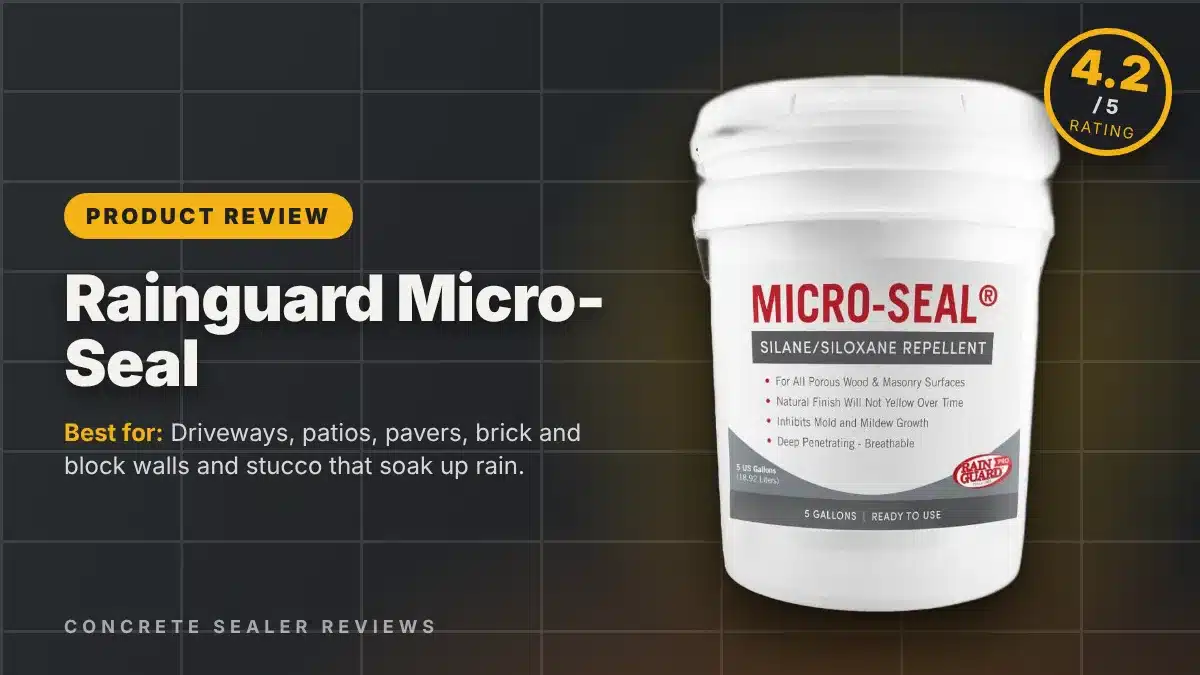
Rainguard Micro-Seal is a water-based silane/siloxane penetrating water repellent for concrete, brick, block, stucco, pavers and wood. It dries invisible, has essentially no VOCs, and can even be applied to fresh concrete as a curing aid. The bottom line: it’s a versatile, well-documented and affordable clear repellent, best for porous surfaces that soak up rain, though its warranty terms are confusing and it won’t stop water under pressure.
| Type | Penetrating water repellent (non-film-forming) |
| Chemistry | Water-based silane/siloxane with MICRO-LOK bonding; VOC under 15 g/L |
| Finish | Clear, no sheen; won’t yellow or cloud |
| Coverage | Ready-to-use: about 300 sq ft/gal on horizontal concrete; 125–150 brick; 100–150 stucco; 40–80 concrete block |
| Coats | 1 or more; very porous surfaces may need 2 |
| Dry/recoat | About 1 hour |
| Cure | Full chemical cure 5–7 days |
| Best for | Driveways, patios, pavers, brick and block walls, stucco, new concrete |
| Not for | Submerged surfaces (bird bath basins), painted stucco, glazed tile, hydrostatic pressure |
| New concrete | Can be applied as a curing compound, typically the day after pouring |
Watch: Rainguard Micro-Seal in 60 seconds
What It Is / How It Works
Micro-Seal is a silane/siloxane water repellent made by Rainguard Brands in the U.S. It goes into the pores of masonry and reacts there, leaving a water-repellent lining instead of a surface film. Rainguard calls its bonding technology MICRO-LOK. The surface stays breathable, so moisture vapor can still escape.
It's still sold, now mostly under the RainguardPro Micro-Seal name, with Home Depot also listing it as "RAIN GUARD Micro-Seal." It comes as a ready-to-use (RTU) liquid, such as the 1-gallon CR-0356, and as a concentrate you mix with water. Rainguard also sells Micro-Seal HD, a stronger version, and Micro-Seal SiH4, a pure silane. Make sure you know which form you have: the RTU must not be diluted, while the concentrate is mixed at ratios that change the expected life.
Rainguard's data sheet includes more test data than most consumer sealers: 98.7% leak reduction in wind-driven rain testing (ASTM E514), 98.6% effectiveness in water absorption tests on block, 96.8% reduction in chloride ion intrusion, no effect after 2,200 freeze/thaw cycles (ASTM C666) and no change after 3,500 hours of weathering. It also meets ASTM C309 for curing compounds.
Where It Works Best (and where it doesn't)
Micro-Seal is a generalist. It's listed for concrete, clay brick, concrete block, stucco, pavers, natural stone, unglazed tile, EIFS and wood, indoors and out, on both horizontal and vertical surfaces. That makes it handy if you want to treat a patio, a brick planter and a block retaining wall with one product. It's also one of the few clear repellents that can go on brand-new concrete as a curing aid.
It won't stop water forced through a basement wall by hydrostatic pressure, and the manufacturer says it isn't suited to stopping moisture rising up through a slab. It's not meant for surfaces that stay submerged, such as bird bath basins. Some versions of the data sheet also note that clear repellents aren't designed to waterproof horizontal masonry details like ledges, sills and parapets, which need flashing or caps. If you want a sheen or color boost, you'll need a film-forming sealer instead. Compare more options in our best silane-siloxane concrete sealers guide.
Pros
- Works on concrete, brick, block, stucco, pavers, stone and wood
- Near-zero VOC, low odor and nonflammable
- Strong published test data for freeze/thaw, salt and wind-driven rain
- Can be used on new concrete as a curing compound
- Invisible finish; multiple coats won't whiten or yellow
- Well rated at Home Depot; owners commonly mention easy application and good water beading
Cons
- Warranty terms vary by document (5, 10 or 20 years), and the longer warranties require a Rainguard site visit and approval
- Doesn't stop hydrostatic pressure or rising slab moisture
- Low coverage on block (as little as 40–55 sq ft per gallon on lightweight block)
- Strict weather window: no rain, snow or sub-40°F temperatures for 48 hours
- Some owners report weak results on dense pavers or needing a second coat
How to Apply It
- Clean the surface. Remove dirt, efflorescence, lime, form oils, release agents, grease and mildew. Let it dry fully; Rainguard's current data sheet sets a 15% maximum moisture content.
- Repair openings. Caulk or patch cracks, voids and gaps around pipes, vents and door frames.
- Check the forecast. Air, surface and product must be above 40°F and at least 5°F above the dew point, with humidity under 90%. Skip it if rain, snow or colder temperatures are expected within 48 hours, or if it's windy.
- Test a small area first, as Rainguard requires.
- Spray it on. Use a pump-up garden sprayer or a low-pressure airless sprayer held 8–12 inches from the surface. A roller also works for flat areas. Don't dilute the ready-to-use version.
- Add another coat if needed once the first is dry to the touch, about an hour. Very porous surfaces may need it.
- Let it cure. Full chemical cure takes 5 to 7 days.
How It Compares
Rust-Oleum OKON S-40 is the closest alternative: a water-based silane/siloxane with about 3/8 inch of penetration and a 5-year warranty option for registered projects. S-40 needs 21 days on new concrete, while Micro-Seal can go on as a curing aid. Micro-Seal also covers wood and stucco.
Valspar Concrete & Masonry Waterproofer is a simple siloxane option at Lowe's. It's convenient, but Valspar publishes far less test data.
For basement walls with seepage, a latex masonry waterproofer such as DRYLOK Original, which is rated for hydrostatic pressure, is the more appropriate tool. Our best waterproofing concrete sealers guide explains the difference.
FAQ
How long does Rainguard Micro-Seal last?
Retail listings claim protection for up to 10 years. Rainguard's data sheets list warranties ranging from 5 to 20 years depending on version and mix ratio, and the longer ones require a site inspection and approved warranty application. Reapply when water stops beading.
Can I use Micro-Seal on new concrete?
Yes. It meets ASTM C309 for curing compounds and is typically applied the day after pouring, once form oils and release agents are dealt with. Home Depot's listing says within 48 hours of pouring.
Is Micro-Seal waterproof?
It's a water repellent. It stops rain and surface water from soaking in, but it doesn't stop water under pressure, and it's not for surfaces that stay underwater.
Will it change the look of my pavers?
No. It dries clear with no sheen and doesn't change color or texture. If you want a darker or glossy look, use a film-forming paver sealer instead.
Verdict
Rainguard Micro-Seal, now sold mainly as RainguardPro Micro-Seal, is a capable, near-zero-VOC water repellent that works on almost any porous surface around the house, and it can even cure new concrete. The published test data is strong and owners rate it well. Read the label carefully to know whether you have the ready-to-use or concentrate version, and don't count on the long warranties unless you go through Rainguard's approval process. Our rating: 4.2/5
How we reviewed this product: this is a research-based review built from the manufacturer's technical data sheet and current retail listings. We have not run our own hands-on tests of this product. Details were checked in October 2026; always follow the current label.
Where to Buy
Check Price on Amazon
Related Guides
Affiliate disclosure: Some links on this page are affiliate links. As an Amazon Associate we earn from qualifying purchases, at no extra cost to you.
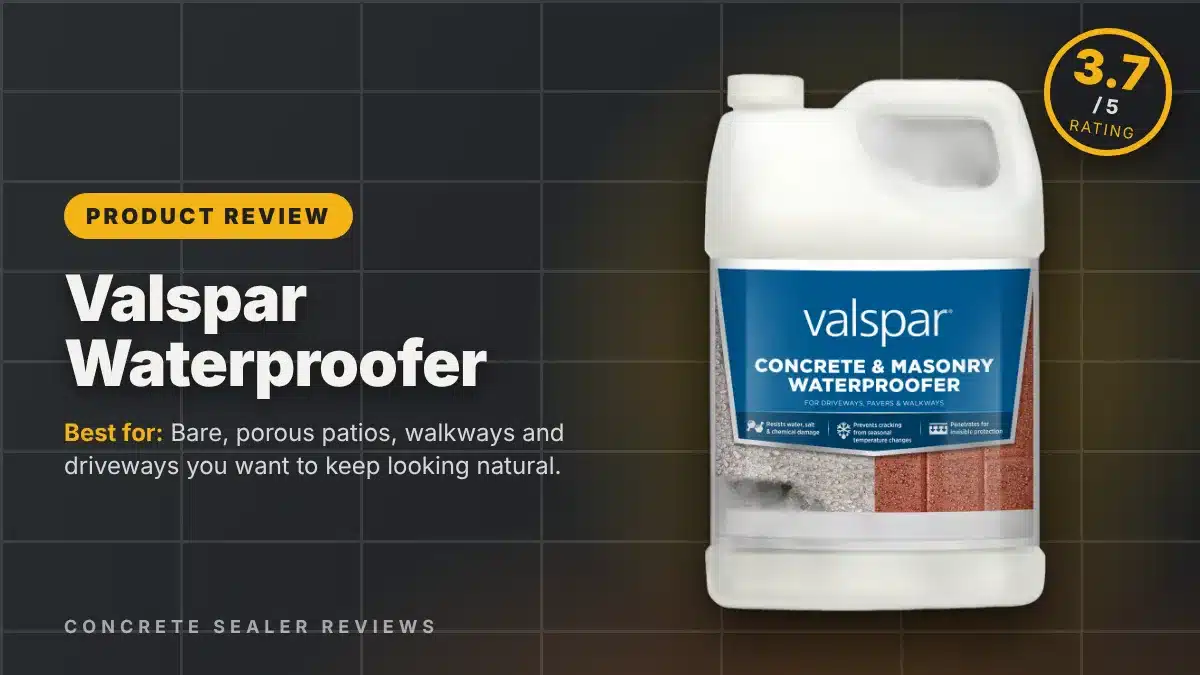
Valspar Concrete & Masonry Waterproofer is a clear, water-based siloxane sealer sold at Lowe’s for bare driveways, patios, walkways, pool decks and basement slabs. It soaks in rather than forming a film, so it is aimed at homeowners who want water to bead up without changing how the concrete looks. The bottom line: it is an easy, low-odor, budget-friendly water repellent for porous concrete, but Valspar publishes very little technical data for it, and it is not a fix for wet basements or a protective topcoat.
| Type | Penetrating water repellent (non-film-forming) |
| Chemistry | Water-based siloxane |
| Finish | Clear, matte; does not change color or texture |
| Coverage | Not published on Valspar’s product page; check the can label |
| Coats | 1–2, second coat applied wet-on-wet |
| Dry/recoat | Touch dry 1–2 hours; recoat in 5–10 minutes (77°F, 50% RH) |
| Cure | Not stated by the manufacturer |
| Best for | Bare, porous driveways, patios, walkways, pool decks, basement floors |
| Not for | Painted or previously sealed surfaces; dense surfaces that won’t absorb water |
| New concrete | Wait at least 30 days; new pavers 60 days |
Watch: Valspar Waterproofer in 60 seconds
What It Is / How It Works
This is a penetrating sealer. Valspar describes it as a "siloxane formula that penetrates the surface to help keep water out." Siloxanes react inside the pores of concrete and masonry and leave behind a water-repellent lining. Water beads on the surface instead of soaking in, but the concrete can still breathe, so moisture inside the slab can escape as vapor.
Because nothing builds up on top, the surface keeps its natural look and texture. There is no gloss, no "wet look" and no film to peel. Valspar says it helps guard against water, salt, dirt, chemicals and freeze/thaw cycles, which is the standard job description for this type of product.
At Lowe's the same product is listed as "Valspar Clear Matte Transparent Water-based Interior/Exterior Waterproofer" (model 024.0082490.007). Older Valspar concrete products, such as the silicone-based Natural Look Waterproofer and the acrylic Wet Look sealer, are different formulas, so don't mix up their specs with this one.
Where It Works Best (and where it doesn't)
It works best on bare, absorbent concrete and masonry: broom-finished driveways, sidewalks, patios, pool decks and pavers, plus interior slabs such as basement floors. Valspar says the surface should feel at least as rough as 120-grit sandpaper and should readily absorb water. If water sits on the surface instead of darkening it, the sealer won't be able to penetrate.
It is not for painted or previously sealed concrete. When a Lowe's shopper asked about using it over concrete paint, the Valspar team answered that it should not be applied over sealed surfaces because "the product must be able to soak into the concrete." It also won't stop water pushing through a basement wall or floor under pressure, won't fill cracks, and won't give you stain protection like a film-forming sealer. For a full rundown of options, see our guide to the best silane-siloxane concrete sealers.
Pros
- Invisible, matte finish that doesn't change color or texture
- Water-based, soap-and-water cleanup
- Breathable; no film to peel, blush or wear off in traffic lanes
- Fast wet-on-wet second coat (5–10 minutes)
- Easy to find at Lowe's, with strong average ratings from buyers
Cons
- Very limited published data: no coverage rate, actives percentage or expected service life on the product page
- Bare surfaces only; can't go over paint or old sealer
- Doesn't stop hydrostatic pressure or leaks through cracks
- Little oil or stain resistance compared with film-forming sealers
- Sold mainly in 1-gallon cans, which adds up on large driveways
How to Apply It
- Check the timing. New concrete must cure at least 30 days. New pavers should weather at least 60 days, with excess joint sand swept off.
- Clean thoroughly. Remove grease, oil, paint and old sealers. Valspar recommends a high-pressure water wash. Let the surface dry completely.
- Do a water test. Sprinkle water on the surface. It should soak in and darken the concrete. If it beads, the surface is sealed or too dense.
- Apply with a roller or low-pressure garden sprayer. Work in manageable sections and don't let it pond or puddle.
- Add a second coat wet-on-wet if needed. Valspar says to apply the second coat while the first is still wet, about 5–10 minutes later, for maximum protection.
- Wipe off excess. After 5–10 minutes of penetration time, wipe any unabsorbed product with a clean, dry cloth so it doesn't leave residue.
- Let it dry. It is dry to the touch in 1–2 hours at 77°F and 50% humidity. Cooler or more humid weather slows drying. Valspar doesn't publish a full cure time or traffic schedule, so give it extra time before driving on it.
How It Compares
Rust-Oleum OKON S-40 is also a water-based silane/siloxane, but it comes with a full technical data sheet: published coverage rates, about 3/8" of penetration, test data, and an optional 5-year water repellency warranty for registered projects. If you want to know exactly what you're buying, S-40 is the better-documented choice.
Rainguard Micro-Seal is another zero-VOC silane/siloxane sold at Home Depot. Its data sheet includes coverage charts and freeze/thaw and wind-driven rain test results. It is a good alternative if you also want to treat brick, stucco or wood with the same product.
If you want color enhancement or a sheen, a film-forming acrylic is a different category entirely. Our Best Concrete Sealers for 2026 guide covers both types.
FAQ
Is Valspar Concrete & Masonry Waterproofer really waterproof?
It is a water repellent, not a waterproof membrane. It makes surface water bead up and reduces absorption, but it will not stop water forced through a slab or wall by hydrostatic pressure, and it won't seal cracks.
Can I put it over painted or sealed concrete?
No. Valspar says the surface must be free of paint and sealers, and its customer team has stated it should not be used over sealed surfaces because it has to soak in to work.
Will it make my concrete look wet or shiny?
No. It dries clear and matte and is designed not to change the color or texture of the surface. If you want a darker, glossy look, you need a film-forming acrylic sealer instead.
How long does it last?
Valspar doesn't publish a service life. A simple way to know when to reapply is to sprinkle water on the surface once or twice a year. When it stops beading and starts soaking in, it's time for another coat.
Verdict
Valspar Concrete & Masonry Waterproofer is a convenient, invisible water repellent for bare, porous concrete, and Lowe's shoppers rate it well. The weak spot is documentation: with no published coverage, actives content or service life, it's hard to compare against better-documented silane/siloxane products. It's a reasonable pick for a patio or walkway you want to keep looking natural, as long as you don't expect it to fix a wet basement. Learn more on Valspar's product page. Our rating: 3.7/5
How we reviewed this product: this is a research-based review built from the manufacturer's technical data sheet and current retail listings. We have not run our own hands-on tests of this product. Details were checked in October 2026; always follow the current label.
Related Guides
Affiliate disclosure: Some links on this page are affiliate links. As an Amazon Associate we earn from qualifying purchases, at no extra cost to you.
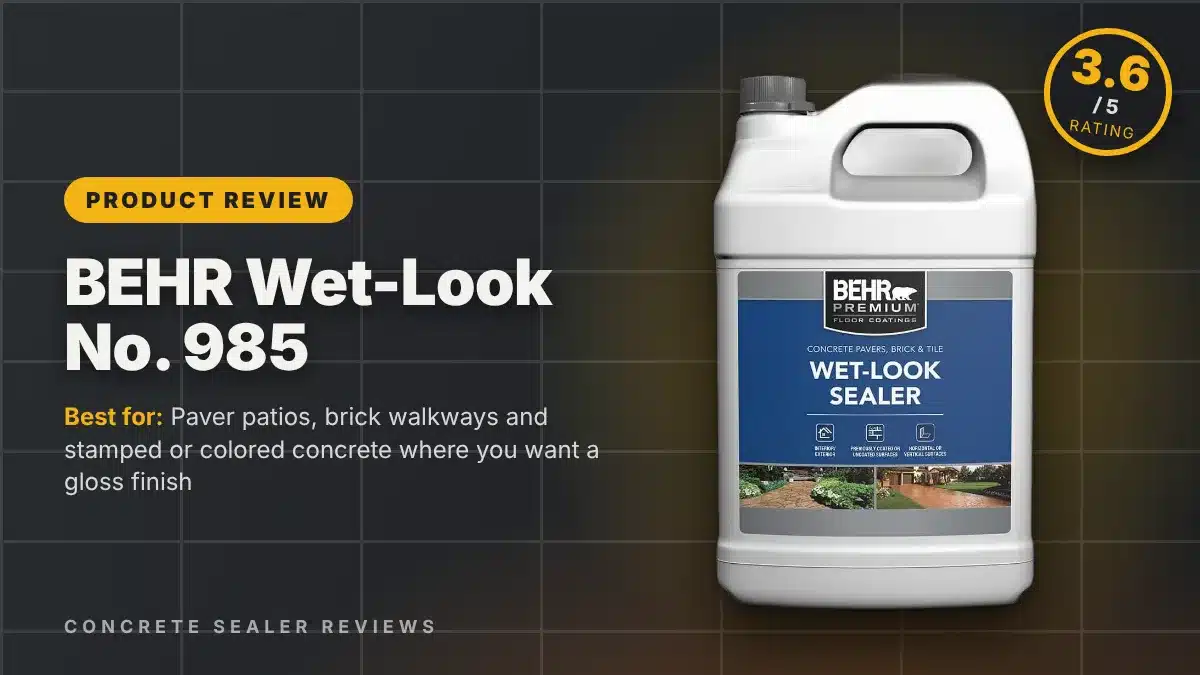
BEHR Premium Wet-Look Sealer (No. 985) is a water-based, high-gloss clear acrylic for concrete, pavers, brick, stone and stucco, sold at Home Depot. It is for homeowners who want a shiny, color-deepening finish on a patio, walkway or paver area with low odor and water cleanup. The bottom line: it does deliver the wet look and goes on easily, but like other thin acrylic films it wears in traffic, can get slick when wet, and needs maintenance coats.
| Type | Film-forming topical sealer |
| Chemistry | Water-based acrylic; about 25% solids by volume; under 100 g/L VOC |
| Finish | High gloss (80–90 at 60°), non-yellowing |
| Coverage | 200–450 sq ft/gal depending on porosity |
| Coats | 2 recommended; BEHR allows up to 4 more for extra gloss |
| Dry/recoat | Dry 1 hour; recoat 4 hours |
| Cure | Heavy foot traffic, furniture and tires after 24–72 hours; no washing for 30 days |
| Best for | Patios, walkways, pavers, brick, unglazed tile, stucco |
| Not for | Wood, metal, granite, marble, terrazzo, areas right next to pools, hydrostatic pressure, over oil-based products |
| New concrete | Wait 30 days, then etch |
Watch: BEHR Wet-Look No. 985 in 60 seconds
What It Is / How It Works
BEHR currently markets this product as BEHR PREMIUM Concrete, Brick & Tile Wet-Look Sealer, and Home Depot lists it as BEHR PREMIUM Wet-Look Sealer (model 98501 for the gallon, 98505 for 5 gallons). It is the same No. 985 product.
It is a clear acrylic resin in water. It looks milky in the can, goes on white and dries clear, leaving a thin glossy film on the surface. That film darkens and enriches the color of the masonry (the "wet look") and repels water and stains. BEHR says water and stain repellency begin within 24 hours. The data sheet lists about 25% volume solids, which is typical for a water-based acrylic, and a high-gloss reading of 80–90 at 60°. BEHR describes the resin as non-yellowing.
Because it is a surface film rather than a penetrating treatment, it will eventually wear in high-traffic areas. BEHR says as much, noting that horizontal surfaces may see excessive wear and need periodic touch-ups or maintenance coats.
Where It Works Best (and where it doesn't)
It is approved for interior and exterior, vertical and horizontal surfaces, coated or uncoated: concrete, exposed aggregate, pavers, brick, Mexican and other unglazed tile, unpolished natural and manufactured stone, masonry and stucco. It looks best on colored or textured surfaces where the gloss brings out the pattern, such as paver patios, brick walkways and stamped concrete.
BEHR does not recommend it for wood, metal, granite, marble, terrazzo, areas immediately next to pools, surfaces with hydrostatic pressure, or over oil-based products. It also warns that sealed surfaces can become slippery when wet, which matters on steps, ramps and pool surrounds. Although BEHR lists a 24–72 hour wait for car tires, it is not a dedicated garage-floor coating. For garages, see our best epoxy floor coatings.
Owner feedback is mixed. The Home Depot gallon listing averaged about 3.8 out of 5 across more than 3,500 reviews when we checked, which reflects a product that looks great when applied right but is sensitive to prep, coat thickness and wear.
Pros
- Strong high-gloss wet look that deepens color
- Water-based, low odor, water cleanup
- Fast: dry in 1 hour, recoat in 4 hours
- Works on many masonry types, inside and out, including vertical surfaces
- Non-yellowing acrylic
- Easy to find at Home Depot in gallon and 5-gallon sizes
Cons
- Thin surface film that wears and needs maintenance coats
- Slippery when wet; consider an anti-slip additive on walkways
- Not for use right next to pools, on marble or granite, or over oil-based products
- Narrow application window (50–80°F, no direct sun)
- Bare concrete needs etching, and some surfaces need BEHR's No. 880 primer
- Mixed owner ratings overall
How to Apply It
- New concrete: let it cure 30 days, then clean and etch to a texture like 150-grit sandpaper. Rinse off all residue and let it dry completely. The data sheet calls for a surface pH of 10 or lower.
- Existing surfaces: clean off dirt, oil, grease and mildew. Strip or scrape failing coatings and scuff-sand glossy areas. On stamped concrete, use a cleaner that removes release agent. Spot-etch any bare concrete.
- Prime where needed. BEHR recommends its No. 880 Bonding Primer on porous or rough horizontal concrete, brick or stone exposed to tires, foot traffic or moisture, and on areas treated for efflorescence or laitance.
- Check the weather. Air and surface between 50°F and 80°F, no direct sun, a dry surface, and no rain or heavy dew for 24 hours.
- Apply a thin coat with a pump sprayer (then back-roll), pad, nylon/polyester brush or roller. Do not thin, and do not let it puddle.
- Recoat after 4 hours. Two coats is the standard. BEHR allows additional thin coats for more gloss.
- Cure. Wait 24–72 hours for heavy foot traffic, furniture and tires, and 30 days before washing the surface.
How It Compares
BEHR Premium Low-Lustre Sealer (No. 986). The same family, with a softer sheen. Choose it if you want enhanced color without the high gloss and with somewhat less glare.
H&C ClariShield Water-Based Wet Look. Sherwin-Williams' water-based acrylic gloss sealer. It is similar in concept and also designed as a topcoat over H&C's water-based concrete stains. Both are thin films that reward thin coats.
Penetrating water repellents. If you want long-lasting water and salt protection on a driveway without any shine or peeling, a silane/siloxane sealer is the better tool. See our best silane-siloxane concrete sealers guide.
FAQ
Is BEHR Wet-Look Sealer water-based or solvent-based?
Water-based. It is milky in the can, dries clear, has under 100 g/L VOC, and tools clean up with water.
How long does BEHR Wet-Look Sealer last?
BEHR does not give a lifespan. It notes that horizontal surfaces may wear and need touch-ups or maintenance coats. Expect to refresh high-traffic, sun-exposed areas more often than walls or covered patios.
Can you put BEHR Wet-Look over an old sealer?
It is approved for previously coated surfaces, but not over oil-based products. Remove failing sealer, scuff-sand glossy areas, clean well and test a small spot first.
Can I use it on a pool deck?
BEHR does not recommend it for areas immediately adjacent to pools, and the gloss can be slippery when wet. A sealer made for pool decks, with an anti-slip additive, is a safer choice.
Verdict
BEHR Premium Wet-Look Sealer No. 985 is a convenient, low-odor way to give pavers, brick and decorative concrete a glossy, deeper color. It is easy to find and quick to recoat. It is also a thin film with a narrow temperature window, slip concerns and regular maintenance, so it suits patios and walkways better than driveways, pool decks or garages. Our rating: 3.6/5.
See the manufacturer's product page
How we reviewed this product: this is a research-based review built from the manufacturer's technical data sheet and current retail listings. We have not run our own hands-on tests of this product. Details were checked in October 2026; always follow the current label.
Related Guides
Affiliate disclosure: Some links on this page are affiliate links. As an Amazon Associate we earn from qualifying purchases, at no extra cost to you.
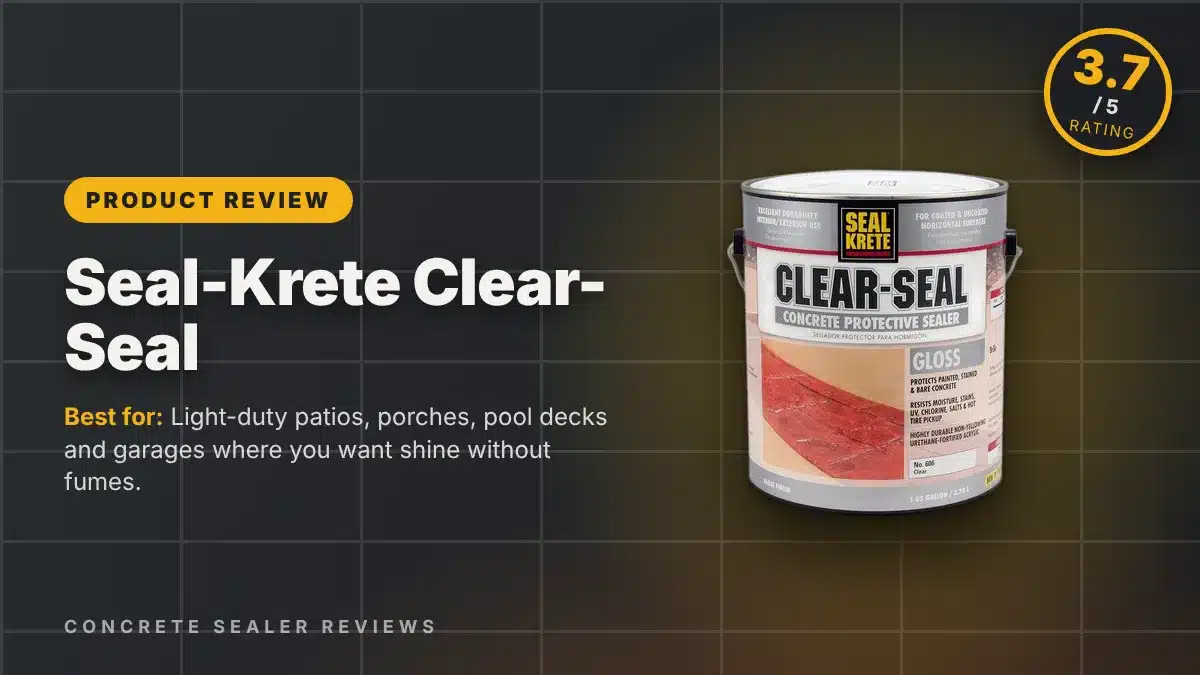
Seal-Krete Clear-Seal is a water-based, urethane-fortified acrylic sealer from Rust-Oleum for interior and exterior concrete floors, patios, pool decks, garages and driveways. It’s low-odor, cleans up with soap and water, and adds a light sheen while resisting oil, salt, chlorine and hot-tire pickup. The bottom line: it’s an easy, user-friendly film sealer for homeowners who want some shine without solvent fumes, but its thin, low-solids film won’t match the depth or durability of heavier sealers.
| Type | Film-forming topical sealer |
| Chemistry | Water-based urethane-acrylic blend; about 11.5% solids; VOC under 50 g/L |
| Finish | Satin, gloss or low gloss depending on version; non-yellowing |
| Coverage | 150–300 sq ft/gal (satin listing); up to 500 sq ft/gal (low-gloss version), depending on porosity |
| Coats | 1 recommended; 2 for porous surfaces or more sheen |
| Dry/recoat | Touch dry 1 hour; recoat 2 hours (77°F, 50% RH) |
| Cure | Foot traffic 24 hours; vehicles 72 hours |
| Best for | Horizontal concrete: patios, porches, pool decks, garages, driveways, pavers, stamped concrete |
| Not for | Over acid stains, oil-based paint, 2-part epoxy, glazed tile; areas with hydrostatic pressure |
| New concrete | Wait at least 30 days |
Watch: Seal-Krete Clear-Seal in 60 seconds
What It Is / How It Works
Clear-Seal is a topical sealer. It goes on milky white, dries clear, and leaves a thin protective film on the concrete. The resin is a proprietary blend of urethane and acrylic, which Rust-Oleum says gives it good UV resistance and gloss retention, an F pencil hardness, and resistance to most tires, including hot-tire pickup. In 1-hour spot tests, the data sheet lists resistance to gasoline, oil, water, salt and chlorine.
The product line has shifted over the years. The classic "Clear-Seal Concrete Protective Sealer" in Satin (604001) and Gloss (607001) is still listed at Home Depot and other retailers. Rust-Oleum also now sells a Clear-Seal Premium Low Gloss Sealer (365001), listed at Lowe's as a "soft-gloss" sealer that covers up to 500 sq ft per gallon in one coat. Both are water-based urethane-fortified acrylics, but check the label for the exact coverage and sheen of the can you buy.
At about 11.5% solids, Clear-Seal lays down a fairly light film. That's part of why it's easy to apply in one coat without puddles, but it also means it won't build the deep, glassy look of a high-solids solvent sealer.
Where It Works Best (and where it doesn't)
Clear-Seal is made for horizontal surfaces, inside and out. Typical uses are pool decks, patios, porches, driveways and garage floors, plus brick, stone, exposed aggregate, slate, pavers and stamped concrete. It can also go over sound, fully cured one-part water-based paints and stains, which is useful if you've painted a porch or patio and want a clear protective layer.
Don't use it over acid-based stains, oil-based coatings, 2-part epoxies or glazed tile, or anywhere with hydrostatic pressure, such as a basement slab with moisture coming up. Smooth, troweled concrete in basements and garages needs to be etched first so the sealer can bond. Rust-Oleum also warns that sealed smooth concrete can be slippery when wet, and suggests adding its Clear Grip anti-skid additive on high-traffic areas. If you'd rather keep a natural look with no film, see our best penetrating concrete sealers.
Pros
- Water-based, low odor and low VOC; works indoors
- Soap-and-water cleanup
- Resists oil, gasoline, salt, chlorine and hot-tire pickup per the data sheet
- Non-yellowing, with satin, gloss and low-gloss options
- Can go over cured one-part water-based paints and stains
- Fast recoat (2 hours)
Cons
- Low solids means a thin film with less color depth than solvent wet-look sealers
- Horizontal surfaces only
- Long wait before driving on it (72 hours)
- Smooth concrete needs etching, and sealed smooth floors can be slippery when wet
- Not compatible with acid stains, oil-based coatings or epoxies
- Product names, sheens and coverage claims vary between versions, which can be confusing
How to Apply It
- Wait for new concrete to cure at least 30 days. Freshly painted or stained surfaces need at least 72 hours.
- Clean the surface. Pressure washing is recommended. Use an oil stain remover on stubborn spots. For painted surfaces, clean with a TSP solution, rinse and let dry.
- Etch smooth concrete. Basement and garage floors with a troweled finish should be etched. If you use muriatic acid, neutralize it before sealing.
- Check the weather. Apply between 50°F and 90°F, with no drop below 50°F for 24 hours, and no rain expected for 12 hours.
- Stir gently; don't shake or thin. The goal is a smooth coat without foam.
- Roll it on. Dampen the roller, then saturate it. Use a 1/4" nap on smooth surfaces and 3/8" on rough or porous ones. Keep a wet edge and avoid puddles, foam and runs. If you use a pump sprayer, spray a fine mist and back-roll right away.
- Add a second coat if needed after 2 hours, for porous surfaces or more sheen. Allow 24 hours before foot traffic and 72 hours before vehicles, longer in cool or humid weather.
How It Compares
Eagle Supreme Seal is a solvent-based pure acrylic that gives a much glossier wet look on exterior concrete. It's ready for foot traffic in 4 hours, but it's exterior-only, has a strong odor and needs xylene for cleanup. Clear-Seal is the easier, friendlier choice; Eagle is the one for maximum gloss.
Penetrating silane/siloxane sealers like Rust-Oleum OKON S-40 leave no film, so nothing can peel or get slippery. They're a better pick for plain driveways in freeze/thaw climates, but they don't add sheen or block oil stains as well as a film.
For garage floors that see heavy use, a true epoxy or polyurethane coating gives a thicker, more chemical-resistant surface. See our best epoxy floor coatings guide.
FAQ
Is Seal-Krete Clear-Seal waterproof?
It forms a water-resistant film that keeps surface water, salt and many stains out. It's not for areas under hydrostatic pressure, so it won't stop moisture pushing up through a basement slab.
Can you put Clear-Seal over painted concrete?
Yes, over sound, one-part water-based paints and stains that have cured at least 72 hours. Don't use it over oil-based paints, 2-part epoxies or acid-based stains.
Can I use Clear-Seal on a garage floor?
Yes. Garages are a listed use, and Rust-Oleum says it resists hot-tire pickup. Etch smooth garage concrete first and wait 72 hours before parking on it.
How should I clean a floor sealed with Clear-Seal?
Use mild soap and water. Rust-Oleum says not to use solvent-based cleaners.
Verdict
Seal-Krete Clear-Seal is a convenient, low-odor water-based sealer that adds a light sheen and decent stain and tire resistance to patios, pool decks and garage floors. It's easy for a first-timer to apply and can go over water-based paint. The tradeoffs are a thin film, a 72-hour wait for vehicles, and a product lineup with overlapping names and coverage claims. It's a reasonable pick for low-stress surfaces; choose a heavier sealer or coating where you want maximum durability. Our rating: 3.7/5
How we reviewed this product: this is a research-based review built from the manufacturer's technical data sheet and current retail listings. We have not run our own hands-on tests of this product. Details were checked in October 2026; always follow the current label.