
Affiliate disclosure: Some links on this page are affiliate links. As an Amazon Associate we earn from qualifying purchases, at no extra cost to you.
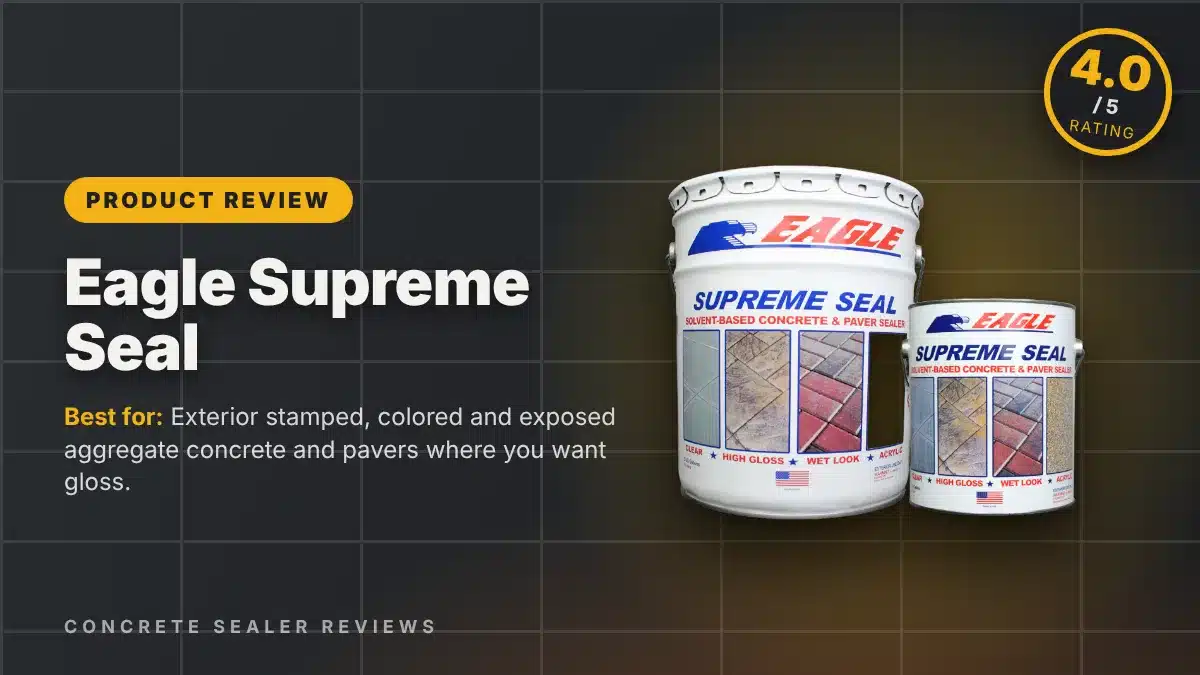
Eagle Supreme Seal is a solvent-based, pure acrylic sealer that gives exterior concrete and pavers a high-gloss “wet look.” It’s a good fit for homeowners who want stamped, colored or exposed aggregate concrete to look richer and darker. The bottom line: it delivers the glossy look people buy it for at a fair price, but it’s strong-smelling, exterior-only, and like any wet-look acrylic it needs proper prep and periodic resealing.
| Type | Film-forming topical sealer |
| Chemistry | Solvent-based pure acrylic (aromatic naphtha solvent) |
| Finish | High gloss, wet look; non-yellowing per manufacturer |
| Coverage | 300 sq ft/gal smooth; 200 textured, stamped or broom; 100 exposed aggregate and pavers (two thin coats) |
| Coats | 2 thin coats, second rolled perpendicular to the first |
| Dry/recoat | Second coat once the first is tack-free |
| Cure | Foot traffic 4 hours; vehicles 48 hours |
| Best for | Exterior stamped, colored, broom-finish and exposed aggregate concrete; concrete pavers |
| Not for | Interiors without full ventilation, clay brick, natural stone, polished or densified concrete, painted surfaces |
| New concrete | For cured concrete; no specific wait stated, and the surface must not have a recent curing compound |
Watch: Eagle Supreme Seal in 60 seconds
What It Is / How It Works
Supreme Seal is a topical acrylic sealer. Unlike a penetrating silane or siloxane, it lays down a thin plastic-like film on top of the concrete. That film darkens and saturates the color underneath, adds gloss, and blocks water, salt and many stains while it's intact. Eagle's data sheet calls it a "pure acrylic non-yellowing solvent-based clear sealer" and says it meets or exceeds ASTM C1315, a common standard for curing and sealing compounds.
Because it's solvent-based, it soaks into the surface a bit more than many water-based acrylics and tends to give a deeper wet look. The tradeoff is a combustible product with a strong odor. The standard version lists VOC under 700 g/L, which means it can't be sold everywhere. Eagle also makes Low VOC (EVTU1) and CARB-compliant (EUVC1) versions of Supreme Seal for stricter states. The common retail sizes of the standard formula are 1 gallon (EU1) and 5 gallon (EU5).
Where It Works Best (and where it doesn't)
Supreme Seal is made for exterior decorative concrete: stamped patios, colored pool decks, exposed aggregate walkways, broom-finished driveways and concrete pavers. The surface needs to be porous enough to absorb water. Very dense or smooth troweled concrete should be etched first so the sealer can grip.
Eagle lists a long set of surfaces to avoid: clay brick, slate, stone slabs, granite, travertine, glazed tile, terrazzo, polished or densified concrete and painted surfaces. It's also not recommended over water-based stains or colored sealers, and it isn't meant for vertical surfaces other than steps. Indoors, it's only acceptable with complete ventilation. If you want a natural look with no shine, a penetrating sealer is a better fit; see our best penetrating concrete sealers.
Pros
- Strong high-gloss wet look that brings out color in stamped and stained concrete
- Pure acrylic, described as non-yellowing
- Clear coverage chart by surface type
- Quick to foot traffic (4 hours)
- Can be recoated with more Supreme Seal, and solvent re-wets the old coat to fix problems
- Well rated by buyers at Home Depot and Lowe's
Cons
- Strong solvent odor; owners commonly report fumes that linger
- Combustible, with xylene or lacquer thinner cleanup (not mineral spirits or water)
- Exterior only; not for many stone and brick surfaces
- Glossy film can be slippery when wet unless you add an anti-skid additive
- Film wears and needs resealing; some owners in hot, sunny climates report it fading within about a year
- Hot surfaces or heavy coats can cause bubbles
How to Apply It
- Clean and prep. Remove dirt, wax, grease, oil and any coating that isn't a similar solvent-based sealer. Degrease oil spots, etch slick troweled concrete, fill cracks, then pressure wash. Let it dry 24 hours.
- Check the weather. Air and surface should be above 50°F and below 90°F. Avoid hot afternoon slabs, which can cause bubbles or streaks, and don't apply if rain is coming.
- Test a small area to check the look and compatibility before doing the whole surface.
- Use a solvent-resistant roller. Pick the nap for the texture: short for smooth, medium for textured, long for exposed aggregate. Pour into a metal tray, not directly onto the concrete. Don't thin it.
- Roll a thin first coat. Keep the roller loaded and avoid puddles. Brush edges where the roller can't reach.
- Apply a second thin coat once the first is tack-free, rolling perpendicular to the first. Add an anti-skid additive (not sand) to this coat for pool decks and steps.
- Stay off it. Wait 4 hours for foot traffic and 48 hours for vehicles. Clean with water only and reseal as needed, but Eagle says no more often than every two years to avoid buildup.
How It Compares
Seal-Krete Clear-Seal is a water-based urethane-fortified acrylic with low odor and soap-and-water cleanup. It's easier to live with and works indoors, but it gives a lower-gloss look than a solvent-based wet-look sealer.
Penetrating silane/siloxane sealers such as Rust-Oleum OKON S-40 or Rainguard Micro-Seal leave no film, don't change the look and won't make the surface slick. They're better for plain driveways in freeze/thaw climates, but they won't give you any color boost.
Higher-solids solvent acrylics from contractor brands generally build a thicker film for more gloss and durability, at a higher price. Our best driveway sealer guide covers how film-forming and penetrating options hold up under cars.
FAQ
How long does Eagle Supreme Seal last?
Eagle says to reseal as needed but not more than every two years, to avoid building up too thick a film. Real-world life depends on sun, traffic and prep. Some owners in hot, sunny areas report needing to reseal after about a year.
Can I use Eagle Supreme Seal indoors or in a garage?
It's labeled for exterior use. Eagle says interior use requires complete ventilation because of the solvent fumes. For garage floors, a coating designed for hot tires is usually a better choice; see our best epoxy floor coatings.
Can I put Supreme Seal over an old water-based sealer?
Eagle doesn't recommend it over water-based stains or colored sealers. It can go over the same or a similar solvent-based sealer. Otherwise, remove the old coating first and always test a small spot.
Will it make my patio slippery?
Any glossy film can be slick when wet, especially on smooth concrete. Eagle allows anti-skid additives in the second coat. Don't use sand.
Verdict
Eagle Supreme Seal does what a solvent wet-look sealer should: it adds gloss and deepens color on exterior decorative concrete at a reasonable price, and buyers generally rate it well. Expect a strong odor, solvent cleanup and periodic resealing, and skip it for natural stone, interiors and surfaces you want to keep looking natural. Our rating: 4.0/5
How we reviewed this product: this is a research-based review built from the manufacturer's technical data sheet and current retail listings. We have not run our own hands-on tests of this product. Details were checked in October 2026; always follow the current label.
Related Guides
Affiliate disclosure: Some links on this page are affiliate links. As an Amazon Associate we earn from qualifying purchases, at no extra cost to you.
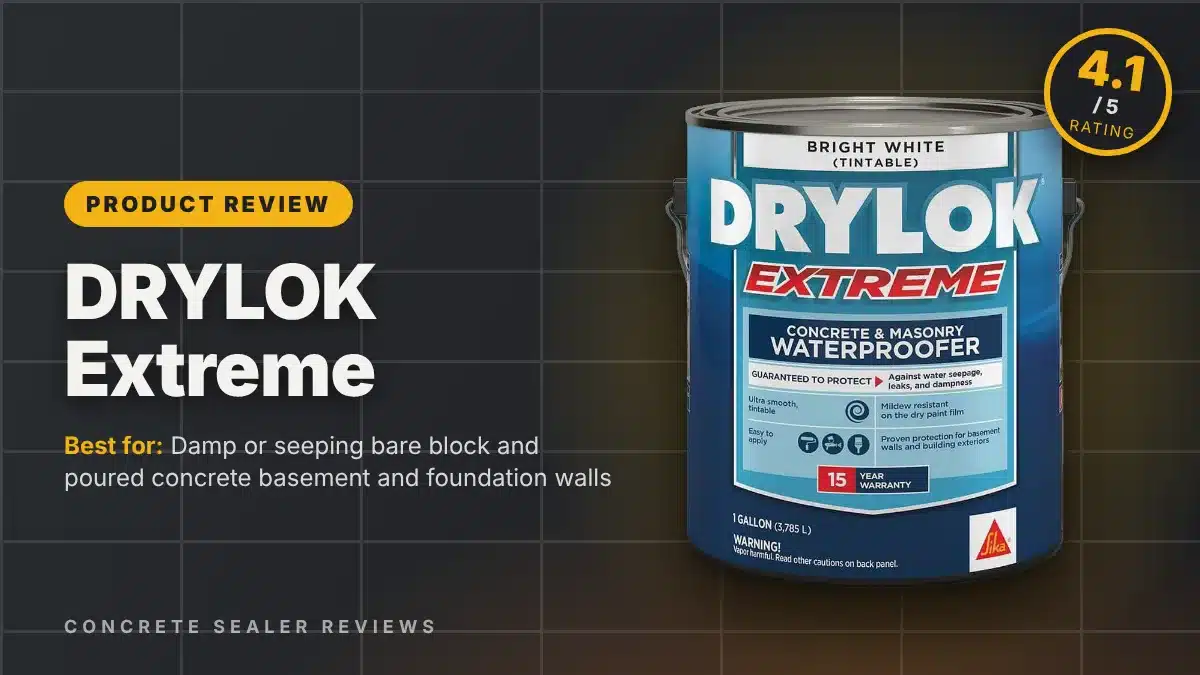
DRYLOK Extreme Masonry Waterproofer is a thick, latex-based coating for concrete block, poured concrete, brick and stucco walls, inside or out, above or below grade. It’s aimed at homeowners dealing with damp or seeping basement and foundation walls. The bottom line: it’s one of the stronger DIY wall waterproofers you can buy, rated to hold back 15 psi of water pressure with a 15-year warranty. It only performs on properly prepared bare masonry, though, and it won’t fix drainage or structural problems.
| Type | Film-forming masonry waterproofing coating (paint-like) |
| Chemistry | Latex base with flexible encapsulated polymers; contains a mildewcide |
| Finish | Flat, bright white; tintable to light colors |
| Coverage | About 75 sq ft/gal first coat; 75–100 sq ft/gal second coat |
| Coats | Minimum 2 (required for the warranty) |
| Dry/recoat | Tack-free about 45 min; dry 2–3 hours; recoat about 2 hours |
| Cure | Latex topcoat after about 24 hours; backfill 24 hours after second coat |
| Rating | 15 psi hydrostatic pressure (ASTM D7088); Category 4 wind-driven rain |
| Best for | Bare block and poured concrete basement and foundation walls, retaining walls |
| Not for | Floors or other walked-on surfaces, painted walls, fishponds and bird baths |
| New concrete | Wait 28–30 days, or until pH is below 10 |
Watch: DRYLOK Extreme in 60 seconds
What It Is / How It Works
Unlike a clear penetrating sealer, DRYLOK Extreme is a heavy-bodied coating. You work it into the pores and pinholes of the masonry, and it builds a continuous, flexible film that physically blocks water. The current product data sheet (now published by Sika, which owns the DRYLOK brand) rates it to resist 15 psi of hydrostatic pressure under ASTM D7088, which DRYLOK equates to a 33-foot wall of water, plus Category 4 wind-driven rain resistance (140 mph) under ASTM D6904.
DRYLOK describes it as semi-impermeable, under 1 perm, so it slows water vapor as well as liquid water. It also says it reduces radon gas penetration, and it contains a biocide to resist mildew on the dry film. It goes on bright white and can be tinted to light shades. Cleanup is soap and water. The product is still widely sold at Home Depot, Lowe's, Ace and hardware stores, in quarts, gallons and 5-gallon pails.
Where It Works Best (and where it doesn't)
It's at its best on bare, sound concrete block or poured concrete walls that show dampness, light seepage or musty odors, especially in basements. It also works on exterior foundation walls before backfilling, on retaining walls, and on brick and stucco. For many homeowners it's the practical first step before calling a waterproofing contractor.
The limits are just as important. DRYLOK says it's not formulated for floors or other horizontal surfaces with foot traffic; it points to its Floor & Wall product instead. It cannot go over existing paint (latex or oil), and coating over existing coatings voids the warranty. Recurring efflorescence and cracked structural surfaces are also excluded from coverage. A Washtenaw County conservation district guide on basement walls makes the broader point: waterproofing paints aren't always strong enough for the hydrostatic pressure that builds in saturated soil, and when one starts peeling, the cause is usually moisture coming through the wall. Fix gutters, grading and cracks first. If you need an invisible treatment for a slab or exterior flatwork instead, see our best waterproofing concrete sealers guide.
Pros
- Rated to 15 psi of hydrostatic pressure, high for a DIY product
- 15-year, transferable warranty when applied as directed to prepared bare masonry
- Works interior or exterior, above or below grade
- Fast recoat (about 2 hours) lets you finish two coats in a day
- Mildew-resistant film; also marketed to reduce radon penetration
- Soap-and-water cleanup, and easy to find in stores
Cons
- Low coverage (75–100 sq ft/gal), so you need a lot of product
- Can't go over paint; old coatings must come off first
- Not for floors or any walked-on surface
- Heavy prep: efflorescence removal, etching smooth walls, plugging cracks
- Can peel if moisture keeps pushing through from behind
- Changes the wall's appearance (it's a white coating, not a clear sealer)
How to Apply It
- Strip and clean. The surface should be clean and free of grease, oil, form-release compound and paint. Wire-brush off dust, dirt and loose mortar. Scraping old paint can release lead dust, so protect yourself.
- Remove efflorescence. Treat white salt deposits with DRYLOK Etch or muriatic acid, then rinse and let dry.
- Profile smooth surfaces. Acid-etch smooth concrete to roughly the feel of medium-grit sandpaper. Water should soak in, not bead.
- Patch. Fill cracks and holes with a hydraulic cement such as DRYLOK Fast Plug, and seal the floor-to-wall joint.
- Check conditions. Air and surface should be 50°F or warmer. A slightly damp surface is acceptable. New concrete needs 28–30 days to cure first.
- First coat. Stir well and don't thin. Use a 3/4-inch nap roller, DRYLOK brush or nylon brush, working it into pores and pinholes. If rolling, back-brush.
- Second coat. After 2–3 hours, apply the second coat by brush, roller or sprayer. Inspect for pinholes and touch them up.
- Cure. Wait about 24 hours before a latex topcoat, or 24 hours after the second coat before backfilling a foundation.
How It Compares
Versus DRYLOK Original: DRYLOK's own literature points to the Original formula for fishponds and bird baths, where Extreme's mildewcide could harm aquatic life. For a typical basement wall, Extreme is the version DRYLOK markets with the 15 psi rating and 15-year warranty.
Versus penetrating sealers (silane/siloxane or silicate): clear penetrating products don't change the look, can't peel and let walls breathe, but they typically aren't sold with a hydrostatic pressure rating like this one. They're often the better choice for slabs, floors and exterior flatwork, while DRYLOK Extreme is the better choice for a seeping block wall.
Versus exterior membranes and drainage: excavating and installing an exterior membrane, or an interior drain tile system, addresses water at the source. They cost far more, but they're the real fix when water pressure is heavy or ongoing.
FAQ
Does DRYLOK Extreme really stop basement leaks?
It's rated to stop water up to 15 psi on properly prepared bare masonry with two coats. It won't stop water through structural cracks, failing joints or walls under heavy, persistent pressure, so deal with grading, gutters and cracks first.
Can I put DRYLOK Extreme over painted walls?
No. DRYLOK says it can't be used over latex or oil paint, and applying over existing coatings voids the warranty. Remove the old paint down to bare masonry first.
Can I use it on a basement floor?
No. It isn't formulated for horizontal surfaces with foot traffic. DRYLOK recommends its Floor & Wall Masonry Waterproofer for floors. For a garage or basement floor coating, see our best epoxy floor coatings.
How long does DRYLOK Extreme last?
The warranty runs 15 years, but real-world life depends on prep and on how much moisture is behind the wall. Peeling is usually a sign that water is pushing through from outside.
Verdict
DRYLOK Extreme is a strong, well-documented choice for damp or lightly seeping bare masonry walls, with a real pressure rating and a long warranty that most DIY wall products can't match. It asks a lot in return: careful prep, bare masonry, two heavy coats and plenty of product. Treat it as one part of a moisture plan, not a cure for drainage or structural problems. Full details are on DRYLOK's product page. Our rating: 4.1/5
How we reviewed this product: this is a research-based review built from the manufacturer's technical data sheet and current retail listings. We have not run our own hands-on tests of this product. Details were checked in October 2026; always follow the current label.
Where to Buy
Check Price on Amazon
Related Guides
Affiliate disclosure: Some links on this page are affiliate links. As an Amazon Associate we earn from qualifying purchases, at no extra cost to you.
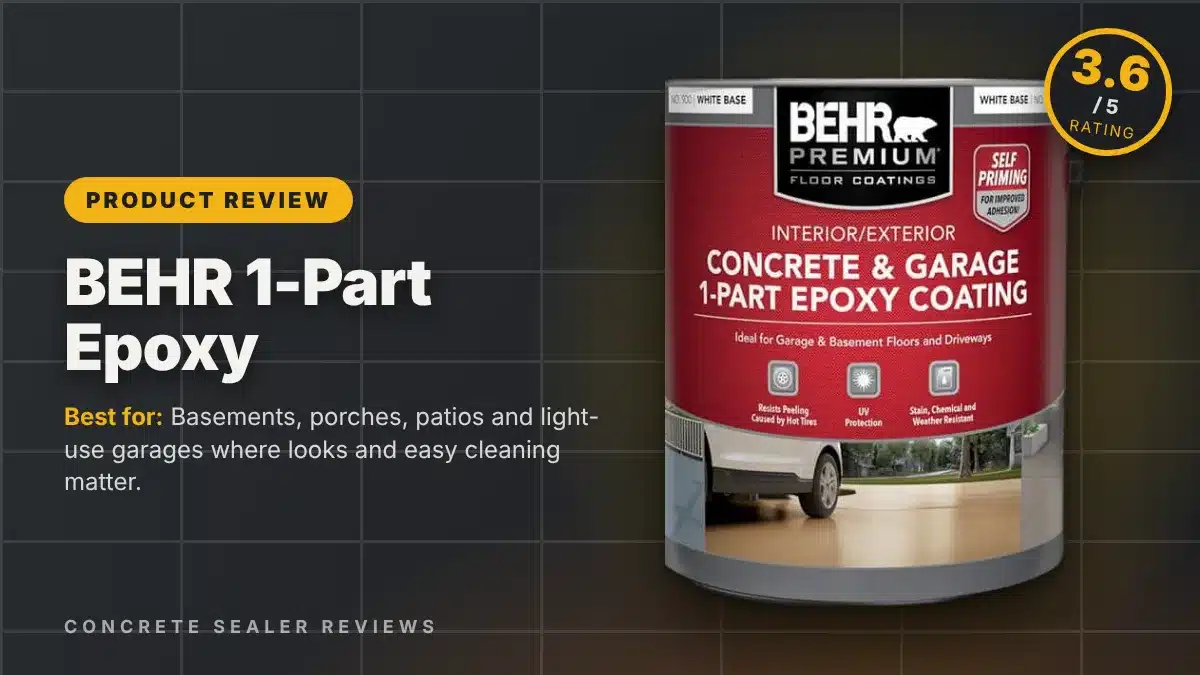
BEHR Premium 1-Part Epoxy is a water-based, no-mix floor paint for garages, basements, porches and driveways, sold at Home Depot in a wide range of tintable colors. It is for homeowners who want a clean, colored floor in a weekend without mixing a two-part kit. The bottom line: it looks good and goes on easily, but it is a thin acrylic-epoxy paint, not a true epoxy coating, and it only holds up in a garage when the slab is etched properly and you give it the full week before parking.
| Type | Single-component floor paint (self-priming) |
| Chemistry | Water-based 1-part epoxy (acrylic-epoxy) |
| Finish | Satin; many tinted colors |
| Coverage | 300–400 sq ft/gal on rough surfaces; 400–500 sq ft/gal on smooth |
| Coats | 1–2 (no more than 2) |
| Dry/recoat | Dry to touch about 1 hour; recoat in 4–6 hours |
| Cure | Light foot traffic 24 hours; heavy foot traffic 72 hours; car tires 7 days; no washing for 30 days |
| Best for | Light-use garages, basements, porches, patios |
| Not for | Vertical surfaces, hydrostatic pressure, industrial or forklift traffic |
| New concrete | Wait 30 days, then etch |
Watch: BEHR 1-Part Epoxy in 60 seconds
What It Is / How It Works
The product reviewed here as "BEHR Premium 1-Part Epoxy Concrete & Garage Floor Paint" is now sold as BEHR PREMIUM Self-Priming 1-Part Epoxy Satin Interior/Exterior Concrete & Garage Floor Paint. The base product numbers include No. 900 White Base, 901 Silver Gray, 902 Slate Gray and 930 Deep Base, and it is tinted at Home Depot.
"1-part epoxy" is the important phrase. A true epoxy is two parts, a resin and a hardener, that react chemically into a thick, hard film. A one-part epoxy is essentially a high-quality acrylic floor paint with some epoxy added for hardness and adhesion. It comes ready to use in the can, has under 50 g/L VOC and cleans up with soap and water. It dries by evaporation like other latex paints, so the film is much thinner than a 2-part kit, and it reaches its working strength over days rather than hours.
The current version is labeled self-priming. On bare concrete the first coat acts as the primer, although BEHR also allows its No. 880 Concrete & Masonry Bonding Primer. BEHR claims resistance to hot-tire pickup, automotive fluids and most household chemicals.
Where It Works Best (and where it doesn't)
It works best where the main goal is appearance and easy cleaning: basement floors, porches, patios, laundry rooms, workshops and garages that see light vehicle use. It is also a good way to even out blotchy or stained concrete, and the color range is much wider than most garage-floor kits.
Its limits are written right on the label. It is not for vertical surfaces, areas with hydrostatic pressure (water pushing up through the slab), industrial use or forklift traffic. BEHR also notes that tire-traffic areas may need an annual touch-up and that heavy traffic too soon causes failures that need spot recoating. If you drive in with hot tires every day, or the slab has moisture problems, a 2-part epoxy or polyaspartic system is a better match. Our best epoxy floor coatings guide covers those.
Owner feedback reflects that split. The Home Depot listing averaged about 4 out of 5 across more than a thousand reviews when we checked. Third-party reviewers point to skipped etching, moisture and hot tires as the usual reasons for peeling.
Pros
- No mixing and no pot life; open the can and roll
- Self-priming on bare concrete
- Low VOC (under 50 g/L), low odor, soap-and-water cleanup
- Good coverage: 300–500 sq ft per gallon per coat
- Wide range of tintable colors
- Interior and exterior use
Cons
- Thin film compared with a 2-part epoxy; less resistant to hot tires and abrasion
- 7-day wait before parking, and 30 days before washing
- Etching is required on bare concrete; skipping it is a common cause of peeling
- Not for slabs with moisture or hydrostatic pressure
- Tire lanes may need annual touch-ups
- Slippery when wet unless you add an anti-slip additive
How to Apply It
- Let new concrete cure 30 days. Do not use it on slabs with hydrostatic pressure.
- Clean and degrease. The floor must be clean, sound, dry and free of oil and grease.
- Etch bare concrete with a muriatic acid etcher to a texture like 150-grit sandpaper. Rinse off all residue and let it dry completely. Sprinkle water on the dry floor: it should soak in quickly. If it beads, etch again. On previously painted or sealed floors, strip or scrape failing coatings, scuff-sand gloss and spot-etch bare spots.
- Check conditions. Air and surface temperature between 50°F and 90°F, with no rain or heavy dew expected for 24 hours.
- Mix all cans together (box them) for consistent color. Do not thin.
- Prime or apply the first coat. On bare concrete, the first coat of this product (or BEHR No. 880 primer) serves as the primer. Cut in the edges with a brush, then roll a thin, even coat with a 3/8" nap roller in long strokes in one direction.
- Second coat. After 4–6 hours, decide whether a second coat is needed and roll it crosswise. Do not apply more than two coats.
- Respect the cure. Light foot traffic after 24 hours, furniture after 72 hours, cars after 7 days (cardboard under tires is allowed after 72 hours), and no wet cleaning for 30 days.
How It Compares
KILZ 1-Part Epoxy Acrylic Concrete & Garage Floor Paint. A very close match: same coverage range, same 50–90°F window, same 7-day wait for tires and the same restrictions. The main difference is that KILZ calls for its bonding primer on new or uncoated concrete, while BEHR's current formula is labeled self-priming.
2-part epoxy kits. Resin-and-hardener kits build a thicker, harder film that handles hot tires and chemicals better. They take more work, have a limited working time once mixed, and usually cost more, but they are the better choice for a daily-use garage.
Penetrating sealer. If you only want to protect bare concrete and do not need color, a penetrating sealer has nothing to peel and keeps the original look. See our best concrete sealers for 2026 roundup.
FAQ
Is BEHR 1-Part Epoxy real epoxy?
Not in the 2-part sense. It is a water-based, single-component paint with epoxy added for toughness. It is harder-wearing than ordinary porch paint but much thinner and softer than a mixed resin-and-hardener epoxy.
How long before I can park on it?
BEHR says to wait 7 days before car tires. If you must, you can put corrugated cardboard under the tires after 72 hours. Driving on it early is one of the most common causes of failure.
Why is my BEHR epoxy floor peeling?
The usual causes are poor prep (no etching, or etch residue left on the floor), moisture coming up through the slab, too-early traffic, or hot tires on a thin film. Peeled spots can be scraped, spot-etched, primed and recoated.
Can you put it over an old sealer or paint?
Yes, if the old coating is sound. Strip or scrape anything failing, scuff-sand glossy areas, clean the floor and spot-prime any bare concrete. Test a small area first.
Verdict
BEHR Premium Self-Priming 1-Part Epoxy is one of the easiest ways to put color on a concrete floor, and it is a fair value for basements, porches and light-use garages. Its weak points are the ones all 1-part floor paints share: a thin film, strict prep and a long wait before tires. Etch properly and be patient and it is a good DIY choice. Skip either and expect touch-ups. Our rating: 3.6/5.
See the manufacturer's product page
How we reviewed this product: this is a research-based review built from the manufacturer's technical data sheet and current retail listings. We have not run our own hands-on tests of this product. Details were checked in October 2026; always follow the current label.
Related Guides
Affiliate disclosure: Some links on this page are affiliate links. As an Amazon Associate we earn from qualifying purchases, at no extra cost to you.
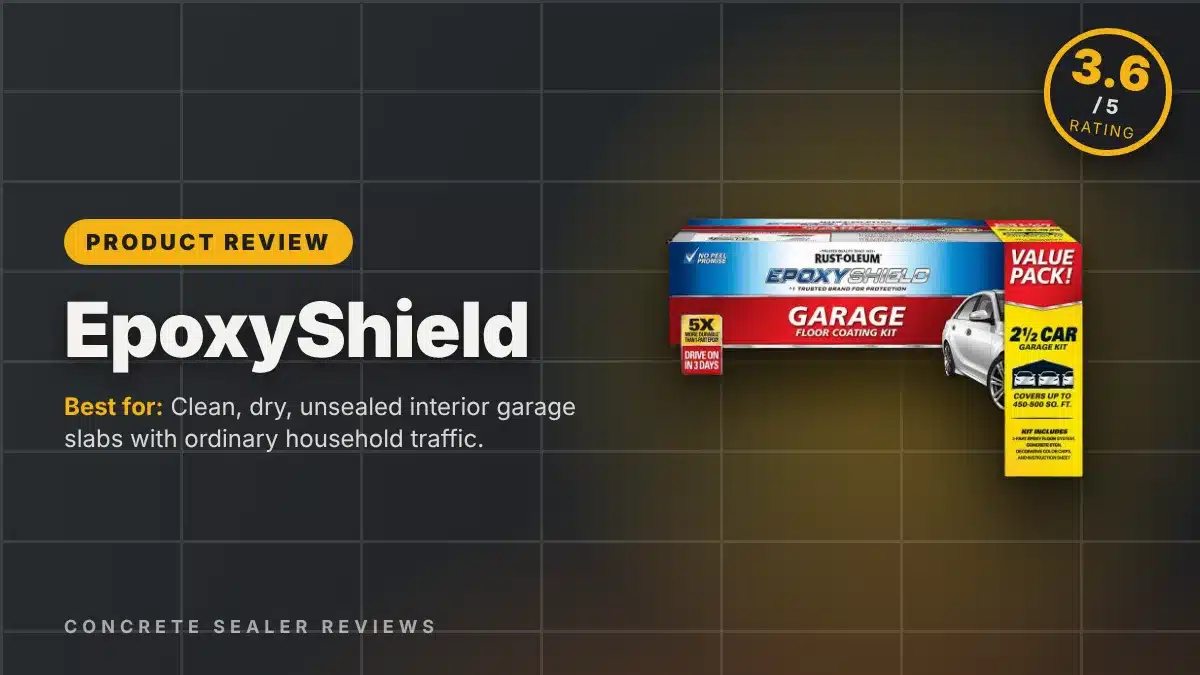
Rust-Oleum EpoxyShield Garage Floor Coating is a water-based, two-part epoxy kit sold at most big-box stores, made for homeowners who want a glossy, chip-flecked garage floor in a weekend. It is a real two-component epoxy, which puts it a clear step above one-part “epoxy” paints, but it goes on thin, and how long it lasts depends almost entirely on your prep. Bottom line: a good-value DIY kit for a clean, dry, unsealed garage slab, not a substitute for a thick professional system.
| Type | Two-part garage floor coating kit (film-forming) |
| Chemistry | Water-based, amine-cured epoxy; mixed 3:1 base to activator; about 52.6% solids by volume; VOC under 100 g/L |
| Finish | Gloss; Gray, Tan or tint base, with decorative color chips |
| Coverage | About 250 sq ft per 1-car kit (120 fl oz) at the recommended thickness; the 2.5-car kit (240 fl oz) is rated about 450–500 sq ft |
| Coats | One coat under most conditions (3.0–3.5 mils dry) |
| Dry/recoat | Foot traffic in 24 hours; vehicles in 3 days (at 70–80°F, 50% RH) |
| Cure | Full cure time not stated on the data sheet |
| Best for | Interior garage and basement slabs that are bare, sound and dry |
| Not for | Sealed floors (unless ground or blasted), slabs with moisture problems, unsound old coatings, exterior use |
| New concrete | Wait at least 28 days |
Watch: EpoxyShield in 60 seconds
What It Is / How It Works
EpoxyShield is Rust-Oleum's entry-level two-part epoxy for garage floors. The kit contains a base, an activator, concrete etch and decorative chips. Mixed together, the resin and hardener form a cross-linked film that is harder and more chemical-resistant than a one-part floor paint. Rust-Oleum markets it as five times more durable than one-part epoxy and says it resists gasoline, antifreeze, motor oil, salt and hot tire pickup.
The important number is film thickness. The technical data sheet calls for 3.0–3.5 mils dry (6–7 mils wet) in a single coat. That is thin compared with high-solids or 100% solids epoxy systems. A thin film can look great on day one, but it has less material to absorb abrasion and tire wear, and it won't hide cracks or rough concrete.
The product is still widely sold in 2026. Some retailers now list it as "EpoxyShield 2-Part Concrete and Garage Floor Paint (Kit)," and Rust-Oleum also sells a separate EpoxyShield Premium Clear Coating that it recommends as an optional topcoat for extra protection and gloss.
Where It Works Best (and where it doesn't)
EpoxyShield is at its best on a bare, structurally sound garage slab that has never been sealed or painted, stays dry, and sees ordinary household traffic: a couple of cars, foot traffic, storage. There, a careful DIYer can get a glossy floor that is far easier to clean than raw concrete.
It is a poor fit in a few common situations. Rust-Oleum says it is not for floors with a moisture problem, not over unsound previous coatings, and not over floors that have curing agents or sealers on them. If your slab was sealed with an acrylic or similar product, the data sheet says the sealer has to be removed by grinding or shot blasting before you coat. The kit is labeled for indoor use only, so it is not a driveway or patio product. And because it goes on thin, it is a weaker choice for heavy-use shops, floors with lots of pitting, or anyone who wants a decade-plus floor without recoating.
Pros
- True two-part epoxy at a big-box kit price
- Water-based, low odor, VOC under 100 g/L, water cleanup while wet
- Kit includes etch and decorative chips, so you need fewer extra purchases
- One coat in most cases; walk on in 24 hours, drive on in 3 days
- Resists common garage fluids and hot tire pickup, per the manufacturer
- Easy to find at Home Depot, Lowe's and hardware stores
Cons
- Thin film (about 3 mils dry), so less wear resistance than heavy-build systems
- Won't bond over sealed concrete; sealers must be ground or blasted off
- Not for slabs with moisture problems, and not for exterior use
- Narrow 60–85°F application window and a 1–2 hour pot life once mixed
- Real-world coverage often falls short of the label on porous concrete
- Results depend heavily on prep; the included acid etch is not as thorough as mechanical grinding
How to Apply It
- Check the slab. New concrete needs at least 28 days. The floor must be dry, sound and free of sealers and curing compounds. If water beads on the surface, it is probably sealed and needs mechanical prep before coating.
- Clean and degrease. Sweep, remove oil and grease, scrub with a degreaser or detergent and rinse. Patch cracks and spalls ahead of time.
- Etch. Etch the whole floor with the included concrete etch, rinse thoroughly and let it dry completely.
- Watch the conditions. Air, surface and material should all be 60–85°F, the surface at least 5°F above the dew point, and relative humidity no higher than 85%.
- Mix and wait. Pour all of Part A into Part B and mix for 3 minutes. Induction depends on temperature: at 60–70°F, wait about 45 minutes before rolling and use within 2 hours; at 81–85°F you can roll within 5–15 minutes but must use it within 1 hour.
- Cut in and roll. Brush the edges, then roll with a 1/2" nap synthetic roller in 4 ft x 4 ft sections, keeping a wet edge. Scatter chips onto each wet section as you go. One coat is enough under most conditions.
- Let it cure. Allow 24 hours before foot traffic and 3 days before driving on it (at 70–80°F, 50% RH). Many owners give it longer before parking cars, especially in cool garages.
How It Compares
One-part epoxy floor paints (including Rust-Oleum's own one-part garage floor paint) are cheaper and simpler, but they are basically tough paints. EpoxyShield's two-part chemistry is the better pick if you are going to drive on the floor.
Rust-Oleum RockSolid is the brand's premium polycuramine garage kit. It costs more and is aimed at buyers who want something tougher.
High-solids or 100% solids epoxy kits from coating suppliers go on much thicker and usually pair with a polyurethane or polyaspartic topcoat. They take more work and money, and they usually expect a ground floor, but they are the better match for shops and heavy use. See our best epoxy floor coatings guide for options.
FAQ
How long does Rust-Oleum EpoxyShield last?
Rust-Oleum does not publish a service life. Because the film is thin, lifespan depends mostly on prep, slab moisture and how hard the floor is used. An optional clear topcoat adds wear protection.
Can you put EpoxyShield over a sealed or painted floor?
Not over a sealer. The data sheet says sealers must be removed by grinding or shot blasting. Over old paint, the coating must be sound and scuff-sanded; loose or peeling paint has to come off first.
How many kits do I need for a 2-car garage?
A typical 2-car garage is roughly 400–500 sq ft, which matches the 2.5-car kit's 450–500 sq ft rating or two 1-car kits. Coverage drops on porous or rough concrete, and owners commonly report needing extra, so buy a little more than the math says.
Verdict
EpoxyShield is an honest, affordable two-part epoxy that rewards careful prep. On a dry, unsealed garage slab with household use, it is a big upgrade over bare concrete or one-part paint. Its thin single coat, narrow application window and intolerance for sealed or damp slabs keep it from being a heavy-duty floor; look at thicker systems if you work in the garage hard. You can check current kit options on Rust-Oleum's product page.
Our rating: 3.6/5
How we reviewed this product: this is a research-based review built from the manufacturer's technical data sheet and current retail listings. We have not run our own hands-on tests of this product. Details were checked in October 2026; always follow the current label.
Where to Buy
Check Price on Amazon
- Rust-Oleum EpoxyShield Garage Floor Coating, Gray (1-car kit)
- Rust-Oleum EpoxyShield Garage Floor Coating, Dark Gray (2.5-car kit)
Related Guides
Affiliate disclosure: Some links on this page are affiliate links. As an Amazon Associate we earn from qualifying purchases, at no extra cost to you.
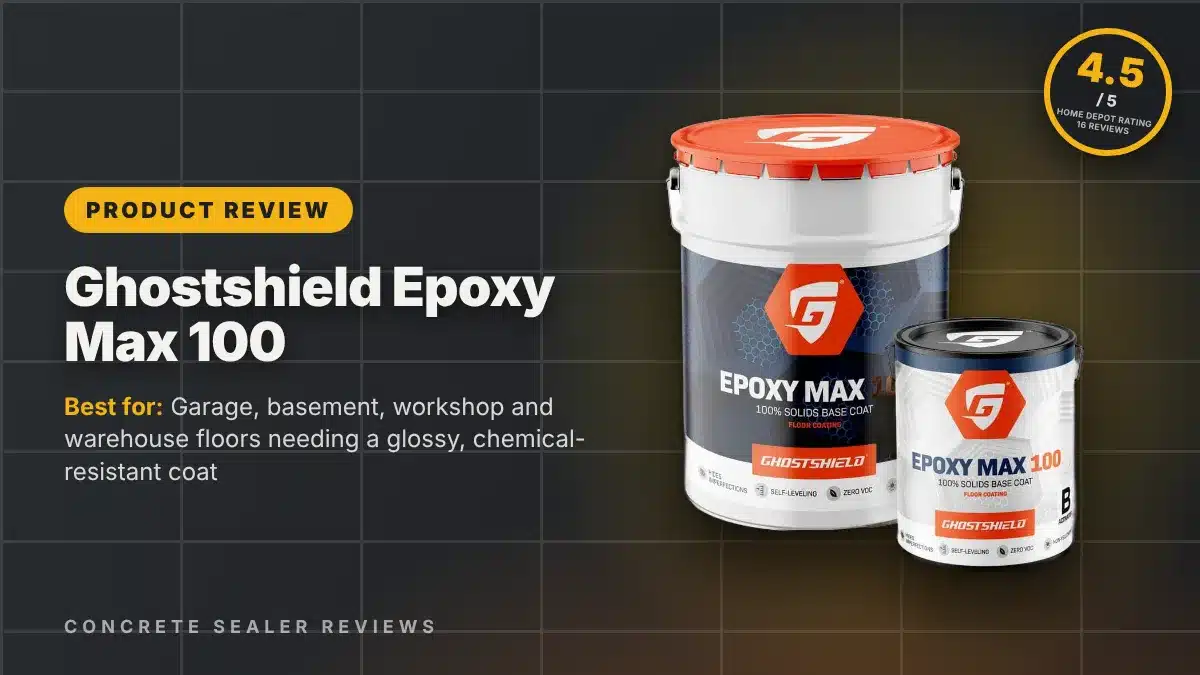
Home Depot rating: ★ 4.5/5 (16 Home Depot reviews)
Watch: Ghostshield Epoxy Max 100 in 60 seconds
Ghostshield Epoxy Max 100 : A High-Performance Floor Coating
Ghostshield Epoxy Max 100 is a high-performance, two-part epoxy coating designed to protect concrete surfaces in both commercial and residential settings. It’s ideal for areas that experience heavy traffic, spills, or wear, such as garages, basements, or warehouse floors. This review will break down the key features, application process, and benefits of Ghostshield Epoxy Max 100.
What is Ghostshield Epoxy Max 100?
Ghostshield Epoxy Max 100 is a durable, high-solid, two-part epoxy system that comes in two components: the epoxy resin (Part A) and the hardener (Part B). When mixed together, these parts chemically react to form a tough, protective coating. This coating bonds well to concrete surfaces, providing excellent protection against stains, wear, and chemicals, while also enhancing the appearance of your floors.
Why Choose Epoxy Max 100?
If you're looking for a floor coating that can handle heavy traffic, or if you are looking for a durable option for your garage floor Ghostshield Epoxy Max 100 is a great choice. Once applied, it creates a strong, long-lasting surface that can withstand heavy foot traffic, vehicle movement, and even chemical spills. Whether you're working on your garage floor, a basement, or a workshop, this epoxy will give your concrete a fresh, durable finish.
How Does It Work?
The magic behind Epoxy Max 100 lies in its chemical structure. The epoxy resin (Part A) and hardener (Part B) mix to form a hard, plastic-like surface that sticks tightly to the concrete. This helps the coating resist cracking, peeling, or chipping over time. The coating also has a low permeability, which means water and other liquids are less likely to soak into the concrete, preventing damage or staining.
The epoxy also offers impressive chemical resistance. If your concrete surface is exposed to things like oils, grease, or cleaning chemicals, Epoxy Max 100 can handle it. This makes it an excellent option for garages, workshops, and even areas that might see the occasional spill.
Application: Step-by-Step
- Prep the Surface: The key to a successful epoxy application is good surface preparation. You'll need to rough up the surface using a grinder or shot blaster to ensure the epoxy adheres properly.
- Mixing the Epoxy: Once your surface is clean and dry, it's time to mix the two components. Epoxy Max 100 comes in a 3 gallon, 2 component kit. 2 parts resin to 1 part hardener. Be sure to mix thoroughly, as improper mixing can affect the performance of the coating.
- Apply the Epoxy: You can apply the mixed epoxy using a roller, brush, or squeegee. Start in one corner and work your way out to avoid stepping on the freshly applied coating. The epoxy has a smooth consistency that spreads easily, making the application process relatively straightforward. You can apply multiple coats for added thickness, but be sure to follow the recommended curing times between coats.
- Curing Time: After applying the first coat, you'll need to let it dry. Typically, the epoxy will feel dry to the touch within a few hours, but it can take up to 72 hours to fully cure and harden. Be patient and avoid heavy traffic on the surface until it's completely cured.
Benefits of Ghostshield Epoxy Max 100
- Durability: Once cured, the epoxy creates a tough surface that resists damage from foot traffic, vehicles, and even chemical spills.
- Chemical Resistance: It’s highly resistant to oils, gasoline, cleaning agents, and other chemicals commonly found in garages and workshops.
- Easy Maintenance: Epoxy floors are easy to clean and maintain, helping keep your concrete surfaces looking new for years.
- Aesthetic Appeal: Epoxy Max 100 gives concrete floors a smooth, glossy finish that can brighten up a space. It’s available in a variety of colors, allowing you to customize the look of your floor. Can also be used with flakes and metallics for an aesthetically pleasing look.
- DIY-Friendly: The application process is straightforward, especially if you follow the instructions carefully. Most DIYers can tackle this project on their own. The hardest part of the whole application will be your surface preparation. It is essential the floor is properly grind-ed to ensure the best possible adhesion.
Performance and Longevity
Ghostshield Epoxy Max 100 is designed to perform well in even the toughest conditions. Whether your concrete surface is exposed to constant foot traffic, heavy machinery, or accidental spills, this epoxy coating holds up over time. Its ability to resist abrasion and staining makes it particularly beneficial for high-traffic areas like garages and workshops.
Once applied, the coating remains resistant to most chemicals, making it an excellent choice for spaces where spills are common. The tough, durable finish helps protect the concrete beneath, preventing cracks, stains, and water damage.
Environmental Impact and Safety
Ghostshield Epoxy Max 100 is a low-VOC (Volatile Organic Compounds) product, meaning it emits fewer harmful fumes compared to traditional solvent-based coatings. However, it’s still important to ensure good ventilation while applying the epoxy, as there will still be fumes during the curing process. Always follow the safety guidelines provided in the instructions, including wearing gloves and protective eyewear during application.
Conclusion
Overall, Ghostshield Epoxy Max 100 is a fantastic product for anyone looking to improve the durability and appearance of their concrete floors. Whether you’re a DIYer tackling a garage floor or a professional applying it in an industrial setting, this epoxy offers a reliable, long-lasting solution. Its easy application process, strong chemical resistance, and tough finish make it an excellent choice for high-traffic, high-use areas. With a little patience and preparation, you'll have a floor that looks great and stands up to wear for years to come.

Related Guides
Affiliate disclosure: Some links on this page are affiliate links. As an Amazon Associate we earn from qualifying purchases, at no extra cost to you.
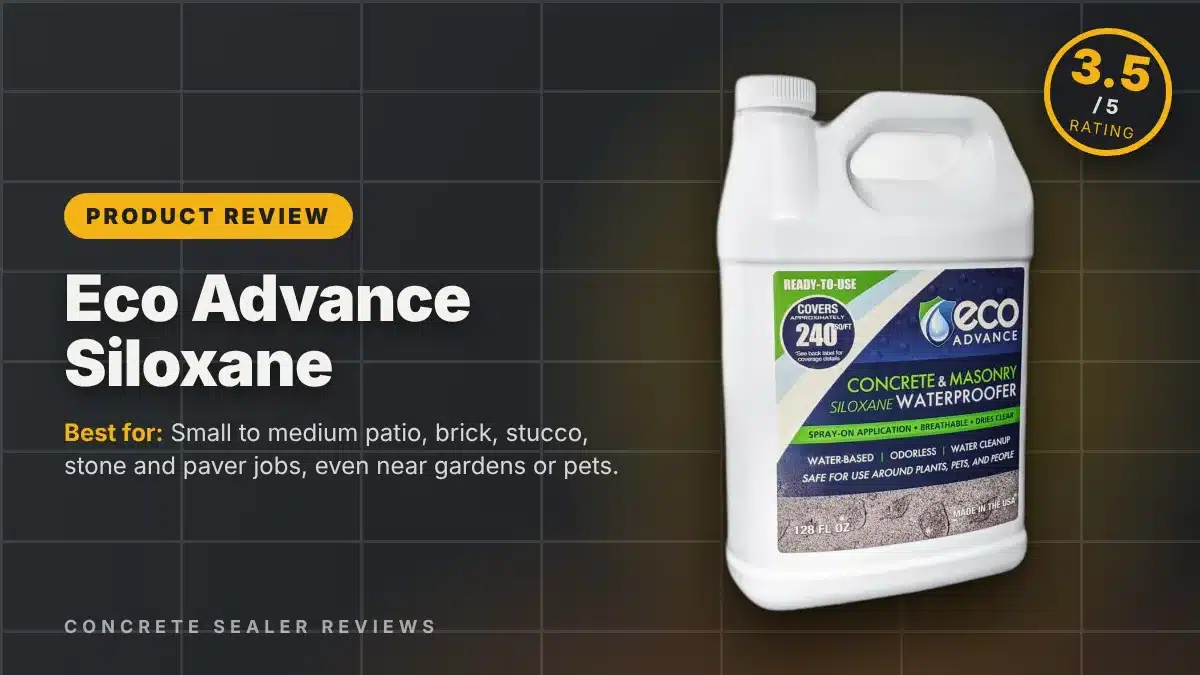
Eco Advance Concrete/Masonry Siloxane Waterproofer is a water-based, low-odor siloxane water repellent that you spray on with a garden sprayer. It is sold ready-to-use by the gallon or as a small concentrate you mix with water, and it is marketed as safe around people, pets and plants. Bottom line: a convenient, breathable, invisible water repellent for patios, walls and pavers, held back by thin published technical data and the need to apply it carefully.
| Type | Penetrating water repellent (no film) |
| Chemistry | Water-based siloxane; non-flammable, low VOC, low odor |
| Finish | Dries clear with no sheen; owners report slight darkening on some surfaces |
| Coverage | No official rate published in the listings we found; buy extra for porous or textured surfaces |
| Coats | Two coats is the common recommendation; very porous surfaces may need more |
| Dry/recoat | Walkable in under 2 hours, per the seller |
| Cure | Not published |
| Best for | Concrete, brick, stucco, natural and manufactured stone, pavers, split-face block, EIFS |
| Not for | Stopping active leaks or hydrostatic pressure; anyone who needs a full spec sheet before buying |
| New concrete | Marketed as usable on new concrete and masonry |
Watch: Eco Advance Siloxane in 60 seconds
What It Is / How It Works
Eco Advance is its own brand, sold by Eco Advancements Inc., and it is still available in 2026 through hardware and online retailers. You will see several versions of the same concrete/masonry product: a 1-gallon ready-to-use jug (model EACON128PD), a 16 oz concentrate that makes 1 gallon (EACON16CON) and a 64 oz concentrate that makes 5 gallons (EACON64CON). Some stores, such as Do it Best, list it as "Eco Advance Clear Concrete and Masonry Water Repellent Sealer." The brand also makes a separate exterior wood waterproofer, so check the label before you buy.
Our older review lumped it into the "Rainguard family." We could not find any source that confirms Eco Advance is made by Rainguard, so treat them as separate brands. Both use a spray-on, water-based siloxane approach, which is likely where the confusion came from.
A siloxane repellent soaks into the pores of concrete and masonry and leaves them water-repellent from the inside. Rain beads up and runs off instead of soaking in, while water vapor can still pass out of the material. That vapor permeability is the main reason to choose this type over a film-forming acrylic: it does not trap moisture, it does not peel, and the surface looks basically untreated. Eco Advance says the treatment protects against water damage, de-icing salts, oil and stains, mold and mildew, and pool and spa chemicals, and that it does not harm landscape plantings.
Where It Works Best (and where it doesn't)
It suits homeowners who want an easy, low-odor treatment for an exterior concrete patio, a brick porch, stucco or stone veneer, paver walkways or split-face block walls, especially next to gardens or where pets are around. Because it's water-based, you can spray it near plantings with less worry than with solvent-based repellents. The seller also says it can be used in cool weather, down to 34°F, which extends the season compared with many sealers.
It is not the product for a leaking basement wall, a foundation with groundwater pressure or a garage floor where you want gloss and stain protection from a coating. Penetrating repellents slow water absorption; they don't seal cracks or hold back pressurized water. The bigger practical drawback is documentation. We could not find a published technical data sheet with coverage rates, cure time or rain windows, which makes it harder to plan a large job than with brands that publish full specs.
Pros
- Water-based, low odor, non-flammable and low VOC
- Breathable (vapor permeable), so it won't trap moisture or peel
- Dries clear with no sheen
- Quick garden-sprayer application; walkable in under 2 hours
- Concentrate option reduces shipping weight and cost per gallon
- Marketed as safe around people, pets and plants, and usable down to 34°F
Cons
- No published technical data sheet: no official coverage, cure or rain window
- Can pool on stamped or textured concrete if over-applied
- Harder to spray evenly in wind or strong sun, per owner reports
- Some owners needed extra coats before water beaded everywhere
- Won't stop active leaks or hydrostatic pressure
How to Apply It
- Clean the surface. Pressure wash or scrub off dirt, mildew and efflorescence, then let the surface dry thoroughly. Penetrating repellents need open, dry pores to soak in.
- Mix if using concentrate. Follow the label: the 16 oz bottle makes 1 gallon and the 64 oz bottle makes 5 gallons. Don't dilute the ready-to-use jug.
- Pick your weather. Choose a calm day without strong sun beating on the surface, and avoid rain until the treatment has had time to set. The label is the final word on temperatures and timing.
- Spray evenly. Use a pump or garden sprayer with a fan tip, working steadily so the surface is evenly wet. On stamped or textured concrete, dab or back-roll any puddles so they don't dry in place.
- Apply a second coat. Two coats is the common recommendation. Owners note the second coat goes on more easily before the first fully dries; follow the label's timing.
- Check it. After it dries, splash water on a few spots. If any area darkens and soaks it up, give that area another coat. Repeat the splash test every year or so to know when to reapply.
How It Compares
Rainguard Advanced Waterproofer is a similar water-based silane/siloxane spray-on product that publishes a full data sheet: theoretical coverage of about 125–150 sq ft/gal on concrete, a 5–7 day full chemical cure and a 10-year limited warranty. If you want firm numbers to plan with, that transparency is an advantage.
Solvent-based or higher-solids silane/siloxane sealers are a common pick for driveways that see de-icing salt and come in products with fully published specs, though solvent-based versions bring more odor. Our best silane/siloxane concrete sealers covers them.
Acrylic film-forming sealers add color enhancement or a wet look and resist surface stains better, but they sit on top, wear and can peel. Choose those only if you want a visible finish; see best concrete sealers for 2026.
FAQ
Is Eco Advance actually waterproof?
It is a water repellent: it makes concrete and masonry shed rain and absorb much less water. It does not create a membrane, so it won't stop water under pressure or seal cracks.
How long does Eco Advance last?
The brand calls it long-lasting but doesn't publish a service life. Owners commonly report water still beading months to a year or two later. Exposure, traffic and surface porosity all affect how long it lasts, so a yearly splash test is the best guide.
Is Eco Advance made by Rainguard?
We found no source that confirms that. Retail listings name Eco Advance as the brand and Eco Advancements Inc. as the seller. Rainguard is a separate brand with its own siloxane waterproofers.
Can I use it on new concrete?
The seller says it can be used on new concrete and masonry and that it lets them keep curing. Make sure the surface is dry to the touch before spraying.
Verdict
Eco Advance is an easy, friendly-to-use siloxane repellent for homeowners who want an invisible, breathable treatment on patios, brick, stucco and pavers without solvent fumes. Owner feedback on beading and ease of spraying is generally positive. The lack of a published spec sheet, the risk of pooling on textured surfaces and the occasional need for extra coats keep it from scoring higher. It's a fair pick for small to medium DIY jobs; for large or salt-exposed driveways, a better-documented silane/siloxane is the safer choice.
Our rating: 3.5/5
How we reviewed this product: this is a research-based review built from the manufacturer's technical data sheet and current retail listings. We have not run our own hands-on tests of this product. Details were checked in October 2026; always follow the current label.
Where to Buy
