Affiliate disclosure: Some links on this page are affiliate links. As an Amazon Associate we earn from qualifying purchases, at no extra cost to you.
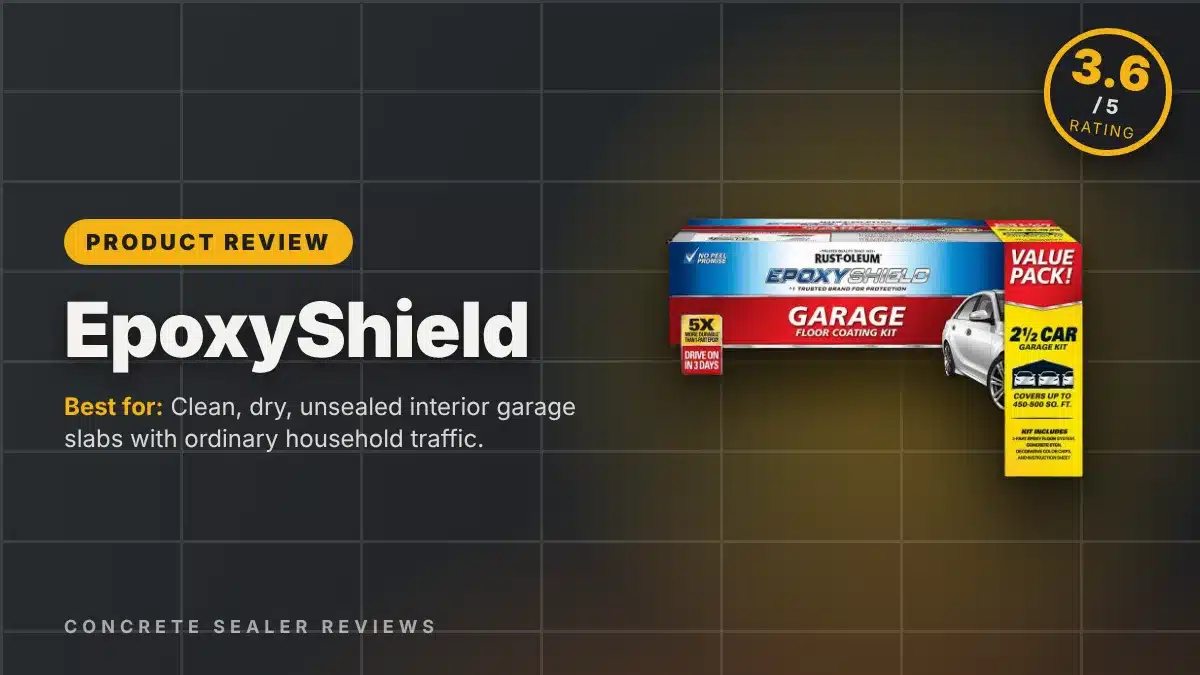
Rust-Oleum EpoxyShield Garage Floor Coating is a water-based, two-part epoxy kit sold at most big-box stores, made for homeowners who want a glossy, chip-flecked garage floor in a weekend. It is a real two-component epoxy, which puts it a clear step above one-part “epoxy” paints, but it goes on thin, and how long it lasts depends almost entirely on your prep. Bottom line: a good-value DIY kit for a clean, dry, unsealed garage slab, not a substitute for a thick professional system.
| Type | Two-part garage floor coating kit (film-forming) |
| Chemistry | Water-based, amine-cured epoxy; mixed 3:1 base to activator; about 52.6% solids by volume; VOC under 100 g/L |
| Finish | Gloss; Gray, Tan or tint base, with decorative color chips |
| Coverage | About 250 sq ft per 1-car kit (120 fl oz) at the recommended thickness; the 2.5-car kit (240 fl oz) is rated about 450–500 sq ft |
| Coats | One coat under most conditions (3.0–3.5 mils dry) |
| Dry/recoat | Foot traffic in 24 hours; vehicles in 3 days (at 70–80°F, 50% RH) |
| Cure | Full cure time not stated on the data sheet |
| Best for | Interior garage and basement slabs that are bare, sound and dry |
| Not for | Sealed floors (unless ground or blasted), slabs with moisture problems, unsound old coatings, exterior use |
| New concrete | Wait at least 28 days |
Watch: EpoxyShield in 60 seconds
What It Is / How It Works
EpoxyShield is Rust-Oleum's entry-level two-part epoxy for garage floors. The kit contains a base, an activator, concrete etch and decorative chips. Mixed together, the resin and hardener form a cross-linked film that is harder and more chemical-resistant than a one-part floor paint. Rust-Oleum markets it as five times more durable than one-part epoxy and says it resists gasoline, antifreeze, motor oil, salt and hot tire pickup.
The important number is film thickness. The technical data sheet calls for 3.0–3.5 mils dry (6–7 mils wet) in a single coat. That is thin compared with high-solids or 100% solids epoxy systems. A thin film can look great on day one, but it has less material to absorb abrasion and tire wear, and it won't hide cracks or rough concrete.
The product is still widely sold in 2026. Some retailers now list it as "EpoxyShield 2-Part Concrete and Garage Floor Paint (Kit)," and Rust-Oleum also sells a separate EpoxyShield Premium Clear Coating that it recommends as an optional topcoat for extra protection and gloss.
Where It Works Best (and where it doesn't)
EpoxyShield is at its best on a bare, structurally sound garage slab that has never been sealed or painted, stays dry, and sees ordinary household traffic: a couple of cars, foot traffic, storage. There, a careful DIYer can get a glossy floor that is far easier to clean than raw concrete.
It is a poor fit in a few common situations. Rust-Oleum says it is not for floors with a moisture problem, not over unsound previous coatings, and not over floors that have curing agents or sealers on them. If your slab was sealed with an acrylic or similar product, the data sheet says the sealer has to be removed by grinding or shot blasting before you coat. The kit is labeled for indoor use only, so it is not a driveway or patio product. And because it goes on thin, it is a weaker choice for heavy-use shops, floors with lots of pitting, or anyone who wants a decade-plus floor without recoating.
Pros
- True two-part epoxy at a big-box kit price
- Water-based, low odor, VOC under 100 g/L, water cleanup while wet
- Kit includes etch and decorative chips, so you need fewer extra purchases
- One coat in most cases; walk on in 24 hours, drive on in 3 days
- Resists common garage fluids and hot tire pickup, per the manufacturer
- Easy to find at Home Depot, Lowe's and hardware stores
Cons
- Thin film (about 3 mils dry), so less wear resistance than heavy-build systems
- Won't bond over sealed concrete; sealers must be ground or blasted off
- Not for slabs with moisture problems, and not for exterior use
- Narrow 60–85°F application window and a 1–2 hour pot life once mixed
- Real-world coverage often falls short of the label on porous concrete
- Results depend heavily on prep; the included acid etch is not as thorough as mechanical grinding
How to Apply It
- Check the slab. New concrete needs at least 28 days. The floor must be dry, sound and free of sealers and curing compounds. If water beads on the surface, it is probably sealed and needs mechanical prep before coating.
- Clean and degrease. Sweep, remove oil and grease, scrub with a degreaser or detergent and rinse. Patch cracks and spalls ahead of time.
- Etch. Etch the whole floor with the included concrete etch, rinse thoroughly and let it dry completely.
- Watch the conditions. Air, surface and material should all be 60–85°F, the surface at least 5°F above the dew point, and relative humidity no higher than 85%.
- Mix and wait. Pour all of Part A into Part B and mix for 3 minutes. Induction depends on temperature: at 60–70°F, wait about 45 minutes before rolling and use within 2 hours; at 81–85°F you can roll within 5–15 minutes but must use it within 1 hour.
- Cut in and roll. Brush the edges, then roll with a 1/2" nap synthetic roller in 4 ft x 4 ft sections, keeping a wet edge. Scatter chips onto each wet section as you go. One coat is enough under most conditions.
- Let it cure. Allow 24 hours before foot traffic and 3 days before driving on it (at 70–80°F, 50% RH). Many owners give it longer before parking cars, especially in cool garages.
How It Compares
One-part epoxy floor paints (including Rust-Oleum's own one-part garage floor paint) are cheaper and simpler, but they are basically tough paints. EpoxyShield's two-part chemistry is the better pick if you are going to drive on the floor.
Rust-Oleum RockSolid is the brand's premium polycuramine garage kit. It costs more and is aimed at buyers who want something tougher.
High-solids or 100% solids epoxy kits from coating suppliers go on much thicker and usually pair with a polyurethane or polyaspartic topcoat. They take more work and money, and they usually expect a ground floor, but they are the better match for shops and heavy use. See our best epoxy floor coatings guide for options.
FAQ
How long does Rust-Oleum EpoxyShield last?
Rust-Oleum does not publish a service life. Because the film is thin, lifespan depends mostly on prep, slab moisture and how hard the floor is used. An optional clear topcoat adds wear protection.
Can you put EpoxyShield over a sealed or painted floor?
Not over a sealer. The data sheet says sealers must be removed by grinding or shot blasting. Over old paint, the coating must be sound and scuff-sanded; loose or peeling paint has to come off first.
How many kits do I need for a 2-car garage?
A typical 2-car garage is roughly 400–500 sq ft, which matches the 2.5-car kit's 450–500 sq ft rating or two 1-car kits. Coverage drops on porous or rough concrete, and owners commonly report needing extra, so buy a little more than the math says.
Verdict
EpoxyShield is an honest, affordable two-part epoxy that rewards careful prep. On a dry, unsealed garage slab with household use, it is a big upgrade over bare concrete or one-part paint. Its thin single coat, narrow application window and intolerance for sealed or damp slabs keep it from being a heavy-duty floor; look at thicker systems if you work in the garage hard. You can check current kit options on Rust-Oleum's product page.
Our rating: 3.6/5
How we reviewed this product: this is a research-based review built from the manufacturer's technical data sheet and current retail listings. We have not run our own hands-on tests of this product. Details were checked in October 2026; always follow the current label.
Where to Buy
Check Price on Amazon
- Rust-Oleum EpoxyShield Garage Floor Coating, Gray (1-car kit)
- Rust-Oleum EpoxyShield Garage Floor Coating, Dark Gray (2.5-car kit)