Affiliate disclosure: Some links on this page are affiliate links. As an Amazon Associate we earn from qualifying purchases, at no extra cost to you.
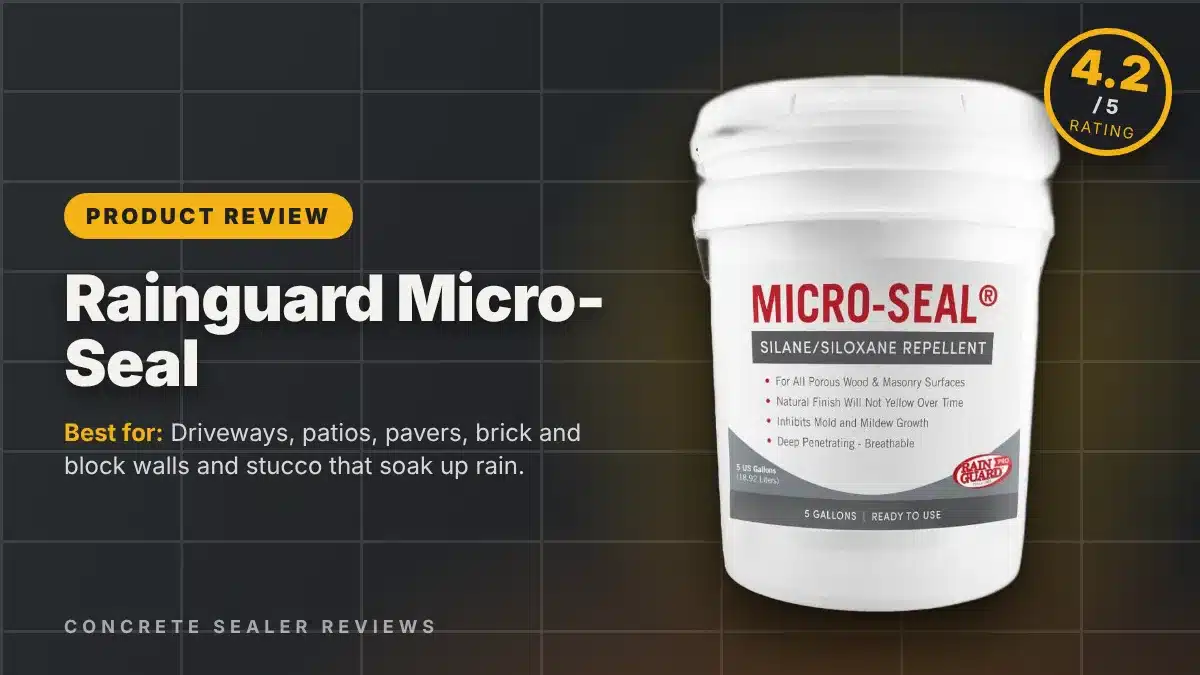
Rainguard Micro-Seal is a water-based silane/siloxane penetrating water repellent for concrete, brick, block, stucco, pavers and wood. It dries invisible, has essentially no VOCs, and can even be applied to fresh concrete as a curing aid. The bottom line: it’s a versatile, well-documented and affordable clear repellent, best for porous surfaces that soak up rain, though its warranty terms are confusing and it won’t stop water under pressure.
| Type | Penetrating water repellent (non-film-forming) |
| Chemistry | Water-based silane/siloxane with MICRO-LOK bonding; VOC under 15 g/L |
| Finish | Clear, no sheen; won’t yellow or cloud |
| Coverage | Ready-to-use: about 300 sq ft/gal on horizontal concrete; 125–150 brick; 100–150 stucco; 40–80 concrete block |
| Coats | 1 or more; very porous surfaces may need 2 |
| Dry/recoat | About 1 hour |
| Cure | Full chemical cure 5–7 days |
| Best for | Driveways, patios, pavers, brick and block walls, stucco, new concrete |
| Not for | Submerged surfaces (bird bath basins), painted stucco, glazed tile, hydrostatic pressure |
| New concrete | Can be applied as a curing compound, typically the day after pouring |
Watch: Rainguard Micro-Seal in 60 seconds
What It Is / How It Works
Micro-Seal is a silane/siloxane water repellent made by Rainguard Brands in the U.S. It goes into the pores of masonry and reacts there, leaving a water-repellent lining instead of a surface film. Rainguard calls its bonding technology MICRO-LOK. The surface stays breathable, so moisture vapor can still escape.
It's still sold, now mostly under the RainguardPro Micro-Seal name, with Home Depot also listing it as "RAIN GUARD Micro-Seal." It comes as a ready-to-use (RTU) liquid, such as the 1-gallon CR-0356, and as a concentrate you mix with water. Rainguard also sells Micro-Seal HD, a stronger version, and Micro-Seal SiH4, a pure silane. Make sure you know which form you have: the RTU must not be diluted, while the concentrate is mixed at ratios that change the expected life.
Rainguard's data sheet includes more test data than most consumer sealers: 98.7% leak reduction in wind-driven rain testing (ASTM E514), 98.6% effectiveness in water absorption tests on block, 96.8% reduction in chloride ion intrusion, no effect after 2,200 freeze/thaw cycles (ASTM C666) and no change after 3,500 hours of weathering. It also meets ASTM C309 for curing compounds.
Where It Works Best (and where it doesn't)
Micro-Seal is a generalist. It's listed for concrete, clay brick, concrete block, stucco, pavers, natural stone, unglazed tile, EIFS and wood, indoors and out, on both horizontal and vertical surfaces. That makes it handy if you want to treat a patio, a brick planter and a block retaining wall with one product. It's also one of the few clear repellents that can go on brand-new concrete as a curing aid.
It won't stop water forced through a basement wall by hydrostatic pressure, and the manufacturer says it isn't suited to stopping moisture rising up through a slab. It's not meant for surfaces that stay submerged, such as bird bath basins. Some versions of the data sheet also note that clear repellents aren't designed to waterproof horizontal masonry details like ledges, sills and parapets, which need flashing or caps. If you want a sheen or color boost, you'll need a film-forming sealer instead. Compare more options in our best silane-siloxane concrete sealers guide.
Pros
- Works on concrete, brick, block, stucco, pavers, stone and wood
- Near-zero VOC, low odor and nonflammable
- Strong published test data for freeze/thaw, salt and wind-driven rain
- Can be used on new concrete as a curing compound
- Invisible finish; multiple coats won't whiten or yellow
- Well rated at Home Depot; owners commonly mention easy application and good water beading
Cons
- Warranty terms vary by document (5, 10 or 20 years), and the longer warranties require a Rainguard site visit and approval
- Doesn't stop hydrostatic pressure or rising slab moisture
- Low coverage on block (as little as 40–55 sq ft per gallon on lightweight block)
- Strict weather window: no rain, snow or sub-40°F temperatures for 48 hours
- Some owners report weak results on dense pavers or needing a second coat
How to Apply It
- Clean the surface. Remove dirt, efflorescence, lime, form oils, release agents, grease and mildew. Let it dry fully; Rainguard's current data sheet sets a 15% maximum moisture content.
- Repair openings. Caulk or patch cracks, voids and gaps around pipes, vents and door frames.
- Check the forecast. Air, surface and product must be above 40°F and at least 5°F above the dew point, with humidity under 90%. Skip it if rain, snow or colder temperatures are expected within 48 hours, or if it's windy.
- Test a small area first, as Rainguard requires.
- Spray it on. Use a pump-up garden sprayer or a low-pressure airless sprayer held 8–12 inches from the surface. A roller also works for flat areas. Don't dilute the ready-to-use version.
- Add another coat if needed once the first is dry to the touch, about an hour. Very porous surfaces may need it.
- Let it cure. Full chemical cure takes 5 to 7 days.
How It Compares
Rust-Oleum OKON S-40 is the closest alternative: a water-based silane/siloxane with about 3/8 inch of penetration and a 5-year warranty option for registered projects. S-40 needs 21 days on new concrete, while Micro-Seal can go on as a curing aid. Micro-Seal also covers wood and stucco.
Valspar Concrete & Masonry Waterproofer is a simple siloxane option at Lowe's. It's convenient, but Valspar publishes far less test data.
For basement walls with seepage, a latex masonry waterproofer such as DRYLOK Original, which is rated for hydrostatic pressure, is the more appropriate tool. Our best waterproofing concrete sealers guide explains the difference.
FAQ
How long does Rainguard Micro-Seal last?
Retail listings claim protection for up to 10 years. Rainguard's data sheets list warranties ranging from 5 to 20 years depending on version and mix ratio, and the longer ones require a site inspection and approved warranty application. Reapply when water stops beading.
Can I use Micro-Seal on new concrete?
Yes. It meets ASTM C309 for curing compounds and is typically applied the day after pouring, once form oils and release agents are dealt with. Home Depot's listing says within 48 hours of pouring.
Is Micro-Seal waterproof?
It's a water repellent. It stops rain and surface water from soaking in, but it doesn't stop water under pressure, and it's not for surfaces that stay underwater.
Will it change the look of my pavers?
No. It dries clear with no sheen and doesn't change color or texture. If you want a darker or glossy look, use a film-forming paver sealer instead.
Verdict
Rainguard Micro-Seal, now sold mainly as RainguardPro Micro-Seal, is a capable, near-zero-VOC water repellent that works on almost any porous surface around the house, and it can even cure new concrete. The published test data is strong and owners rate it well. Read the label carefully to know whether you have the ready-to-use or concentrate version, and don't count on the long warranties unless you go through Rainguard's approval process. Our rating: 4.2/5
How we reviewed this product: this is a research-based review built from the manufacturer's technical data sheet and current retail listings. We have not run our own hands-on tests of this product. Details were checked in October 2026; always follow the current label.