Affiliate disclosure: Some links on this page are affiliate links. As an Amazon Associate we earn from qualifying purchases, at no extra cost to you.
Need to waterproof a damp basement wall? No. 980 is a clear water repellent for above-grade concrete and masonry. For BEHR’s paint-like basement wall coating, see our BEHR DryPlus Masonry Waterproofer (No. 875) review.
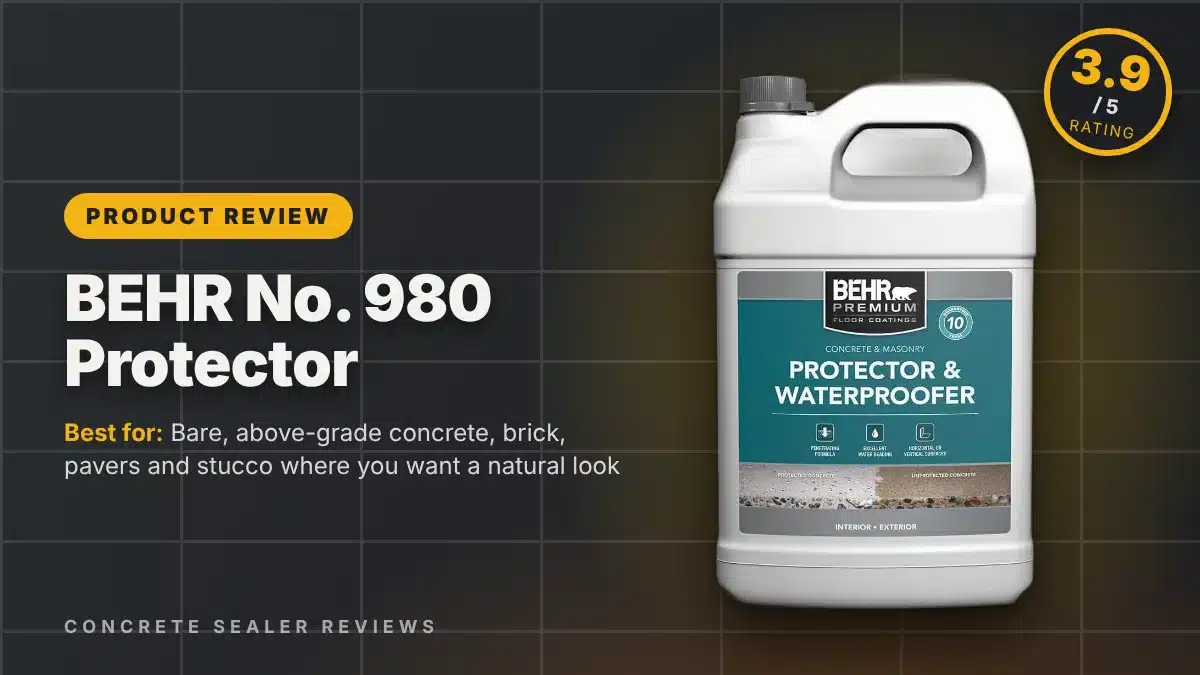
BEHR PREMIUM Concrete & Masonry Protector & Waterproofer (No. 980) is a clear, water-based penetrating water repellent sold at Home Depot for driveways, patios, walkways, brick, pavers and stucco. It is aimed at homeowners who want water to bead off bare concrete without adding a shiny film. The bottom line: it is an easy, low-odor, budget-friendly repellent for above-grade masonry, but it is low in solids, it will not stop water pushing through a basement wall, and it needs a clean, open surface to work.
| Type | Penetrating water repellent (no surface film) |
| Chemistry | Water-based silane/siloxane, about 6% solids (Behr’s consumer page describes it as silicone-based) |
| Finish | Natural, no sheen |
| Coverage | About 250 sq ft per gallon, depending on porosity |
| Coats | Apply until the surface is saturated; do not let it puddle |
| Dry/recoat | Paint or primer can go over vertical surfaces after 2–4 hours; avoid rain for 24 hours |
| Cure | 24–48 hours; wait 30 days before washing |
| VOC | Under 120 g/L |
| Best for | Above-grade driveways, patios, walkways, brick, pavers, stucco, unglazed tile, slate |
| Not for | Basement walls or floors under hydrostatic pressure; sealed, coated or dense floors |
| New concrete | Wait at least 30 days |
Watch: BEHR No. 980 Protector in 60 seconds
What It Is / How It Works
No. 980 is still sold under the same name and number. It is a thin, milky liquid that soaks into porous concrete and masonry and lines the pores with a water-repellent treatment. Behr's technical data sheet lists it as a water-based silane/siloxane that penetrates up to 1/2 inch, while the consumer product page simply says it is "formulated with silicone." Either way, it works the same way: it does not build a coating on top, so the surface keeps its natural look and texture and trapped moisture vapor can still escape.
Behr says the treatment helps reduce spalling, efflorescence, freeze-thaw damage, salt damage and mold or mildew staining by keeping liquid water out of the pores. The data sheet also notes that protection continues even after visible water beading fades, which is typical of penetrating repellents. What it will not do is add color, gloss or stain resistance against oil the way a film-forming sealer can.
The solids content is listed at about 6%. That is low compared with many contractor-grade silane/siloxane products, which is one reason it is inexpensive and easy to apply but also why it should not be expected to perform like a high-solids professional repellent. If you want to see how this category works in more detail, our guide to the best silane/siloxane concrete sealers covers the chemistry and the stronger options.
Where It Works Best (and where it doesn't)
It is a good fit for bare, above-grade, porous surfaces: broom-finished driveways and walkways, patios, exposed aggregate, brick walls, concrete block, pavers, stucco, unglazed tile, slate and unpolished natural stone such as sandstone. It can be used inside or outside and on horizontal or vertical surfaces.
Behr is clear about the limits. It is not recommended for areas under hydrostatic pressure, such as basement walls and floors, and it is not for coated, dense or previously sealed floors. Hard-troweled garage slabs are often too dense for it to soak in, and any old sealer has to be stripped first. Behr also warns not to paint dense horizontal floors after treatment, so do not use it on a slab you plan to coat with epoxy or floor paint later. Rough vertical surfaces can be painted with oil or latex products once dry. For a basement wall that seeps water, a masonry waterproofing paint such as BEHR DryPlus is the more appropriate product.
Pros
- Leaves a natural, no-sheen look; does not change texture
- Breathable, so moisture vapor can still escape
- Water-based, low odor, soap-and-water cleanup, VOC under 120 g/L
- Works on a wide range of masonry: concrete, brick, block, pavers, stucco, stone
- Easy to find at Home Depot in sizes from a sample up to 5 gallons
- Vertical masonry can be painted over after it dries
Cons
- Low solids (about 6%), so it is lighter-duty than professional silane/siloxane repellents
- Not for basement walls or floors with hydrostatic pressure
- Will not soak into dense, troweled or previously sealed concrete
- Over-application or poor prep can leave a milky white haze or tacky surface
- Do not paint dense horizontal floors after treatment
- Prep calls for stripping old sealers and etching, which adds work
How to Apply It
- Make sure new concrete has cured at least 30 days.
- Clean the surface of dirt, oil and grease. Strip any existing coating or sealer. Behr's directions call for etching to a texture similar to 150-grit sandpaper.
- Do a water test: sprinkle water on the surface. It should soak in quickly. If it beads, the surface is still sealed or too dense.
- Let the surface dry completely. Apply between 50°F and 90°F, out of direct sun, not on surfaces that are hot to the touch, and with no rain or heavy dew expected for 24 hours.
- Stir or shake; do not thin. Apply with a pump sprayer, a 1/4–3/8 inch nap roller, a synthetic brush or a pad. On walls, work from the bottom up.
- Apply until the surface is saturated, then spread or remove any puddles. Pooled product is what causes white haze and tackiness.
- Allow 24–48 hours to cure. Wait 30 days before washing or cleaning the surface.
How It Compares
BEHR DryPlus Masonry Waterproofer (No. 875): a different product entirely. DryPlus is a thick, paint-like coating for basement and retaining walls rated to resist 12 psi of hydrostatic pressure. Use No. 980 for exterior flatwork and walls where you want an invisible treatment; use DryPlus for a basement wall that you are willing to coat and color.
Higher-solids silane/siloxane repellents: contractor products in this category usually carry much more active material than No. 980's roughly 6% solids. They cost more per gallon but are better suited to driveways that see road salt and hard freeze-thaw cycles.
BEHR PREMIUM Wet-Look or Low-Lustre sealers: these are film-forming acrylics that add color depth and some gloss. They resist surface stains better but wear, need recoating and can be slippery. If you want a "wet" look, they are the better fit; if you want the concrete to look untouched, No. 980 is.
FAQ
Is BEHR Protector and Waterproofer silicone or siloxane?
Behr's consumer page says it is formulated with silicone, and its technical data sheet lists it as a water-based silane/siloxane. Silane and siloxane are silicon-based water repellents, so both descriptions point to the same type of penetrating treatment.
Can I use it on a basement wall?
Not if water is pushing through the wall. Behr says it is not recommended for areas under hydrostatic pressure, such as basement walls or floors. Fix drainage and leaks, then consider a waterproofing coating made for basements.
Can I paint or seal over it later?
On rough vertical masonry, yes. Behr says oil or latex paint or primer can be applied after it dries. On dense horizontal floors, Behr says not to paint after treatment, so do not use it on a slab you plan to coat.
Why did my concrete turn white after applying it?
Behr lists over-application, poor surface prep and insufficient drying as causes of a milky white appearance or tackiness. Apply until saturated, but never leave puddles, and make sure the surface is fully dry first.
Verdict
BEHR No. 980 is a sensible, easy-to-find choice for keeping water out of bare, above-grade concrete and masonry without changing how it looks. It is not a heavy-duty repellent, it cannot fix a wet basement, and it needs a clean, absorbent surface. For a patio, walkway or brick wall on a budget, it does the job. For a salted driveway in a cold climate, a higher-solids product from our best waterproofing concrete sealer list is worth the extra cost. Check the current price and label on Behr's product page. Our rating: 3.9/5
How we reviewed this product: this is a research-based review built from the manufacturer's technical data sheet and current retail listings. We have not run our own hands-on tests of this product. Details were checked in October 2026; always follow the current label.