Affiliate disclosure: Some links on this page are affiliate links. As an Amazon Associate we earn from qualifying purchases, at no extra cost to you.
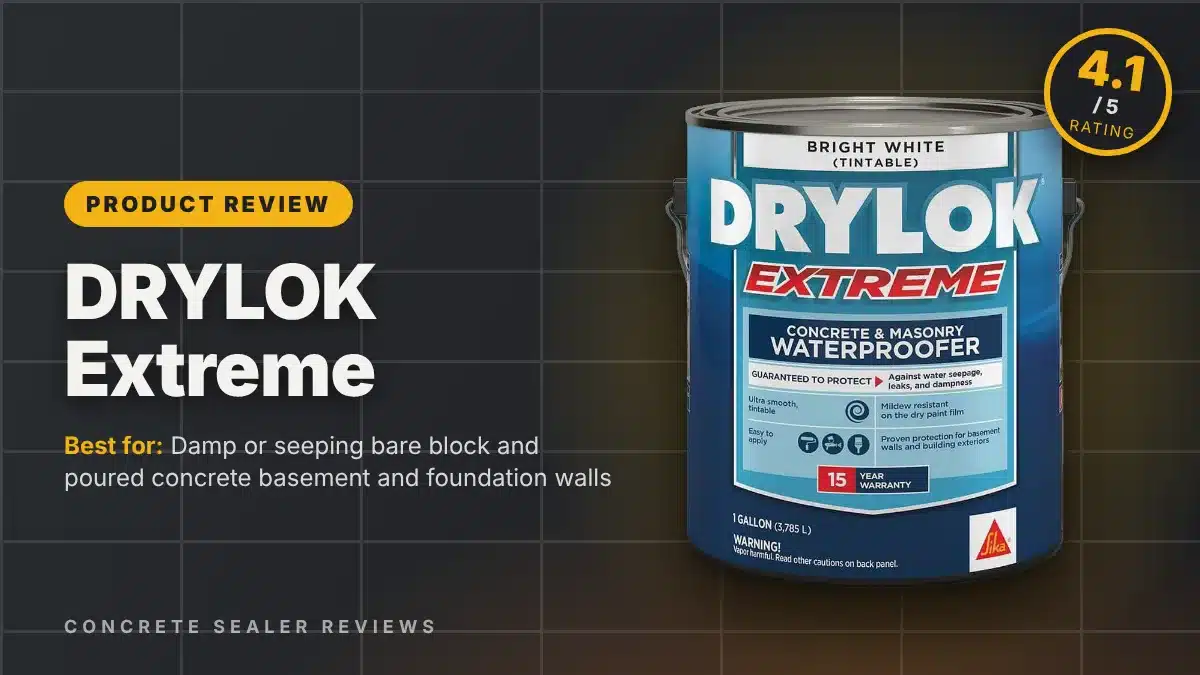
DRYLOK Extreme Masonry Waterproofer is a thick, latex-based coating for concrete block, poured concrete, brick and stucco walls, inside or out, above or below grade. It’s aimed at homeowners dealing with damp or seeping basement and foundation walls. The bottom line: it’s one of the stronger DIY wall waterproofers you can buy, rated to hold back 15 psi of water pressure with a 15-year warranty. It only performs on properly prepared bare masonry, though, and it won’t fix drainage or structural problems.
| Type | Film-forming masonry waterproofing coating (paint-like) |
| Chemistry | Latex base with flexible encapsulated polymers; contains a mildewcide |
| Finish | Flat, bright white; tintable to light colors |
| Coverage | About 75 sq ft/gal first coat; 75–100 sq ft/gal second coat |
| Coats | Minimum 2 (required for the warranty) |
| Dry/recoat | Tack-free about 45 min; dry 2–3 hours; recoat about 2 hours |
| Cure | Latex topcoat after about 24 hours; backfill 24 hours after second coat |
| Rating | 15 psi hydrostatic pressure (ASTM D7088); Category 4 wind-driven rain |
| Best for | Bare block and poured concrete basement and foundation walls, retaining walls |
| Not for | Floors or other walked-on surfaces, painted walls, fishponds and bird baths |
| New concrete | Wait 28–30 days, or until pH is below 10 |
Watch: DRYLOK Extreme in 60 seconds
What It Is / How It Works
Unlike a clear penetrating sealer, DRYLOK Extreme is a heavy-bodied coating. You work it into the pores and pinholes of the masonry, and it builds a continuous, flexible film that physically blocks water. The current product data sheet (now published by Sika, which owns the DRYLOK brand) rates it to resist 15 psi of hydrostatic pressure under ASTM D7088, which DRYLOK equates to a 33-foot wall of water, plus Category 4 wind-driven rain resistance (140 mph) under ASTM D6904.
DRYLOK describes it as semi-impermeable, under 1 perm, so it slows water vapor as well as liquid water. It also says it reduces radon gas penetration, and it contains a biocide to resist mildew on the dry film. It goes on bright white and can be tinted to light shades. Cleanup is soap and water. The product is still widely sold at Home Depot, Lowe's, Ace and hardware stores, in quarts, gallons and 5-gallon pails.
Where It Works Best (and where it doesn't)
It's at its best on bare, sound concrete block or poured concrete walls that show dampness, light seepage or musty odors, especially in basements. It also works on exterior foundation walls before backfilling, on retaining walls, and on brick and stucco. For many homeowners it's the practical first step before calling a waterproofing contractor.
The limits are just as important. DRYLOK says it's not formulated for floors or other horizontal surfaces with foot traffic; it points to its Floor & Wall product instead. It cannot go over existing paint (latex or oil), and coating over existing coatings voids the warranty. Recurring efflorescence and cracked structural surfaces are also excluded from coverage. A Washtenaw County conservation district guide on basement walls makes the broader point: waterproofing paints aren't always strong enough for the hydrostatic pressure that builds in saturated soil, and when one starts peeling, the cause is usually moisture coming through the wall. Fix gutters, grading and cracks first. If you need an invisible treatment for a slab or exterior flatwork instead, see our best waterproofing concrete sealers guide.
Pros
- Rated to 15 psi of hydrostatic pressure, high for a DIY product
- 15-year, transferable warranty when applied as directed to prepared bare masonry
- Works interior or exterior, above or below grade
- Fast recoat (about 2 hours) lets you finish two coats in a day
- Mildew-resistant film; also marketed to reduce radon penetration
- Soap-and-water cleanup, and easy to find in stores
Cons
- Low coverage (75–100 sq ft/gal), so you need a lot of product
- Can't go over paint; old coatings must come off first
- Not for floors or any walked-on surface
- Heavy prep: efflorescence removal, etching smooth walls, plugging cracks
- Can peel if moisture keeps pushing through from behind
- Changes the wall's appearance (it's a white coating, not a clear sealer)
How to Apply It
- Strip and clean. The surface should be clean and free of grease, oil, form-release compound and paint. Wire-brush off dust, dirt and loose mortar. Scraping old paint can release lead dust, so protect yourself.
- Remove efflorescence. Treat white salt deposits with DRYLOK Etch or muriatic acid, then rinse and let dry.
- Profile smooth surfaces. Acid-etch smooth concrete to roughly the feel of medium-grit sandpaper. Water should soak in, not bead.
- Patch. Fill cracks and holes with a hydraulic cement such as DRYLOK Fast Plug, and seal the floor-to-wall joint.
- Check conditions. Air and surface should be 50°F or warmer. A slightly damp surface is acceptable. New concrete needs 28–30 days to cure first.
- First coat. Stir well and don't thin. Use a 3/4-inch nap roller, DRYLOK brush or nylon brush, working it into pores and pinholes. If rolling, back-brush.
- Second coat. After 2–3 hours, apply the second coat by brush, roller or sprayer. Inspect for pinholes and touch them up.
- Cure. Wait about 24 hours before a latex topcoat, or 24 hours after the second coat before backfilling a foundation.
How It Compares
Versus DRYLOK Original: DRYLOK's own literature points to the Original formula for fishponds and bird baths, where Extreme's mildewcide could harm aquatic life. For a typical basement wall, Extreme is the version DRYLOK markets with the 15 psi rating and 15-year warranty.
Versus penetrating sealers (silane/siloxane or silicate): clear penetrating products don't change the look, can't peel and let walls breathe, but they typically aren't sold with a hydrostatic pressure rating like this one. They're often the better choice for slabs, floors and exterior flatwork, while DRYLOK Extreme is the better choice for a seeping block wall.
Versus exterior membranes and drainage: excavating and installing an exterior membrane, or an interior drain tile system, addresses water at the source. They cost far more, but they're the real fix when water pressure is heavy or ongoing.
FAQ
Does DRYLOK Extreme really stop basement leaks?
It's rated to stop water up to 15 psi on properly prepared bare masonry with two coats. It won't stop water through structural cracks, failing joints or walls under heavy, persistent pressure, so deal with grading, gutters and cracks first.
Can I put DRYLOK Extreme over painted walls?
No. DRYLOK says it can't be used over latex or oil paint, and applying over existing coatings voids the warranty. Remove the old paint down to bare masonry first.
Can I use it on a basement floor?
No. It isn't formulated for horizontal surfaces with foot traffic. DRYLOK recommends its Floor & Wall Masonry Waterproofer for floors. For a garage or basement floor coating, see our best epoxy floor coatings.
How long does DRYLOK Extreme last?
The warranty runs 15 years, but real-world life depends on prep and on how much moisture is behind the wall. Peeling is usually a sign that water is pushing through from outside.
Verdict
DRYLOK Extreme is a strong, well-documented choice for damp or lightly seeping bare masonry walls, with a real pressure rating and a long warranty that most DIY wall products can't match. It asks a lot in return: careful prep, bare masonry, two heavy coats and plenty of product. Treat it as one part of a moisture plan, not a cure for drainage or structural problems. Full details are on DRYLOK's product page. Our rating: 4.1/5
How we reviewed this product: this is a research-based review built from the manufacturer's technical data sheet and current retail listings. We have not run our own hands-on tests of this product. Details were checked in October 2026; always follow the current label.