Affiliate disclosure: Some links on this page are affiliate links. As an Amazon Associate we earn from qualifying purchases, at no extra cost to you.
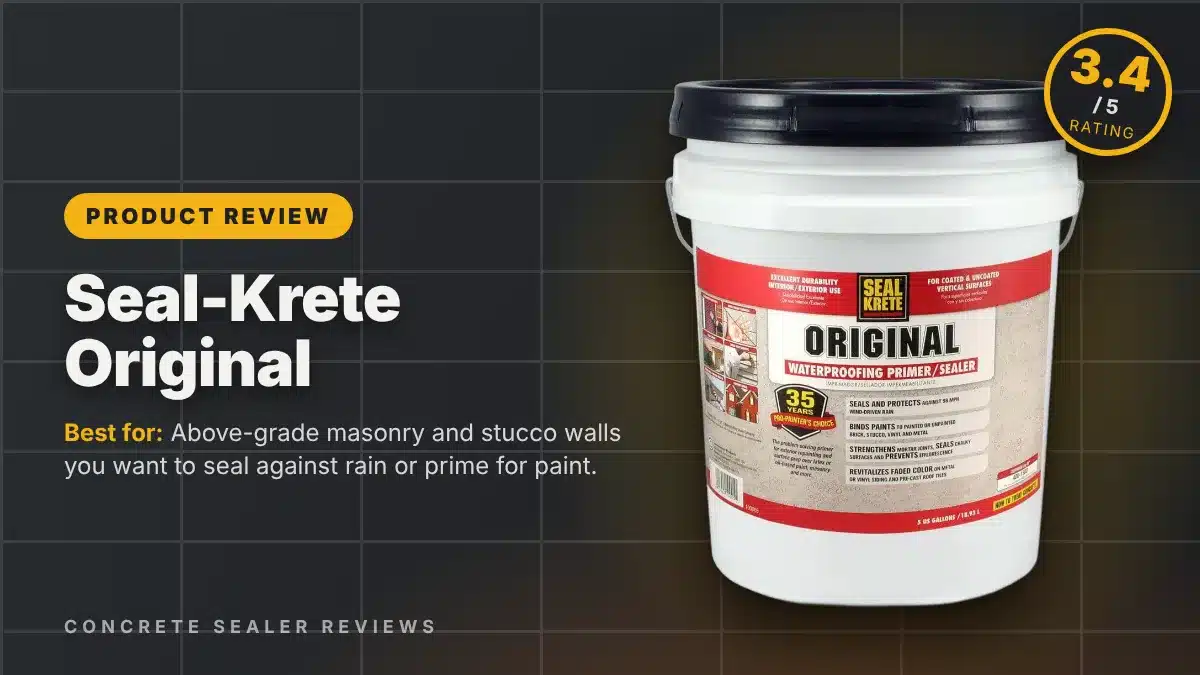
Seal-Krete Original is a water-based acrylic waterproofing primer/sealer for above-grade concrete, block, brick and stucco walls. It is inexpensive, low odor and easy to brush, roll or spray, and it doubles as a primer under paint. Bottom line: a useful wall sealer and primer, but despite the “waterproofing” name it is not a basement-wall or below-grade fix, and it is not designed as a stand-alone driveway or floor sealer.
| Type | Waterproofing primer/sealer (thin film-forming) |
| Chemistry | Water-based proprietary acrylic resin, 10% solids; low VOC (under 50 g/L) |
| Finish | Goes on milky white, dries clear with a satin look |
| Coverage | 80–300 sq ft/gal depending on porosity (about 175 on concrete slab/tilt-up, 125 on brick, 80 on concrete block); second coat needs about 50% more |
| Coats | Minimum two; two are required to waterproof bare vertical concrete |
| Dry/recoat | Dry in 2–4 hours; recoat after 2 hours |
| Cure | Not stated; no rain for 12 hours, temps must stay above 50°F for 24 hours |
| Best for | Above-grade vertical masonry and stucco; priming before latex, oil or elastomeric paint |
| Not for | Below-grade walls, hydrostatic pressure, pools and water features, very porous block, cedar or redwood |
| New concrete | No cure wait stated on the data sheet; it is marketed for buffering pH on “hot” cement before painting |
Watch: Seal-Krete Original in 60 seconds
What It Is / How It Works
Seal-Krete is a Rust-Oleum brand, and this product is the line's long-running "Original." It is still sold in 2026, labeled as Seal-Krete Original Waterproofing Primer/Sealer (Home Depot lists the 1-gallon as "Clear Original Waterproofing Concrete Sealer," model 100001). If you read our older review under the simpler name "Seal Krete Waterproofing Sealer," this is the same product.
It is a low-solids acrylic: about 10% solids by the data sheet. The liquid soaks into the surface pores and dries into a thin, clear acrylic film that sheds rain and binds dusty or chalky surfaces. Because it is so thin, it works more like a sealing primer than a heavy coating. That is why Rust-Oleum lists so many side uses: rejuvenating old brick and plaster, binding chalky surfaces, priming vinyl siding, dustproofing and priming floors, and even adding 4–8 oz per gallon to latex paint to improve spread. Once dry, it can be topcoated with latex, oil-based or elastomeric coatings.
It is not a penetrating silane/siloxane water repellent. Those react inside the pores and leave the surface looking untreated and fully breathable. Seal-Krete Original leaves a film you can see as a slight satin sheen, which also means it can wear, and it can eventually need recoating.
Where It Works Best (and where it doesn't)
Rust-Oleum is clear on scope: the product is for above-grade vertical surfaces, or as a primer on horizontal surfaces. Good jobs include exterior concrete or stucco walls, brick, tilt-up panels, garden walls and chimneys where you want to cut down on water soak-in, and any masonry you plan to paint and want primed first.
Where it falls short is where many homeowners first reach for it. The label says not for below-grade use and not where hydrostatic pressure is likely, so it is not the answer for a basement wall that weeps or a foundation that takes on groundwater. It is also not for pools, bird baths or water features. On very porous surfaces such as low-density decorative block, Rust-Oleum points you to Seal-Krete Heavy-Duty Waterproofer (25% solids) instead. And while you can use it to dustproof or prime a floor, it is not built as a driveway or garage-floor sealer; Seal-Krete sells separate products for that job.
Pros
- Inexpensive and easy to find at Home Depot, Lowe's and hardware stores
- Water-based, low odor, low VOC, soap-and-water cleanup
- Doubles as a primer under latex, oil-based and elastomeric paint
- Fast: recoat in 2 hours, dry in 2–4 hours
- Binds chalky or dusty masonry before painting
- Brush, roll or spray, no dilution needed
Cons
- Not for below-grade walls or anywhere with hydrostatic pressure
- Low solids (10%), so it needs at least two coats and protection is modest
- Film-forming: adds a satin look and is less breathable than a silane/siloxane
- Not designed as a stand-alone floor, driveway or garage sealer
- Coverage drops sharply on block (about 80 sq ft/gal)
- Weather-sensitive: needs 12 rain-free hours and temps above 50°F for 24 hours
How to Apply It
- Confirm it's the right job. Above-grade wall, no active leaks, no groundwater pressure. If water is coming through a basement wall from outside, fix drainage and use a below-grade-rated product instead.
- Prep the surface. Clean off dirt, loose paint, efflorescence and excess chalk, repair cracks, and let the surface dry.
- Check the forecast. Don't apply if rain is expected within 12 hours or if temperatures will drop below 50°F within 24 hours.
- Apply straight from the can. Do not dilute. Brush, roll or spray; if you spray, back-roll so it works into the pores. Wipe overspray off glass and trim right away with water.
- Second coat. Wait at least 2 hours and apply a second coat. Plan on about 50% more material for that coat. Two coats are required to waterproof bare vertical concrete.
- Paint if desired. Once dry (typically 2–4 hours), you can topcoat with latex, oil-based or elastomeric paint.
How It Compares
Seal-Krete Heavy-Duty Concrete & Masonry Waterproofer is the same brand's thicker (25% solids) acrylic for porous block, split-face block and stucco. Choose it over the Original when the surface drinks product fast. It is also limited to above-grade vertical surfaces.
Penetrating silane/siloxane water repellents leave no film and no sheen, stay fully breathable and are the usual choice when you want masonry to look untouched while shedding water. They don't prime for paint the way Seal-Krete does. See our best silane/siloxane sealers for options.
Masonry waterproofing paints such as DRYLOK or Seal-Krete's own DampLock are thick, pigmented coatings aimed at interior basement walls with dampness. They hide the masonry but resist more moisture than a clear acrylic primer. Our best waterproofing concrete sealers guide covers the category.
FAQ
Is Seal-Krete Original really waterproof?
It makes above-grade masonry shed rain and absorb far less water when two coats are applied, but it is not rated for below-grade walls or hydrostatic pressure. It won't stop water being pushed through a foundation wall from the soil side.
Can I use Seal-Krete Original on basement walls?
Not as a waterproofer. The data sheet excludes below-grade use and areas where hydrostatic pressure is likely. For damp interior basement walls, look at a masonry waterproofing paint and, more importantly, fix the outside drainage.
Can you paint over Seal-Krete Original?
Yes. It is designed as a primer, and Rust-Oleum says it can be topcoated with latex, oil-based or elastomeric coatings once it is dry.
Can I use it on my driveway or garage floor?
Only as a dustproofer or primer on horizontal surfaces. It isn't built to be the wear surface on a driveway. For that job, see our best driveway sealers.
Verdict
Seal-Krete Original is a cheap, easy, low-odor acrylic that does two jobs well: sealing above-grade masonry against rain and priming it for paint. Its name oversells it, though. It is not a basement or below-grade waterproofer, its low solids mean modest protection, and it is not meant to be a driveway or floor sealer. Use it on the right wall and it is good value; use it to fix a leaking foundation and you'll be disappointed.
Our rating: 3.4/5
How we reviewed this product: this is a research-based review built from the manufacturer's technical data sheet and current retail listings. We have not run our own hands-on tests of this product. Details were checked in October 2026; always follow the current label.