
Affiliate disclosure: Some links on this page are affiliate links. As an Amazon Associate we earn from qualifying purchases, at no extra cost to you.
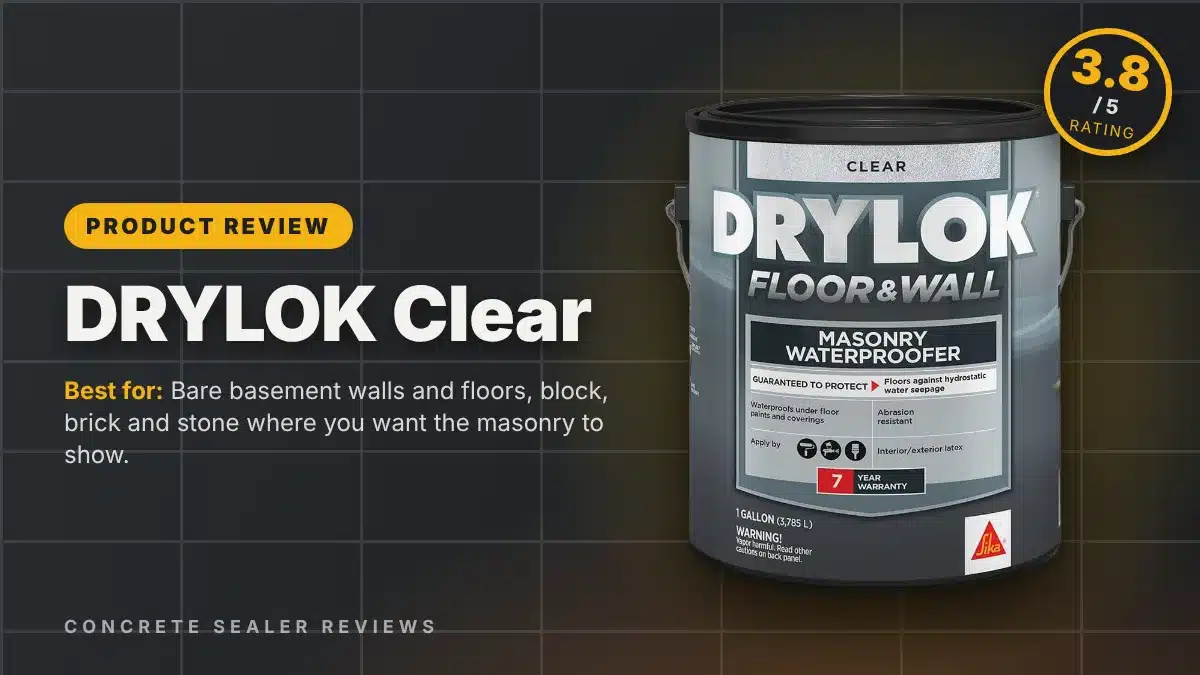
DRYLOK Clear is a clear latex waterproofer for bare concrete and masonry floors and walls. The original name was DRYLOK Clear Masonry Waterproofer, and it’s now sold as DRYLOK Floor & Wall Masonry Waterproofer, still in the 1-gallon (20913) and 5-gallon (20915) sizes. If you want to waterproof a basement wall or floor without hiding the masonry, it’s a solid choice. Keep in mind that it builds a high-gloss film, so it isn’t an invisible penetrating sealer, and it isn’t made for driveways or garage floors that see car traffic.
| Type | Clear film-forming masonry waterproofer |
| Chemistry | Water-based latex, about 30% solids, VOC 100 g/L (retail listing) |
| Finish | Clear, high gloss, non-yellowing |
| Coverage | About 90 sq ft/gal first coat, about 114 sq ft/gal second coat |
| Coats | Two coats required |
| Dry/recoat | Touch dry 2 hours; recoat walls after 2 hours |
| Cure | Light foot traffic 4 hours; heavy foot traffic and floor coverings 24 hours |
| Best for | Basement walls and floors, block, brick, stone, stucco, precast pieces |
| Not for | Vehicle traffic, previously painted or sealed surfaces, a “no-change” look |
| New concrete | Concrete must be dry. Use the plastic-sheet test on the label and let new concrete cure fully first. |
Watch: DRYLOK Clear in 60 seconds
What It Is / How It Works
DRYLOK Floor & Wall is made by United Gilsonite Laboratories (UGL), which is now a Sika company. It's a clear, non-pigmented version of the latex waterproofing chemistry DRYLOK is known for. You roll or brush on two coats, and they dry into a continuous clear film on the surface. That film is what keeps water out, so it works differently from a silane or siloxane repellent, which soaks in and leaves almost nothing on top.
The data sheet says that at the recommended film thickness, the coating resists 4 psi of hydrostatic pressure (ASTM D7088), roughly a 9-foot wall of water. It also resists 98 mph wind-driven rain (ASTM D6904). That 4 psi rating is well below the 10 psi DRYLOK claims for its pigmented Original waterproofer, so the clear version is the lighter-duty option. You choose it because you want the masonry to show through. The film also contains a biocide that resists mold and mildew on the dried coating.
Where It Works Best (and where it doesn't)
It works best on bare interior basement walls and floors where you want to keep the concrete or block look, stop dampness from wicking through and get a surface that's easy to wipe clean. It also suits exterior split-face block, brick, stone and stucco walls that take driving rain, plus decorative precast pieces.
Skip it for driveways and garage floors. DRYLOK says it's not recommended for vehicle traffic, and the glossy film can be slippery when wet. The label offers an optional non-skid additive at 2–4 oz per gallon for that. It's also a poor fit if you want the concrete to look untouched, because it leaves a visible gloss. Active leaks, open cracks and walls with recurring efflorescence need repairs first, and the warranty excludes failures caused by cracked substrates or recurring efflorescence. If you want a penetrating product for outdoor flatwork instead, see our best penetrating concrete sealers.
Pros
- Clear waterproofing film that shows off natural block, brick and stone
- Hydrostatic pressure rating of 4 psi (ASTM D7088) and wind-driven rain rating of 98 mph (ASTM D6904)
- Fast turnaround: recoat in 2 hours, light foot traffic in 4 hours
- Water-based, cleans up with soap and water
- Can serve as a moisture barrier under water-based flooring adhesives or as a base for latex paint
- Transferable 7-year waterproofing warranty when applied per directions
Cons
- Low coverage (about 90–114 sq ft per gallon per coat), so large areas take a lot of product
- High-gloss film changes the look of the surface and can be slippery when wet
- Not for vehicle traffic
- Smooth or troweled floors must be acid-etched or abraded first (ICRI CSP 3–4)
- Lower hydrostatic rating than pigmented DRYLOK waterproofers
- Screws, nails or anchors driven through the coating void the waterproofing
How to Apply It
- Clean. Remove dirt, dust, grease, oil, form release and any paint. If you're removing old paint, follow lead-safety practices.
- Repair. Patch holes and cracks, especially the floor/wall joint. DRYLOK suggests its Fast Plug hydraulic cement.
- Remove efflorescence and open the surface. Use DRYLOK Etch or muriatic acid, then rinse and let it dry. Etch or grind smooth, troweled concrete to roughly medium-grit sandpaper texture. If a drop of water doesn't soak in, etch again.
- Check dryness. Tape a 1 ft x 1 ft piece of plastic to the surface for 24 hours. If moisture shows up under it, keep drying.
- Watch the weather. Air and surface temperatures should be at least 50°F, with no rain coming. Cool, damp or humid conditions slow drying.
- Apply two coats. Stir well and don't thin. Use a brush, roller or sprayer, and don't over-apply. On floors, apply the second coat at a right angle to the first. You can recoat after 2 hours.
- Let it cure. Allow light foot traffic after 4 hours and heavy foot traffic or floor coverings after 24 hours. If a wall still leaks, look for pinholes and add a coat there.
How It Compares
DRYLOK Original Masonry Waterproofer is the pigmented, flat-sheen latex. DRYLOK rates it for 10 psi of hydrostatic pressure, and it comes with a 10-year warranty, but it's white or gray, so it hides the masonry. It's also not made for floors that get foot traffic. Pick Original for leaky walls where looks don't matter and Floor & Wall when you want a clear finish.
Silane/siloxane water repellents soak into the concrete and leave little or no visible film, so they're the better pick for driveways, patios and other exterior flatwork that takes car traffic and freeze-thaw cycles. They aren't built to resist the kind of hydrostatic pressure DRYLOK's film is tested for. Our silane-siloxane sealer guide covers the main options.
Epoxy floor coatings make more sense if you want a durable, cleanable basement or garage floor that can take heavier wear. See our epoxy floor coating picks.
FAQ
Is DRYLOK Clear the same as DRYLOK Floor & Wall?
Yes. DRYLOK's current data sheet lists Floor & Wall Masonry Waterproofer as "formerly Clear Masonry Waterproofer," and retailers still sell it under the 20913 (1 gallon) and 20915 (5 gallon) item numbers.
Is DRYLOK Clear waterproof?
Yes, as long as you reach the recommended film thickness. Two coats, about 16 wet mils in total, are rated to resist 4 psi of hydrostatic pressure. If the coats are thin, or if the substrate is cracked or holding efflorescence, you won't get that rating.
Can you use DRYLOK Clear on a garage floor or driveway?
DRYLOK doesn't recommend it for vehicle traffic. For a garage, a coating made for tires holds up better. For a driveway, a penetrating repellent is the better choice.
Can you put DRYLOK Clear over paint or an old sealer?
No. It's made for bare masonry, and the prep instructions say to remove paint first. Remove the old coating or choose a different product.
Verdict
DRYLOK Floor & Wall, formerly DRYLOK Clear, is a good clear waterproofer for basement walls, floors and exterior masonry, as long as a glossy film is fine with you. It recoats quickly and has real ASTM ratings behind it. The drawbacks are low coverage, a finish that can get slippery, no vehicle traffic and the need for careful etching and dryness checks. You can see the current specs on the DRYLOK product page. Our rating: 3.8/5
How we reviewed this product: this is a research-based review built from the manufacturer's technical data sheet and current retail listings. We have not run our own hands-on tests of this product. Details were checked in October 2026; always follow the current label.
Where to Buy


Related Guides
Affiliate disclosure: Some links on this page are affiliate links. As an Amazon Associate we earn from qualifying purchases, at no extra cost to you.
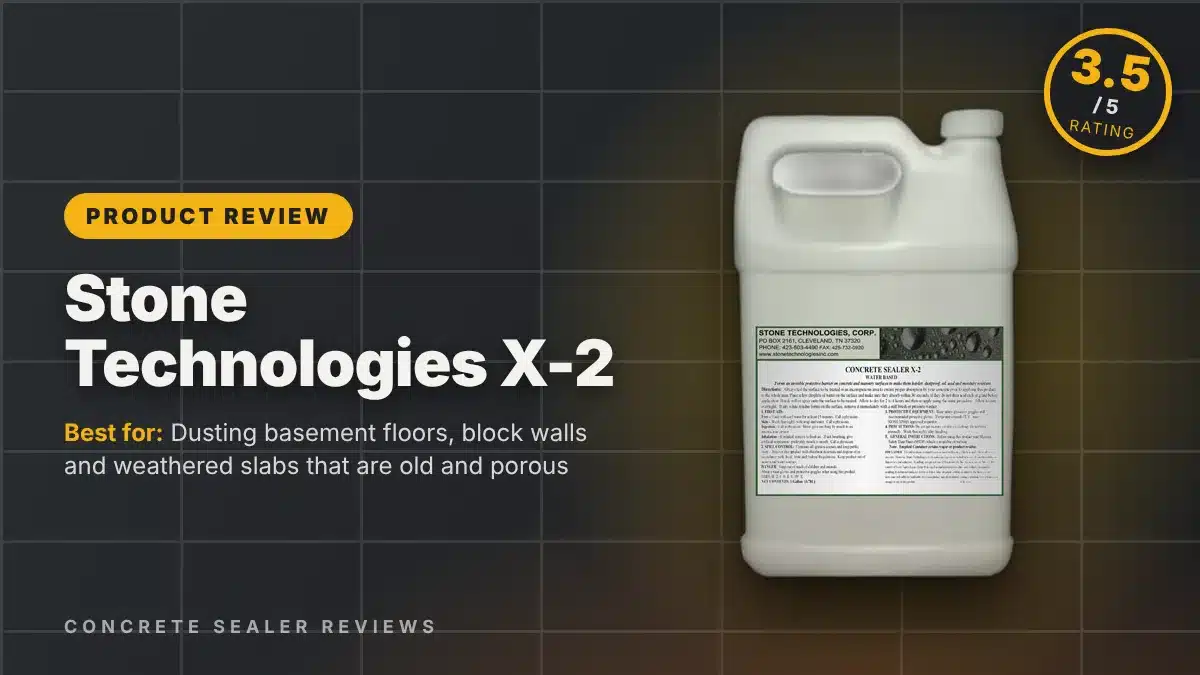
Stone Technologies Concrete Sealer X-2 is a water-based silicate densifier and hardener, the more concentrated version of the company’s X-1. It’s meant for old, porous, dusty concrete and block. It reacts inside the concrete to tighten and harden the surface, and it doesn’t leave a coating on top. It’s a reasonable pick for dusting basement floors and weathered slabs. Don’t expect water beading or stain repellency from X-2 alone. Some of the bigger marketing claims also lack published test data.
| Type | Penetrating densifier/hardener |
| Chemistry | Water-based silicate (sodium silicate); solvent-free, no VOCs claimed |
| Finish | Natural, no sheen; may darken the surface slightly |
| Coverage | About 200–400 sq ft/gal per coat, depending on porosity |
| Coats | Two, 2–4 hours apart |
| Dry/recoat | Recoat in 2–4 hours; keep dry and rain-free for 24–48 hours |
| Cure | Reaction continues for up to 28 days; foot traffic allowed during that time |
| Best for | Old, porous or dusting concrete; block; basement floors and walls; efflorescence-prone slabs |
| Not for | Decorative, colored, stamped or exposed-aggregate concrete (unless the maker approves) |
| New concrete | Apply only to fully cured concrete, normally 28 days |
Watch: Stone Technologies X-2 in 60 seconds
What It Is / How It Works
Stone Technologies Corp. still sells X-2 under the same name on its own site, in sizes from 1 quart to 55-gallon drums. Some marketplace listings call it "Silicate Based Hardener Densifier Concrete Sealer X-2." Like other silicate densifiers, it soaks into the concrete and reacts with the calcium hydroxide (free lime) left over from cement hydration. That reaction forms extra calcium silicate hydrate in the pores. The result is a surface that's harder, less porous and less likely to dust, and that resists abrasion and some chemicals better.
Because X-2 doesn't form a film, the surface stays breathable, isn't slippery and can still take paint. The maker says it can also bond to adhesives and epoxy coatings after a mild etch. The flip side is that a densifier isn't a water repellent. One long-term buyer review noted that water doesn't bead on the treated surface. Stone Technologies also sells X-3, a separate silane/siloxane repellent that's marketed for use alone or over X-1 or X-2 for added water and stain repellency.
The maker also claims X-2 reduces radon, stops efflorescence, increases strength (one listing says "up to 30%") and is guaranteed for the life of the concrete. We didn't find published test data or guarantee terms for these claims, so treat them as marketing until the company provides the details.
Where It Works Best (and where it doesn't)
It works best on concrete more than about ten years old that's porous, dusting, spalling at the surface or showing seepage and efflorescence. Typical spots are basement floors, block foundation walls, worn garage floors and weathered outdoor slabs. It can also be used as a prep step under paint or coatings, after the light etch the maker recommends.
It's not the right choice for decorative work. Stone Technologies doesn't recommend it for colored, stamped or exposed-aggregate concrete without checking with them first. It also won't give a wet look, and it won't keep oil or water from soaking into a driveway the way a repellent would. Dense, smooth or previously sealed concrete that won't absorb a drop of water in 20–30 seconds has to be etched before X-2 can get in. For repellency on exterior slabs, see our silane-siloxane sealer picks.
Pros
- Densifies and hardens porous, dusting concrete without a surface film
- Invisible, non-slip, breathable finish
- Water-based and solvent-free, with low odor
- Paintable, and can be used under epoxy after a light etch
- Wide range of sizes, from quarts to drums
Cons
- Not a water or stain repellent by itself; you need a second product such as X-3 for that
- No published test data for the radon, strength or efflorescence claims
- Terms of the lifetime guarantee aren't spelled out
- Not recommended for decorative, colored, stamped or aggregate concrete
- Narrow weather window (40–80°F, no rain for 48 hours)
- Sold mainly direct and online, with few retail reviews
How to Apply It
- Confirm the concrete is cured. Wait the normal 28 days after pouring.
- Clean. The surface must be free of standing water, oil and dust.
- Do a water test. Water drops should soak in within 20–30 seconds. If they bead, etch the surface first. The maker suggests its Eco Concrete Etcher.
- Pick your weather. Apply between 40°F and 80°F, with no rain forecast for at least 48 hours. Avoid direct hot sun if you can. One long-term buyer reported that the sealer flashed off quickly in sun and had to be reapplied.
- First coat. Use a 3/8" nap roller or a low-pressure pump sprayer. Wet the surface until it looks evenly wet, without puddles. Wipe up any excess with a clean, dry towel.
- Second coat. After 2–4 hours, repeat the same way.
- Let it cure. Keep the surface dry for 24–48 hours. The reaction keeps going for up to 28 days, and the maker says foot traffic won't harm it during that time.
How It Compares
Stone Technologies X-1 works the same way and uses the same application steps, coverage and reactions as X-2. X-2 is the more concentrated version, so it's the one to choose for very porous or deteriorated concrete.
Lithium silicate densifiers are the other common densifier chemistry, often chosen for interior floors and polished concrete. Like X-2, they harden the surface but don't add much water repellency.
Silane/siloxane repellents, such as Eagle Natural Seal or Sikagard-400 Enviroseal, work the other way around. They make water bead and slow chloride intrusion, but they don't harden a dusting surface. On exterior flatwork that sees deicing salt, a repellent, or a densifier followed by a repellent, is usually a better plan than a densifier alone. Our best penetrating concrete sealers covers both types.
FAQ
Is Concrete Sealer X-2 waterproof?
Not on its own. The maker says it reduces porosity and water permeability, but it isn't a repellent coating, so water won't bead. For water repellency, top it with a silane/siloxane product.
Does X-2 stop radon?
Stone Technologies says it helps reduce radon, but we found no published test data. Sealing slabs can be one part of radon reduction, but test your home and follow EPA guidance, which typically centers on active mitigation systems.
Can you paint or epoxy over X-2?
The maker says yes. It's paintable, and it accepts adhesives and epoxy coatings after a mild etch. Confirm with your coating manufacturer before you start.
How long does X-2 last?
Silicate densifiers react inside the concrete and don't wear off the way a film does, and the maker guarantees X-2 for the life of the concrete. Any repellent top coat you add will need periodic reapplication.
Verdict
Concrete Sealer X-2 is a straightforward, solvent-free silicate densifier. It makes sense for hardening old, porous or dusting concrete and block, and it can serve as a base for paint or coatings. Don't count on it for water or stain repellency by itself. Its radon and strength claims would be more convincing with published data. Details are on the Stone Technologies X-2 page. Our rating: 3.5/5
How we reviewed this product: this is a research-based review built from the manufacturer's technical data sheet and current retail listings. We have not run our own hands-on tests of this product. Details were checked in October 2026; always follow the current label.
Where to Buy

Related Guides
Affiliate disclosure: Some links on this page are affiliate links. As an Amazon Associate we earn from qualifying purchases, at no extra cost to you.
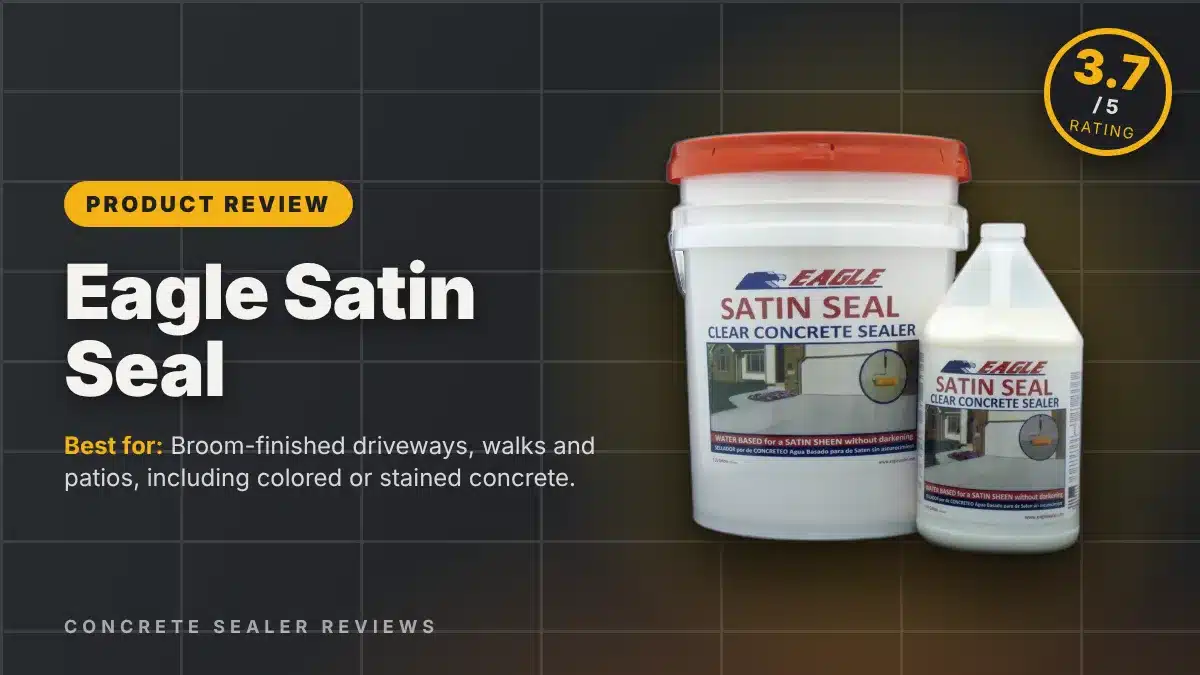
Eagle Satin Seal is a water-based acrylic sealer made for broom-finished concrete, such as driveways, walkways and patios. It leaves a low satin sheen without the deep darkening a solvent-based wet-look sealer gives. If you want a light, low-odor topical sealer for plain or colored concrete, it’s an affordable option. Expect to reseal on a regular schedule, and keep in mind that it’s a surface film, not a penetrating repellent.
| Type | Topical (film-forming) clear sealer |
| Chemistry | Water-based acrylic, 25% total solids, low VOC (under 63–70 g/L depending on source) |
| Finish | Satin; more coats add gloss. No deep darkening. |
| Coverage | Per gallon, two coats: smooth troweled 300 sq ft, broom swept or stamped 200 sq ft, exposed aggregate and pavers 100 sq ft |
| Coats | Two thin coats, about 4 hours apart |
| Dry/recoat | Dry to touch in about 2–4 hours |
| Cure | Foot traffic in 4–6 hours; vehicles in 48 hours (product page) or 72 hours (label) |
| Best for | Broom-finished driveways, walks and patios; colored or stained concrete |
| Not for | Natural stone, clay or terra cotta brick, asphalt, surfaces with an incompatible coating |
| New concrete | Not addressed on the label. Wait until the slab is cured, dry and porous enough to absorb water. |
Watch: Eagle Satin Seal in 60 seconds
What It Is / How It Works
Satin Seal is part of Eagle's line of concrete sealers (Eagle IFP Company). It's a clear acrylic in water that goes on cloudy and dries clear. As the water evaporates, the acrylic forms a thin protective film on top of the concrete. Eagle says the film resists oils, detergents, acids, salts and most chemicals, and that it doesn't yellow, holds up to UV and doesn't haze when it gets wet. Lowe's carries it as "Eagle Clear Satin" acrylic sealer, model BC1 (1 gallon) and BC5 (5 gallons).
Eagle steers broom-finish concrete toward Satin Seal instead of its solvent-based gloss products. Its Premium Coat label, for example, says not to use that sealer on cured broom-swept concrete and points users to Supreme Seal or Satin Seal. Satin Seal is a thinner, lower-build coating, so it lets more of the broom texture show through and adds less slickness than a heavy gloss film.
Where It Works Best (and where it doesn't)
It's a good fit for broom-finished driveways, sidewalks and patios where you want a subtle, freshly sealed look and some resistance to oil and salt. Eagle also says it brings out color on dyed, stained or colored concrete, and it can be used indoors on concrete floors.
It's a weaker choice where you need deep freeze-thaw and deicing-salt protection on exterior flatwork. A thin acrylic film wears away from tires and weather, so a penetrating silane/siloxane often lasts longer there. Eagle also lists natural stone, clay or terra cotta brick and asphalt as unsuitable surfaces. Very dense, smooth-troweled concrete has to be etched or mechanically prepped so the sealer can bond. See our best driveway sealer guide for other options.
Pros
- Made specifically for broom-finished concrete
- Satin sheen without heavy darkening
- Water-based, low odor and low VOC; cleans up with water
- Resists oils, detergents, salts and many chemicals, and won't yellow
- Quick to walk on (4–6 hours)
- Can be recoated with the same or a similar water-based sealer
Cons
- Surface film wears and needs periodic resealing
- Narrow application window: 50–90°F, no rain on the way, no hot surfaces
- Smooth or dense concrete needs etching or mechanical prep to accept it
- Eagle's label and product page list different vehicle-traffic times (72 vs. 48 hours) and maximum temperatures (90°F vs. 95°F)
- Not for natural stone, clay brick or asphalt
- Few owner reviews on major retail listings at the time of checking
How to Apply It
- Clean. Remove dirt, wax, grease and oil. Scrub oily spots with Eagle Cleaner Degreaser & Neutralizer and a bristle brush. Strip any foreign coating unless it's the same or a similar water-based sealer.
- Open the surface. Etch slick concrete with Eagle Etch & Clean. The concrete should absorb water, and very dense surfaces may need mechanical prep.
- Rinse and dry. Rinse well with a 2,500–3,000 psi pressure washer, then let the surface dry for 24 hours.
- Check conditions. Air and surface temperatures should be between 50°F and 90°F, on a calm day with no rain coming. Avoid hot surfaces, since fast drying can cause bubbles or streaks.
- Test first. Seal a small area to check appearance and compatibility.
- Apply two thin coats. Don't thin the sealer. Spray it on with a low-pressure garden sprayer and back-roll with a 3/4"–1" nap roller on textured concrete. On smooth concrete, use a short-nap roller, lamb's wool or microfiber applicator and cross-roll. Wait about 4 hours between coats.
- Let it cure. Allow foot traffic after 4–6 hours. Wait 72 hours before driving on it, which is the more conservative label figure.
How It Compares
Eagle Supreme Seal is Eagle's solvent-based high-gloss acrylic. It gives a much deeper wet look but covers less (75–100 sq ft per gallon), has a strong solvent odor and contains up to 700 g/L VOC. Choose it for a dramatic sheen, and stick with Satin Seal if you want a subtler look and easier cleanup.
Eagle Natural Seal is a water-based silane/siloxane penetrating repellent. It doesn't change how the concrete looks and doesn't leave a film to wear off, so it's usually the better fit for bare driveways in snow country. It adds no sheen and no color enhancement.
QUIKRETE Acrylic Concrete Cure & Seal is another water-based satin acrylic. It's also rated as an ASTM C309 curing compound for fresh concrete, which Eagle doesn't claim for Satin Seal.
FAQ
How long does Eagle Satin Seal last?
Eagle doesn't give a service life. It says to reseal as needed, but no more often than every two years, to avoid sealer buildup. How long it actually lasts depends on traffic, sun and weather.
Will Eagle Satin Seal make concrete slippery?
Satin Seal is a thin satin coating made for textured broom finishes, so it's less slick than a thick high-gloss film. Any topical sealer can still be slippery when wet, especially on smooth concrete. Test an area before sealing steps or pool decks.
Can you put Eagle Satin Seal over another sealer?
Only over the same or a similar water-based sealer. Eagle says to remove any other foreign coating first and to always test a small area.
Can you use it indoors?
Yes. Eagle lists it for interior and exterior use, including indoor concrete floors. Its low odor helps indoors, but it's still a light-duty coating compared with epoxy.
Verdict
Eagle Satin Seal does what it's built for: it adds a low-odor satin sheen to broom-finished concrete without making it dark or glossy. It has clear coverage figures, quick foot-traffic times and decent resistance to stains and chemicals. As with any thin acrylic film, it wears and needs resealing. Prep matters, and it isn't the strongest protection for driveways that see heavy salt and freeze-thaw. Check details on Eagle's Satin Seal page. Our rating: 3.7/5
How we reviewed this product: this is a research-based review built from the manufacturer's technical data sheet and current retail listings. We have not run our own hands-on tests of this product. Details were checked in October 2026; always follow the current label.
Where to Buy

Related Guides
Affiliate disclosure: Some links on this page are affiliate links. As an Amazon Associate we earn from qualifying purchases, at no extra cost to you.
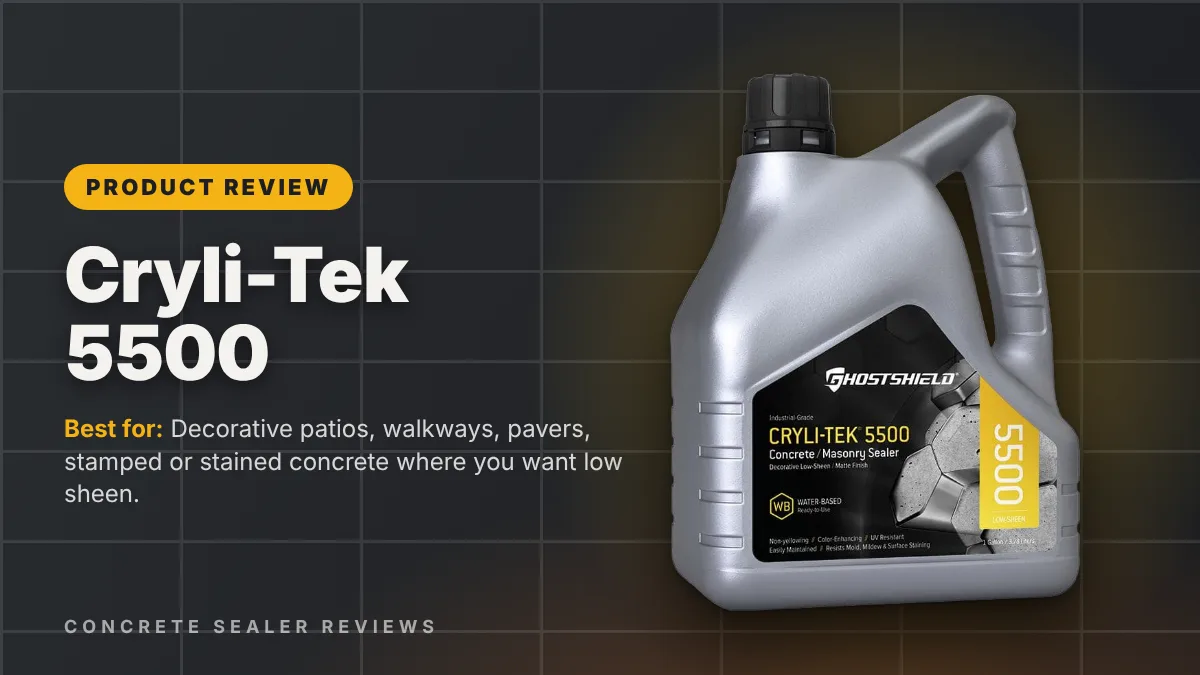
Ghostshield Cryli-Tek 5500 is a water-based acrylic sealer that leaves a low-gloss, satin-type finish on concrete, pavers, brick and stamped or stained surfaces. It is aimed at homeowners who want enhanced color and stain resistance without a high shine or solvent fumes. The bottom line: it is a good fit for decorative patios, walkways and pavers if you prefer a subtle finish, but as a thin film it will need recoating, and Ghostshield’s full application data was not easy to find when we checked, so get the current data sheet before you start.
| Type | Film-forming decorative sealer |
| Chemistry | Water-based acrylic; about 25% solids (per Ghostshield’s product description) |
| Finish | Low gloss / satin, non-yellowing; mild color enhancement |
| Coverage | Retail listings show about 250 sq ft/gal; confirm on the current data sheet |
| Coats | Typically 2 thin coats (check the label) |
| Dry/recoat | Fast set; see the current data sheet for times |
| Cure | See the current data sheet |
| Best for | Patios, walkways, pavers, brick, stamped and acid-stained concrete, driveways |
| Not for | Immersion (pools, ponds), areas with constant chemical exposure |
| New concrete | Listed for new and existing concrete; follow the label’s cure wait |
Watch: Cryli-Tek 5500 in 60 seconds
What It Is / How It Works
Cryli-Tek 5500 is the water-based member of Ghostshield's Cryli-Tek acrylic line. Its sibling, Cryli-Tek 5505, is a solvent-based, high-gloss wet-look sealer. The 5500 trades that deep gloss for a softer, low-sheen look and a water carrier, so there is no solvent smell and it meets VOC rules in all 50 states, including California.
Like other acrylic sealers, it forms a thin, clear film on the surface. That film reduces water absorption, blocks many stains and dirt pickup, and slightly deepens color. Ghostshield describes the resin as nanotechnology-based acrylic at about 25% solids, and says the finish resists water blushing (the white haze some acrylics get from moisture), sets quickly, resists UV breakdown and does not chip, flake or delaminate. The finish stays breathable, which helps moisture vapor escape from the slab.
Retail listings currently describe it as a clear, low-gloss, non-yellowing sealer for concrete, pavers, brick, stamped concrete and exposed aggregate. We found it still listed at Lowe's in 1-gallon size. Ghostshield's own technical data sheet for the 5500 was not available to us when we checked, so a few specs below are left to the label.
Where It Works Best (and where it doesn't)
Cryli-Tek 5500 makes the most sense on decorative concrete where you want the color to look richer but do not want a glossy, plastic look: stamped and acid-stained patios, brick and paver walkways, exposed aggregate and pool surrounds outside the splash zone. It is rated for vertical and horizontal surfaces, indoors and out, so it also works on stained interior floors and masonry walls.
It is not for immersion service such as pool interiors or water features, or for areas with constant chemical exposure. And like any film-forming sealer, it is not the first choice if your only goal is water and salt protection on a plain driveway. A penetrating silane/siloxane repellent lasts longer and will not wear off in tire paths. See our best silane-siloxane concrete sealers guide.
Owner feedback is limited. The few retail reviews we found describe a low or slight sheen, two-coat applications and coverage that met or beat expectations. That is not enough to judge long-term durability.
Pros
- Low-gloss, natural-looking finish rather than a high shine
- Water-based, no solvent odor, VOC compliant in all 50 states
- Ghostshield says it resists water blushing and UV breakdown and does not yellow
- Works on concrete, pavers, brick, stamped and acid-stained surfaces
- Indoor and outdoor, vertical and horizontal use
- Breathable film
Cons
- Thin surface film that wears in traffic and needs periodic recoating
- Less color depth and gloss than a solvent-based wet-look sealer
- Not for immersion or constant chemical exposure
- Current data sheet (coverage, dry and cure times, temperatures) was hard to locate; retail specs vary
- Few owner reviews to judge long-term performance
- Film sealers can be slippery when wet; consider an anti-slip additive on walkways
How to Apply It
- Get the current label or data sheet. Confirm coverage, the temperature range, recoat time and how long new concrete must cure before sealing.
- Clean thoroughly. Remove dirt, efflorescence, oil and any failing sealer. On stamped concrete, remove leftover release agent. Rinse and let the surface dry completely.
- Check compatibility. If the surface was sealed before, test a small area to make sure the new coat bonds and does not lift or haze the old one.
- Pick the right day. Seal in dry weather within the label's temperature range, out of hot midday sun, with no rain in the forecast.
- Apply a thin first coat by roller or low-pressure sprayer, back-rolling to spread it evenly and keep it out of puddles in grout lines and stamped texture.
- Apply a second thin coat once the first is dry, ideally crosswise.
- Let it cure before foot and vehicle traffic as the label directs. Plan to reseal when the color starts to look dull or water stops beading.
How It Compares
Ghostshield Cryli-Tek 5505. The solvent-based sibling. Its data sheet lists a high-gloss wet look, about 200 sq ft per gallon, 250 g/L VOC, a 60–90°F application window and xylene cleanup. Choose 5505 for maximum gloss and color depth. Choose 5500 for a subtler finish and no solvent fumes.
BEHR Premium Low-Lustre Sealer (No. 986). The low-sheen sibling of BEHR's Wet-Look Sealer, sold at Home Depot. It is a convenient big-box alternative if you want a similar subtle finish.
Penetrating sealers. If you do not want any film or sheen at all, a penetrating sealer changes the look little or not at all and does not need stripping later. See our best penetrating concrete sealers.
FAQ
Is Cryli-Tek 5500 glossy?
Only a little. It is sold as a low-gloss, satin-type finish. Retail listings sometimes call it "wet look," but it is far less shiny than a high-gloss wet-look sealer like Cryli-Tek 5505.
Is Cryli-Tek 5500 waterproof?
It reduces water absorption and resists water blushing, but it is not rated for immersion. For maximum water and salt protection on plain concrete, a penetrating repellent is the better tool.
Can you use it on stamped or acid-stained concrete?
Yes. Stamped and acid-stained concrete are among the listed uses. Apply thin coats and back-roll so sealer does not pool in the texture.
How often will I need to reseal?
Ghostshield does not publish a lifespan that we could find. As with any acrylic film, high-traffic and sun-exposed areas will need resealing sooner than covered or vertical surfaces.
Verdict
Cryli-Tek 5500 is a sensible pick for decorative concrete and pavers when you want a low-sheen, natural-looking finish with water-based convenience. Its limits are the usual ones for acrylic films (wear, recoating, no immersion), plus thinner published data than we would like. Confirm the current data sheet before you buy, and choose 5505 or a penetrating sealer if gloss or long-term water protection matters more to you.
How we reviewed this product: this is a research-based review built from the manufacturer's technical data sheet and current retail listings. We have not run our own hands-on tests of this product. Details were checked in October 2026; always follow the current label.
Where to Buy

Related Guides
Affiliate disclosure: Some links on this page are affiliate links. As an Amazon Associate we earn from qualifying purchases, at no extra cost to you.
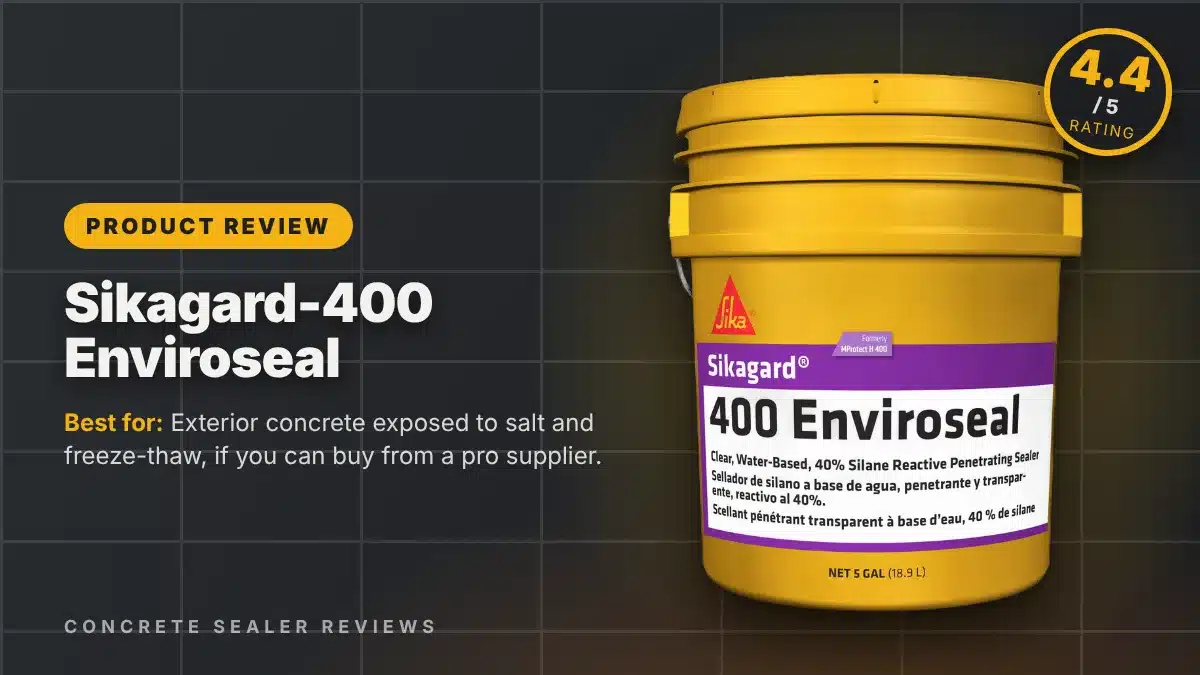
Sikagard-400 Enviroseal is a water-based, 40% silane penetrating sealer for concrete. It’s built for bridge decks, parking garages and other reinforced concrete that faces water, freeze-thaw and deicing salts. You may know it as MasterProtect H 400 or, before that, Enviroseal 40. It’s the same 40% silane sealer under Sika’s name. It’s one of the better-documented penetrating sealers you can buy. It’s sold mainly through contractor and construction-supply channels, not big-box stores, and it won’t fix cracks or change how the concrete looks.
| Type | Penetrating water repellent (no film) |
| Chemistry | Water-based alkylalkoxysilane, 40% active content |
| Finish | Milky white in the pail, dries clear; no change in appearance |
| Coverage | 100–200 sq ft/gal on concrete and brick, depending on porosity |
| Coats | Apply to saturation (no fixed coat count) |
| Dry/recoat | Dry in about 4 hours at 70°F and 50% RH; may stay slippery for several hours |
| Cure | Allow 5–7 days for full reaction before judging a test area |
| Best for | Driveways, garage slabs, parking decks, bridge decks, ramps, precast and cast-in-place concrete above grade |
| Not for | Cracked or unsound concrete, below-grade waterproofing, a wet-look finish |
| New concrete | After it reaches about 80% of design strength, typically 14–28 days |
Watch: Sikagard-400 Enviroseal in 60 seconds
What It Is / How It Works
About the name: The product began as Enviroseal 40. It was later sold as MasterProtect H 400 under Master Builders Solutions, the construction chemicals brand formerly owned by BASF. Sika acquired that business, and Sika's U.S. data sheet now calls it Sikagard-400 Enviroseal, "formerly MProtect H 400." Some Sika documents also list it as Sikagard H 400. Sika's Master Builders site labels it "Sikagard-400 Enviroseal (formerly known as MasterProtect H 400)." Whichever name is on the pail, it's the same water-based 40% silane penetrating sealer. It's sold by Sika, not by a separate company called "Sikagard."
Silane molecules are small enough to soak into concrete pores. Once inside, they react with the moisture and minerals there to form a water-repellent lining in the capillaries, without a coating on the surface. Water and chloride-laden slush bead off, while water vapor inside the slab can still escape. Sika lists a penetration depth of 0.24 in (6.1 mm). It also lists an 87% chloride reduction and an 85% reduction in water weight gain in NCHRP 244 Series II cube tests, a 99% chloride reduction in the Series IV southern-climate test, and a 0 rating (no scaling) after 100 freeze-thaw cycles with deicing salt (ASTM C672). It's approved as Alberta DOT Type 1b.
Where It Works Best (and where it doesn't)
It's a strong choice for exterior concrete that faces salt and freeze-thaw. Think driveways, sidewalks, garage aprons, parking decks, ramps, barrier walls and precast panels. It's rated for traffic-bearing surfaces and works on horizontal and vertical surfaces, indoors or out, above grade.
It won't stop water coming through cracks, failed caulking, bad flashing or structural defects, and Sika says so plainly. It also isn't a basement waterproofer against hydrostatic pressure, and it won't add color, sheen or stain resistance against oil. In California's South Coast AQMD, its use is limited to specific project types under Rule 1113. If you're shopping retail options in the same category, see our best silane-siloxane concrete sealers.
Pros
- High 40% active silane content
- Published DOT-style test data for chloride, water absorption and salt scaling
- Invisible finish that stays breathable and doesn't wear off like a film
- Rated for traffic-bearing surfaces
- Wide application range of 40–110°F
- Water-based; tools clean up with hot soapy water
Cons
- Hard to find in big-box stores; usually sold in 5-gallon pails and drums through contractor suppliers
- Name changes (Enviroseal 40, MasterProtect H 400, MProtect H 400, Sikagard H 400) can confuse shoppers
- Won't bridge cracks or fix defects; repairs come first
- Can leave a slippery surface for several hours
- Coverage varies a lot with porosity, so a test area is needed
- Usage restrictions in Southern California's South Coast AQMD
How to Apply It
- Wait for cure. New concrete should reach about 80% of design strength first, typically 14–28 days.
- Repair and caulk first. Fix cracks and defects. Let joint sealants cure 6–12 hours, or until they skin over, before sealing.
- Clean. Remove sand, dust, dirt, oil, grease, chemical films and old coatings. Power washing, sandblasting or shotblasting may be needed. A dry surface penetrates best, a slightly damp one is acceptable, but there should be no standing water.
- Check the weather. Surface, air and material should be between 40°F and 110°F. Don't apply if temperatures will drop below 40°F, or rain is forecast, within 12 hours.
- Test a 5 x 5 ft area. Give it 5–7 days to react fully before you judge coverage and beading.
- Apply to saturation. Stir before and during use, and don't dilute. Use a low-pressure, non-atomizing sprayer. On flat surfaces you can pour it and spread it with a squeegee or broom. Plan on 100–200 sq ft per gallon.
- Keep traffic off until it's dry. That's about 4 hours at 70°F and 50% RH, longer when it's cool or humid.
How It Compares
Eagle Natural Seal is a widely available water-based silane/siloxane blend at about 200 sq ft per gallon. It's easier to buy and suits homeowner driveways and patios. Eagle doesn't publish an active-solids percentage or DOT test data for it, though.
Other 40% silane sealers from commercial brands target the same bridge-deck and parking-garage work. When you compare them, look for actives percentage, penetration depth and NCHRP 244 or ASTM C672 results, not just the marketing claims.
Film-forming acrylics add sheen and color enhancement, but they wear off and can trap moisture. For the different sealer types, see our best concrete sealers for 2026.
FAQ
Is Sikagard-400 Enviroseal the same as MasterProtect H 400?
Yes. Sika labels it "Sikagard-400 Enviroseal (formerly known as MasterProtect H 400)," and the older Master Builders data sheet lists Enviroseal 40 as its earlier name. The specs carried over, including 40% silane and 100–200 sq ft per gallon.
Will it change the look of my concrete?
Sika says it dries clear and doesn't alter the surface appearance. Test a small area if appearance matters.
Can you put it over an existing sealer?
Not over a coating. Sika says to remove coatings and chemical films so the silane can soak into bare concrete.
What's the VOC content?
The current Sika data sheet doesn't state it. The earlier MasterProtect H 400 data sheet listed less than 350 g/L, excluding water and exempt solvents. Use is restricted in the South Coast AQMD, so check the current SDS and your local rules.
Verdict
Sikagard-400 Enviroseal, formerly MasterProtect H 400 and Enviroseal 40, is a serious, well-tested 40% silane sealer. If you can buy it through a contractor supplier, it's an excellent choice for exterior concrete exposed to salt and freeze-thaw. The drawbacks are practical: limited retail availability, confusing names, the need to test for coverage and nothing to offer if your concrete is cracked. Current details are on Sika's product page. Our rating: 4.4/5
How we reviewed this product: this is a research-based review built from the manufacturer's technical data sheet and current retail listings. We have not run our own hands-on tests of this product. Details were checked in October 2026; always follow the current label.
Related Guides
Affiliate disclosure: Some links on this page are affiliate links. As an Amazon Associate we earn from qualifying purchases, at no extra cost to you.
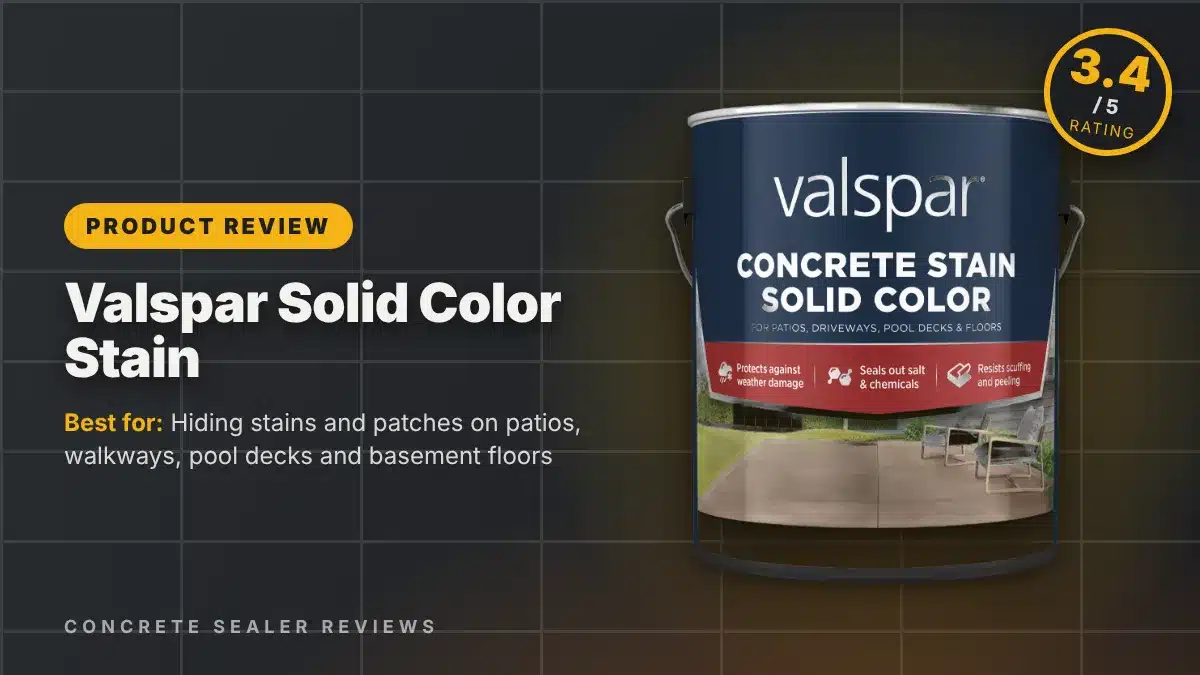
Valspar Solid Color Concrete Stain is a water-based, tintable, opaque coating that covers concrete and masonry in a solid color, much like a thin floor paint. It’s aimed at homeowners refreshing a patio, walkway, pool deck or basement floor who want to hide stains and patches. It’s easy to apply and widely sold, but as a film-forming coating it needs good prep, and Valspar says not to use it on garage floors.
| Type | Opaque (solid) film-forming concrete stain |
| Chemistry | Water-based acrylic (per distributor listing); about 99–100 g/L VOC |
| Finish | Flat to low gloss (Valspar lists both) |
| Coverage | 200–500 sq. ft. per gallon |
| Coats | Two recommended |
| Dry/recoat | Dry to touch in 2–24 hours; recoat after 24 hours (77°F, 50% RH) |
| Cure | About 72 hours (retail listing) |
| Application temp | 50°F to 90°F (retail listings) |
| Best for | Patios, walkways, pool decks, breezeways, basement and laundry floors |
| Not for | Garage floors, asphalt, surfaces treated with water repellents |
| Colors/sizes | Tintable (Ultra White and Base 4) plus ready-mixed colors such as Concrete Gray; 1 and 5 gallon |
Watch: Valspar Solid Color Stain in 60 seconds
What It Is / How It Works
Despite the name, a solid color concrete stain works more like paint than a penetrating stain. It's pigmented (titanium dioxide is listed among its ingredients) and forms a colored film on top of the concrete that hides what's underneath. Valspar credits "heavy-duty resin technology" and says the coating resists hot tire pickup, flaking and peeling, and protects against sun, water and household chemicals. Distributor listings identify the resin as acrylic.
It's ready to use and doesn't need a topcoat. You can tint the white and Base 4 versions to many colors at the paint counter, or buy ready-mixed shades like Concrete Gray. Valspar also sells a Semi-Transparent Concrete Stain if you want some of the concrete's texture and color variation to show through.
One small inconsistency: Valspar's spec section lists the sheen as flat, while its product overview and several retail listings call it low gloss. Expect a mostly flat finish with a slight sheen.
Where It Works Best (and where it doesn't)
Valspar lists properly prepared interior or exterior concrete and masonry: patios, walkways, breezeways, laundry rooms, basement floors, pool decks, sidewalks and privacy walls. It's a good fit for stained, patched or mismatched concrete that a clear sealer can't fix, since the solid color covers it all.
Valspar's directions state, "Do not use on garage floors," even though the marketing copy mentions driveways and hot tire pickup. Lowe's also notes it's not for asphalt or surfaces previously treated with water-repellent sealers, because the film won't bond well over them. For a garage, a two-part coating from our best epoxy floor coatings list is the better choice. Like any film-forming coating on concrete, it depends on clean, dry, porous concrete; poor prep or moisture coming up through a slab can cause peeling.
Pros
- Hides stains, patches and discoloration with a solid color
- Tintable to a wide range of colors
- Water-based with soap-and-water cleanup
- Goes on with a brush or roller; no topcoat needed
- Interior and exterior use on concrete and masonry
- Easy to find at Lowe's and hardware stores
Cons
- Not for garage floors, per Valspar
- Film-forming, so it can peel if prep is poor or moisture comes up through the slab
- Covers the natural look of concrete completely
- Two coats and 24 hours between them make it a multi-day project
- Won't bond over water-repellent sealers
- Specs differ slightly between Valspar's page and retail listings
How to Apply It
- Check the surface. If water beads on it, an old sealer or repellent is still there and must be removed. The product won't bond over water-repellent treatments.
- Clean thoroughly so the concrete is dry and free of loose or peeling paint, dirt, grease and other contaminants.
- Patch cracks and voids with a suitable concrete patch, and level low spots where water ponds.
- Apply when temperatures are between about 50°F and 90°F, with dry weather in the forecast.
- Mix well before and during use. If you have several cans of the same color, intermix them for consistent color.
- Apply with a high-quality polyester brush or a 1/4" to 3/8" nap roller, using long, even strokes in one direction.
- Wait 24 hours, then apply the second coat. Allow about 72 hours for full cure before heavy use.
How It Compares
Valspar Semi-Transparent Concrete Stain is the choice if you want color while keeping some of the concrete's natural variation. It hides less, but it's a lighter look that many people prefer on newer concrete.
BEHR Premium Solid Color Concrete Stain is the closest competitor at Home Depot: a similar tintable, opaque, water-based concrete stain for patios, walks and other masonry. Compare current labels for coverage and use limits before deciding.
Clear penetrating sealers don't change color, but because they soak in rather than forming a film, they can't peel. If your concrete looks fine and just needs protection, see our best concrete sealers for 2026.
FAQ
Does Valspar Solid Color Concrete Stain need a sealer?
No. Lowe's listing describes it as ready to use with no topcoat required.
Can I use it on my garage floor?
Valspar's directions say not to use it on garage floors. Use a garage-rated epoxy or polyaspartic coating instead.
Can you put it over previously sealed concrete?
Not over water-repellent sealers, per Lowe's listing. Do a water test: if water beads, remove the old sealer first or the stain may not bond.
How many gallons do I need?
Valspar lists 200–500 sq. ft. per gallon per coat. Rough or porous concrete lands near the low end. Plan for two coats, so a 400 sq. ft. patio may need two to four gallons.
Verdict
Valspar Solid Color Concrete Stain is a practical, easy-to-find way to give tired patios, walks and basement floors a uniform color. It's tintable, water-based and simple to roll on. As with any solid concrete stain, prep decides how long it lasts, and Valspar's own ban on garage floors limits where it fits. Our rating: 3.4/5
How we reviewed this product: this is a research-based review built from the manufacturer's technical data sheet and current retail listings. We have not run our own hands-on tests of this product. Details were checked in October 2026; always follow the current label.