
Affiliate disclosure: Some links on this page are affiliate links. As an Amazon Associate we earn from qualifying purchases, at no extra cost to you.
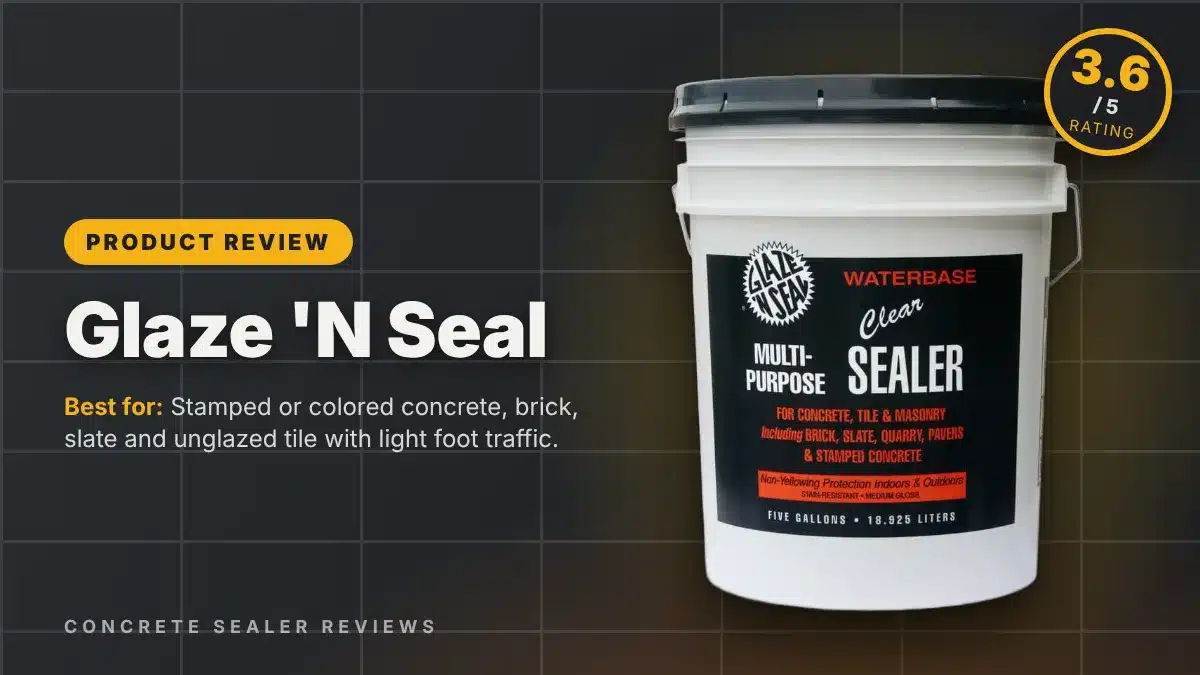
Glaze ‘N Seal Multi-Purpose Sealer is a clear, water-based acrylic that dries to a medium gloss on concrete, unglazed tile, brick, stone and stucco. It’s aimed at homeowners who want light stain protection and a little extra color on decorative surfaces without handling a solvent product. The bottom line: it’s an easy, low-odor, budget-friendly topical sealer, but it’s a thin film that needs multiple coats and periodic reapplication, and it isn’t a heavy-duty waterproofer.
| Type | Topical, film-forming sealer |
| Chemistry | Water-based acrylic copolymer, about 16% solids |
| Finish | Medium gloss; milky in the can, dries clear and non-yellowing |
| Coverage | 100–400 sq ft per gallon, depending on porosity |
| Coats | Two or more thin coats |
| Dry/recoat | Usually 1–3 hours between coats (dry to the touch) |
| Cure | Keep off heavy moisture for 72 hours; keeps hardening for up to a week |
| Best for | Stamped, colored and exposed-aggregate concrete, unglazed tile, brick, slate, flagstone |
| Not for | Driveways with hot-tire traffic, below-grade leaks, surfaces where you want zero sheen |
| Application temp | 55–80°F |
Watch: Glaze 'N Seal in 60 seconds
What It Is / How It Works
This is an acrylic copolymer emulsion. You brush, wipe or spray it on, the water evaporates, and the acrylic particles fuse into a thin, clear film on top of the surface and in the upper pores. That film is what blocks spills. The manufacturer's data sheet says it resists organic stains such as cooking oil, grease and beverages, and it's sold for both indoor and outdoor use. It's still sold today in quarts, gallons, 5-gallon pails and drums; Home Depot lists the 5-gallon pail as "Glaze 'N Seal Multi-Purpose Waterproofing Sealer" (model 134).
At roughly 16% solids, it's a light-bodied product. That's why the label calls for two or more coats: each pass adds a thin layer, and building it up gradually avoids puddles and cloudy spots. The finish is a medium gloss, so expect a noticeable sheen and some darkening or richening of color, especially on stamped or colored concrete and natural stone.
Glaze 'N Seal also positions it as a primer coat before painting concrete and masonry, a protective coat over painted or stained surfaces, and a base under its own indoor floor polish.
Where It Works Best (and where it doesn't)
It makes the most sense on decorative surfaces that see light to moderate foot traffic: a stamped patio, a colored concrete walkway, a brick or slate entry, unglazed quarry or Mexican tile, or a terrazzo floor. On those surfaces the gloss and color boost are part of the appeal, and a water-based acrylic is easy to touch up later.
It's a weaker choice when you mainly want long-term water and salt protection with no change in look. A thin acrylic film wears away in high-traffic lanes and needs to be reapplied, and any film-forming sealer can get slick when wet. If you have an unsealed driveway in a freeze-thaw climate, a penetrating silane/siloxane is usually the better tool. See our best penetrating concrete sealers guide. It also won't stop water pushing through a basement wall or a cracked slab.
Pros
- Water-based, low odor, and cleans up with water
- Works on a wide range of surfaces: concrete, unglazed tile, brick, stone, stucco
- Resists common organic stains like grease, oil and drinks
- Dries clear, non-yellowing, with a medium-gloss enhancement
- Recoatable, so maintenance coats are simple
- Quick recoat window (usually 1–3 hours)
Cons
- Low solids means you need two or more coats
- Thin film wears in traffic areas and needs periodic reapplication
- Narrow application window (55–80°F)
- Adds sheen and changes the look; not for people who want an invisible finish
- Can be slippery when wet, like most glossy topical sealers
- Not a solution for hydrostatic pressure, active leaks or salt damage on driveways
How to Apply It
- Clean thoroughly. Remove efflorescence, dirt, oil, wax, grease and any failing paint or sealer. If you used muriatic acid, rinse away all residue and neutralize (Glaze 'N Seal sells a Neutralizing Rinse) before sealing.
- Let it dry. Allow the surface to dry fully. In humid climates, give it extra time.
- Check the weather. Apply between 55°F and 80°F. On warm, sunny days, lightly mist the surface with water first so the sealer doesn't flash dry.
- Test a small area. Confirm how much it absorbs and how much it darkens or shines.
- Apply a thin first coat. Use a brush, wax applicator or sprayer, depending on how porous and rough the surface is. Don't let it puddle.
- Recoat. When the first coat is dry to the touch (usually 1–3 hours), apply a second thin coat. Add more coats on very porous surfaces.
- Protect while it cures. Keep heavy moisture and standing water off for 72 hours. The film keeps gaining strength for up to a week.
How It Compares
Versus solvent-based acrylic "wet look" sealers (including Glaze 'N Seal's own Wet Look lacquer line): solvent acrylics usually give a deeper, glossier color boost. They also bring stronger fumes and more flammability. The Multi-Purpose Sealer trades some of that depth for easy water cleanup and indoor-friendly odor.
Versus penetrating silane/siloxane sealers: penetrating sealers leave no film, don't change the look, don't get slippery and typically last much longer on exterior flatwork. They don't block oil stains the way a film does, and they give no gloss. If your priority is freeze-thaw and salt protection on a driveway or sidewalk, start with our best concrete sealers roundup.
Versus floor polishes and epoxy coatings: for an indoor concrete floor that gets real wear, a thin acrylic won't hold up like a two-part coating. The Multi-Purpose Sealer is better seen as a light protective coat, or a base under a sacrificial floor polish.
FAQ
Is Glaze 'N Seal Multi-Purpose Sealer waterproof?
It makes surfaces water-resistant and helps keep spills from soaking in. It is not a waterproofing system: it won't stop water coming through cracks, joints or a below-grade wall under pressure.
Will it make my concrete or tile shiny?
Yes. The manufacturer lists a medium-gloss finish, and it slightly enhances color. Test a small area first if you're unsure about the look.
How many coats do I need?
The label calls for two or more thin coats. Very porous surfaces like rough brick or open-textured stone may need more. Several thin coats are better than one heavy coat, which can puddle.
Can I apply it over a previously sealed surface?
The data sheet says to remove defective paint or sealer before applying, and it's recoatable over itself. Over an unknown older sealer, test a small area for adhesion and clarity first.
Verdict
Glaze 'N Seal Multi-Purpose Sealer is a sensible, inexpensive pick for decorative concrete, unglazed tile and masonry where you want a medium-gloss look, stain resistance and easy water cleanup. Its low solids and thin film mean more coats and more frequent touch-ups than heavier sealers, and it isn't built for driveways or real waterproofing. Buy it for looks and light protection, not for heavy-duty durability. Our rating: 3.6/5
How we reviewed this product: this is a research-based review built from the manufacturer's technical data sheet and current retail listings. We have not run our own hands-on tests of this product. Details were checked in October 2026; always follow the current label.
Where to Buy

Related Guides
Affiliate disclosure: Some links on this page are affiliate links. As an Amazon Associate we earn from qualifying purchases, at no extra cost to you.
SealMaster Concrete Sealer is a water-based, 100% acrylic clear sealer from SealMaster, a company better known for asphalt sealcoating and pavement maintenance products. It is sold mainly in 5-gallon pails and drums through SealMaster locations, and it is aimed at contractors and homeowners sealing driveways, patios, walks and garage floors. The bottom line: it is a straightforward, low-VOC acrylic that can be used on fresh or existing concrete, but it is a basic, lower-solids film sealer that will need regular recoating and is harder to find in small sizes.
| Type | Film-forming clear sealer (also meets ASTM C309 as a curing compound) |
| Chemistry | Water-based 100% acrylic emulsion, 18% non-volatiles |
| Finish | Dries clear, non-yellowing (sheen level not stated) |
| Coverage | About 200 sq ft per gallon (200–300 depending on porosity) |
| Coats | One thin coat recommended; optional second coat after 24 hours |
| Dry/recoat | Tack-free in under 40 minutes at 77°F; recoat after 24 hours |
| Temperature | Surface and air at least 50°F during and for 24 hours after |
| VOC | Under 100 g/L |
| Best for | Driveways, patios, sidewalks, walls, garage and basement floors |
| Not for | Cold-weather work; anyone wanting a small can or a penetrating, no-film finish |
| New concrete | Can be applied once fresh concrete is firm enough to walk on with no surface water |
Watch: SealMaster Concrete Sealer in 60 seconds
What It Is / How It Works
SealMaster Concrete Sealer (spec sheet product code SMT-250) is still listed on SealMaster's website under the same name. It is a ready-to-use blend of acrylic emulsion resins, surfactants and water. You spray or roll it on in a thin coat, the water evaporates and the acrylic resin forms a clear film on top of the concrete. That film is what blocks water, salt and oil from soaking in.
Because it meets ASTM C309 Type I Class A, it can also serve as a curing compound on freshly placed concrete, holding moisture in the slab while it gains strength. SealMaster's spec sheet lists "excellent" resistance in spot tests to motor oil, water, 10% sodium hydroxide, 10% sodium chloride, 10% calcium chloride, trisodium phosphate and ammonia, and it says the film stays clear when wet instead of blushing white.
The spec sheet lists 18% non-volatiles. That puts it on the lighter side for an acrylic sealer, so expect a thin protective film rather than a thick, glossy wet look. Thin acrylic films wear away with traffic and UV, which is why acrylic sealers in general are recoated every few years. For more on how acrylics compare with other sealer types, see our Best Concrete Sealers for 2026 guide.
Where It Works Best (and where it doesn't)
SealMaster lists driveways, parking lots, patios, sidewalks, statuary, concrete walls, factory floors, garage floors and basement floors as suitable surfaces, both interior and exterior. It makes the most sense on large jobs where buying a 5-gallon pail is practical, on new concrete where you want one product to cure and seal, and for anyone who already buys from a SealMaster location for driveway work.
It is a poor fit for cool-season work, because both the air and the surface must stay at or above 50°F for 24 hours after application. A thin acrylic film is also not the best choice for a garage floor that sees hot tires and heavy use; acrylics in general can soften or lift under that kind of wear, and an epoxy or polyurea coating is the stronger option there. If you prefer a sealer that leaves concrete looking untouched and does not need stripping later, a penetrating silane/siloxane is a better match.
Pros
- Water-based and low VOC (under 100 g/L), with water cleanup
- Meets ASTM C309, so it can cure and seal new concrete in one step
- Dries tack-free quickly (under 40 minutes at 77°F)
- Non-yellowing, and resists blushing when wet
- Published spot resistance to oil, salt solutions and common cleaners
Cons
- Sold in 5-gallon pails and larger, mainly through SealMaster locations
- Lower solids (18%), so a thin film that will need recoating
- Needs 50°F or warmer for 24 hours after application
- Sheen level and expected service life are not published
- Film-forming, so it can wear in traffic lanes and may need stripping before switching products
- Must not freeze in storage
How to Apply It
- On existing concrete, clean off all dust, debris and stains. On fresh concrete, wait until it is firm enough to walk on and there is no surface water.
- Check the forecast. Surface and air temperatures must be at least 50°F during application and for the next 24 hours, and rain should not be imminent.
- Stir thoroughly. Do not dilute.
- Apply with a garden-type or power sprayer (recommended), or a roller, brush or lambswool applicator.
- Put down one thin, even coat at about 200 sq ft per gallon. Avoid puddles.
- If a second coat is needed, apply it at least 24 hours after the first.
- Clean tools and sprayers with water before the sealer dries.
How It Compares
Big-box water-based acrylics: products sold at Home Depot and Lowe's under brands such as BEHR and Seal-Krete come in gallon sizes and often offer a choice of low-lustre or wet-look finishes. They are easier to buy for a small patio. SealMaster's advantage is the C309 curing rating and bulk packaging for larger jobs.
Solvent-based acrylic cure-and-seals: higher-solids solvent acrylics, such as ChemMasters' Certi-Vex AC 1315 SuperSeal HG, build a glossier, tougher film and tolerate cooler application temperatures (down to 40°F), but they carry higher VOC, strong odor and flammability warnings.
Penetrating silane/siloxane sealers: these soak in, leave no film to wear off and do not change the look of the concrete. They do not add gloss, but for a driveway that sees road salt they usually require less upkeep. See our best driveway sealer picks.
FAQ
Can I use SealMaster Concrete Sealer on new concrete?
Yes. SealMaster says it can go on fresh concrete once it is firm enough to walk on and has no surface water, and it meets ASTM C309 Type I Class A as a curing compound.
Is SealMaster Concrete Sealer glossy?
SealMaster describes it only as drying clear and non-yellowing; it does not publish a sheen level. With 18% solids applied in a single thin coat, it is not marketed as a high-gloss wet-look product.
Can it be used on asphalt?
No. It is listed as a concrete product. For asphalt driveways, SealMaster sells separate pavement sealcoats.
How cold is too cold to apply it?
Below 50°F. Do not apply if the surface or air will drop below 50°F within 24 hours after application.
Verdict
SealMaster Concrete Sealer is an honest, no-frills water-based acrylic with a useful C309 curing rating, quick dry and low VOC. It is best for larger jobs and contractors who already buy from SealMaster. Lower solids, bulk-only packaging and an unpublished sheen and service life keep it from ranking higher for most homeowners. Check current price and availability on SealMaster's product page. Our rating: 3.4/5
How we reviewed this product: this is a research-based review built from the manufacturer's technical data sheet and current retail listings. We have not run our own hands-on tests of this product. Details were checked in October 2026; always follow the current label.
Related Guides
Affiliate disclosure: Some links on this page are affiliate links. As an Amazon Associate we earn from qualifying purchases, at no extra cost to you.
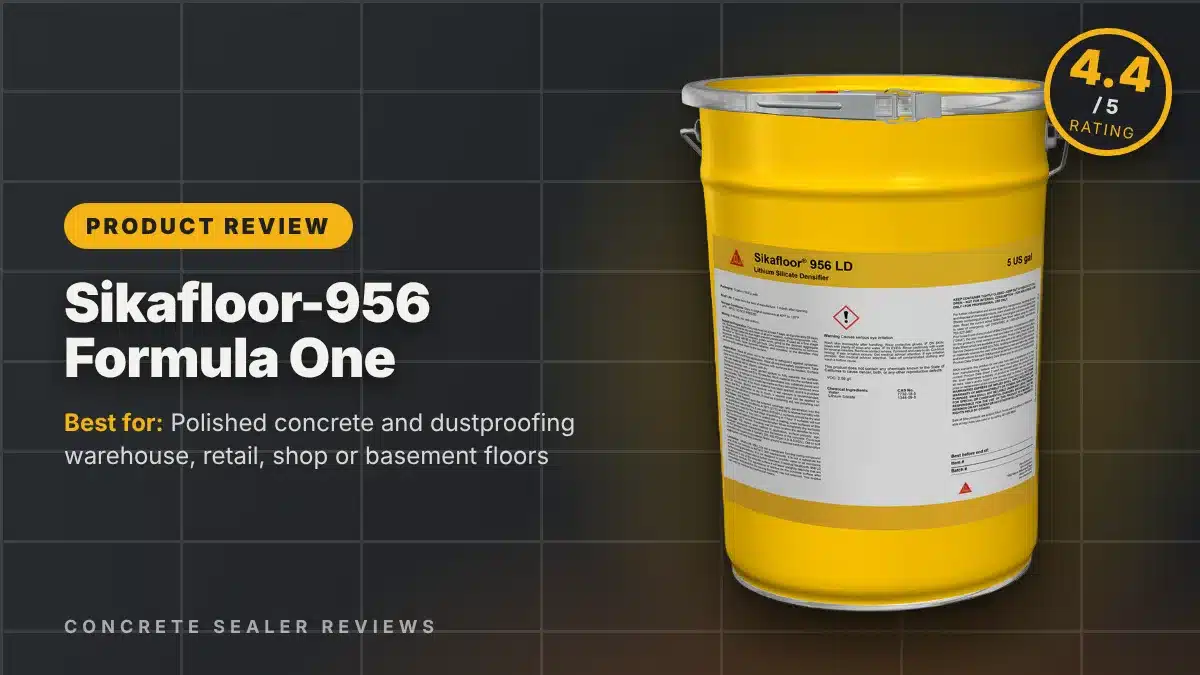
Sikafloor-956 Formula One LD RTU is a ready-to-use lithium silicate densifier for hardening, dustproofing and polishing concrete floors. It was originally sold as Scofield Formula One Lithium Densifier MP and later as Sikafloor-956 LD, and it is now sold under the Sikafloor-956 Formula One LD RTU name. It’s a proven professional product for polished and densified floors, but it is not a water or stain sealer on its own.
| Type | Penetrating densifier/hardener (not a coating) |
| Chemistry | Water-based lithium silicate with a penetrating aid; 12% solids by volume |
| Finish | No film; non-yellowing; sheen comes from polishing |
| Coverage | 200–400 sq. ft. per gallon on flat finished concrete |
| Coats | Two; second coat when the first is dry to the touch |
| Dry/recoat | About 1 hour to walkable and ready to polish (70°F, 50% RH) |
| Cure | Wait 24 hours before applying a sealer or guard |
| VOC | Low VOC, low odor (no number listed) |
| Best for | Polished concrete, dye-locking, dustproofing warehouse, retail and basement floors |
| Not for | Stain or water protection by itself; sealed or coated floors |
| New concrete | At least 7 days old; 28 days preferred |
| Packaging | 5-gallon pail, 55-gallon drum (50-gallon fill) |
Watch: Sikafloor-956 Formula One in 60 seconds
What It Is / How It Works
Scofield is now part of Sika, and the Formula One line has moved to Sikafloor naming. Sika's product page lists "SCOFIELD Formula One Lithium Densifier MP" and "Sikafloor-956 LD" as former names of the current Sikafloor-956 Formula One LD RTU. If you have an older spec or bag label calling for Formula One Lithium Densifier MP, this is the product.
It's a water-based lithium silicate. Once applied, it reacts with the cement, pozzolans and aggregate in the slab to harden and densify the surface. It is not a film, so Sika says it "will not crack, peel, or delaminate." Sika lists it as non-yellowing, UV and weather resistant, and useful against efflorescence, frost damage and alkali-silica reaction (ASR). In polishing work it speeds up grinding and locks in dyes.
The "RTU" means ready to use. The data sheet says not to dilute it. That's different from the separate Sikafloor-956 LD product page, which allows dilution for very hard, freshly ground concrete. Read the label on the pail you actually buy.
Where It Works Best (and where it doesn't)
Sika lists interior and exterior floors, stairs, walkways, terrazzo, polished floors, countertops and below-grade basements. It is a strong fit for polished concrete, dusty warehouse or shop floors, and bare basement slabs where you want a harder, easier-to-clean surface with no coating to wear off.
Two important limits come straight from the data sheet. First, it "does not provide water or oil resistance without further treatment," so a garage floor or patio still needs a sealer or guard if stains matter. Sika pairs it with Sikafloor-958 Formula One Finish Coat or Sikafloor-959 Formula One Guard W for that. Second, it is labeled for experienced professionals, and dried residue can only be removed mechanically. A homeowner can apply it, but sloppy work leaves white haze that's hard to fix. For a homeowner seeking water repellency, a product from our best penetrating concrete sealers guide may be the better fit.
Pros
- Hardens and dustproofs without a film that can peel or delaminate
- Fast: walkable and ready to polish in about an hour under standard conditions
- Ready to use, with no mixing or dilution
- Low odor, low VOC and non-yellowing
- Locks in dyes and shortens polishing time
- Usable indoors or outdoors, including below-grade slabs
Cons
- No water or oil resistance on its own; needs a sealer or guard for stain protection
- Labeled for experienced professionals
- Puddles and dried residue are hard to remove; only mechanical removal works
- Sold in 5-gallon pails and drums, mostly through contractor suppliers
- Not a curing compound and doesn't replace proper curing
- Surface is slippery while wet
How to Apply It
- Wait until the slab is at least 7 days old. Sika prefers 28 days so the concrete is dry and absorbent.
- Make sure the floor is dry and free of sealers, curing compounds, oil and other contaminants. If you're polishing, grind to the aggregate exposure you want, finishing with 80–200 grit, and remove all dust and laitance.
- Do a test area first to confirm color, finish and slip resistance. Mask walls and nearby surfaces against splashes.
- Agitate lightly, then saturate the floor with a pump garden sprayer. Keep it wet for 5–10 minutes.
- Work it in with a broom, mop or sponge. Spread puddles before they dry and avoid lap marks. If puddles remain after 30 minutes, dilute and pick them up with a wet vacuum.
- When the first coat is dry to the touch, apply a second coat. Wet polishing can start at that point.
- If you're not polishing or sealing, rinse with clean water and return the floor to service once dry. If you're sealing, wait 24 hours so the densifier can cure.
Sika's drying figures are based on 70°F and 50% relative humidity. Store and use it above freezing; the storage range is 40–120°F.
How It Compares
Euclid EUCOSIL is a sodium silicate densifier. It's aimed at warehouse, institutional and polished floors and leaves treated concrete slightly water-beading. Euclid warns that excess left on the surface turns into white residue, and it needs 4–6 hours before foot traffic, versus about an hour for Sikafloor-956. That speed difference matters on polishing jobs.
Sikafloor-956 LD is Sika's sister product that can be diluted 1:1 on very hard, freshly ground concrete and is listed as 0 VOC. It's useful if you need flexibility on dense slabs.
Super-Krete S1300 Pene-Krete is a spray-applied penetrating densifier marketed for moisture vapor reduction and coating prep rather than polishing. Choose it if your goal is prepping a slab for a topcoat, not grinding and polishing.
FAQ
Is Scofield Formula One Lithium Densifier MP discontinued?
The Scofield name is retired, but the product isn't. Sika lists Scofield Formula One Lithium Densifier MP as a former name of Sikafloor-956 Formula One LD RTU, which is a current product.
Does a lithium densifier make concrete waterproof?
No. Sika says it does not provide water or oil resistance without further treatment. It hardens the surface; a sealer or guard handles stains and water. For water protection, see our best concrete sealers for 2026.
Can I use it on new concrete?
Yes, once the slab is at least 7 days old, though 28 days is preferred. It is not a curing compound, so the slab still needs proper curing first.
Can you seal over it?
Yes. Wait 24 hours, then apply a compatible sealer or guard. Sika points to its Formula One Finish Coat and Guard W for polished floors.
Verdict
Sikafloor-956 Formula One LD RTU is a well-documented, fast-drying lithium densifier that does exactly what a densifier should: harden, dustproof and help polishing, with no film to fail. It loses points for homeowners because it's sold in bulk through pro channels, needs careful application to avoid residue and still requires a separate sealer for stain or water protection. For its intended use, it's one of the safer choices. Our rating: 4.4/5
How we reviewed this product: this is a research-based review built from the manufacturer's technical data sheet and current retail listings. We have not run our own hands-on tests of this product. Details were checked in October 2026; always follow the current label.
Related Guides
Affiliate disclosure: Some links on this page are affiliate links. As an Amazon Associate we earn from qualifying purchases, at no extra cost to you.
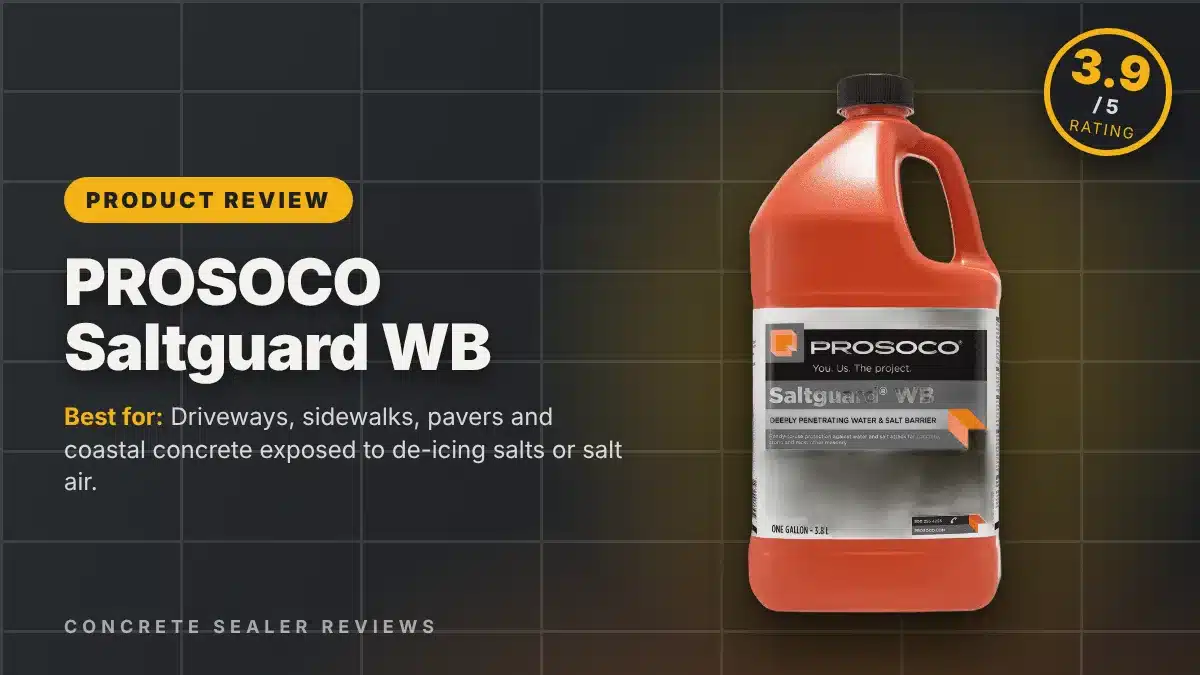
PROSOCO Saltguard WB is a ready-to-use, water-based silane/siloxane water repellent and chloride screen for concrete and masonry. It’s built for driveways, sidewalks, pavers, retaining walls and other surfaces hit by de-icing salts or salt air. The bottom line: it’s a well-documented, low-VOC, invisible penetrating sealer from a respected professional brand, but it’s sold mainly through distributors, its active content is modest, and coverage varies widely, so test first.
A note on the name: older data sheets and some retailers still call it “Consolideck Saltguard WB.” PROSOCO now sells it simply as Saltguard WB (item 46067). It’s the same water-based product, and it’s different from PROSOCO’s solvent-based Saltguard.
| Type | Penetrating water repellent and chloride screen |
| Chemistry | Water-based silane/siloxane, 5% actives |
| VOC | Under 25 g/L |
| Finish | No film; natural look (over-application can darken or mottle) |
| Coverage | 50–300 sq ft per gallon, depending on porosity and texture |
| Coats | One saturating coat on flatwork; two wet-on-wet on vertical surfaces |
| Dry/traffic | Dry to touch in 1 hour; protect from rain 6 hours; traffic after 24 hours |
| Cure | Water repellency keeps building for up to 14 days |
| Best for | Driveways, sidewalks, pavers, retaining walls, coastal concrete |
| Not for | Limestone, marble, travertine, below-grade walls, coated surfaces, car washes |
| New concrete | Can go on concrete 14–28 days old |
Watch: PROSOCO Saltguard WB in 60 seconds
What It Is / How It Works
Saltguard WB is a blend of silane and siloxane carried in water. Silanes are small molecules that soak deep into concrete pores. Siloxanes are slightly larger and help near the surface. Both react inside the substrate to line the pores with a water-repellent layer, without forming a coating on top. Liquid water and dissolved salts bead up and stay out, but water vapor can still escape. That "breathability" is why penetrating repellents don't peel or trap moisture the way films can.
PROSOCO's product data sheet lists 5% actives, VOC under 25 g/L, and alkaline stability, which means it tolerates the high pH of fresh concrete. PROSOCO also says it resists water penetration over shrinkage cracks of 0.02 inch or less. The water base lowers the fire and explosion risk compared with alcohol- or solvent-based repellents.
Where It Works Best (and where it doesn't)
It's a good fit for exterior concrete and masonry exposed to de-icing salts, freeze-thaw cycles or salt air: driveways, sidewalks, brick and concrete pavers, sandstone pavers, retaining walls and coastal structures. It can also go on dense surfaces like tightly troweled garage floors, using one light coat.
PROSOCO is clear about where it doesn't belong. Don't use it on limestone, marble, travertine or other calcareous stone. It's not for surfaces under constant water spray, such as car washes. It shouldn't go over coatings, previously applied repellents or liquid hardeners, and it's not recommended below grade. It also won't stop water coming through structural cracks, defects or open joints. If you're comparing invisible sealers for flatwork, our best silane-siloxane concrete sealers guide covers more options.
Pros
- Penetrating, breathable, film-free; won't peel
- Very low VOC (under 25 g/L), low odor, water-based
- Designed specifically to screen chlorides from de-icing salts and salt air
- Can be used on new concrete as early as 14–28 days
- Ready to use; no mixing
- Detailed, candid data sheet from an established professional brand
Cons
- Modest 5% active content
- Wide coverage range (50–300 sq ft/gal) makes estimating hard without a test
- Mostly sold through distributors and specialty suppliers, not big-box stores
- Not for limestone, marble, travertine or below-grade use
- Freezes at 32°F, so it must be stored and shipped carefully
- No oil or stain repellency, and no color enhancement
How to Apply It
- Prep the surface. Clean thoroughly and remove curing compounds and old sealers, which block penetration. Clean new or repointed masonry before treating. Slightly damp is acceptable, but dry, absorbent surfaces give the best results.
- Check temperatures. Surface and air should be at least 40°F during application and for 8 hours after, and no hotter than 95°F. On hot days, work on shaded surfaces before the afternoon peak. Thaw frozen masonry first.
- Test. Treat a representative area to confirm coverage, penetration and appearance before doing the whole job.
- Horizontal surfaces: apply one saturating coat. Keep the surface wet for 2–3 minutes, broom out puddles until they soak in, and wipe up excess. On dense troweled floors, apply just enough to wet the surface without puddles.
- Vertical surfaces: spray at under 50 psi from the bottom up, with a 4–8 inch rundown. Let it penetrate 5–10 minutes, then apply a second, lighter coat. With brush or roller, saturate evenly and brush out runs.
- Protect and cure. It's dry to the touch in about an hour. Keep rain off for at least 6 hours and traffic off for 24. Repellency keeps improving for up to 14 days.
How It Compares
Versus PROSOCO Saltguard (solvent-based): PROSOCO makes a solvent-based Saltguard alongside the WB version. Saltguard WB is the lower-VOC, lower-odor, lower-fire-risk choice and is better suited where solvent products are restricted or unpleasant to use.
Versus Ghostshield Siloxa-Tek 8500: Siloxa-Tek 8500 is another water-based penetrating repellent, but it's widely sold at big-box stores and online, while Saltguard WB is mostly a distributor product. Siloxa-Tek's data sheet lists a higher maximum VOC (90 g/L) and two wet-on-wet coats as standard.
Versus acrylic sealers: acrylics add gloss, color and stain resistance, but they form a film that wears, can get slippery and may peel if moisture is trapped. Saltguard WB is the better pick when you want protection without changing the look. Our best driveway sealer guide covers both approaches.
FAQ
Is Saltguard WB the same as Consolideck Saltguard WB?
Yes. It was marketed under the Consolideck name and is now sold as PROSOCO Saltguard WB. It's a different product from the solvent-based Saltguard.
Will Saltguard WB change how my concrete looks?
Applied correctly, no. It forms no film and keeps the natural appearance. PROSOCO notes that over-application or poor application can cause slight darkening or mottling, which is why a test area matters.
Can I use it on new concrete?
Yes. The data sheet says it's alkaline stable and suitable for "green" concrete 14–28 days old. Remove any curing compound first.
Can I paint over it later?
Test first. PROSOCO says paint and coating compatibility must be tested, and adhesion of some cementitious coatings may be reduced.
Verdict
Saltguard WB is a solid, low-VOC penetrating repellent with a clear focus on salt and chloride protection, backed by one of the more transparent data sheets in the category. It's best for homeowners or contractors who can buy from a masonry or concrete supplier and are willing to run a test patch. The modest active content and wide coverage range keep it from the top tier, but for invisible, breathable protection on salt-exposed flatwork it's a dependable choice. You can read the details on PROSOCO's Saltguard WB page. Our rating: 3.9/5
How we reviewed this product: this is a research-based review built from the manufacturer's technical data sheet and current retail listings. We have not run our own hands-on tests of this product. Details were checked in October 2026; always follow the current label.
Where to Buy

Related Guides
Affiliate disclosure: Some links on this page are affiliate links. As an Amazon Associate we earn from qualifying purchases, at no extra cost to you.
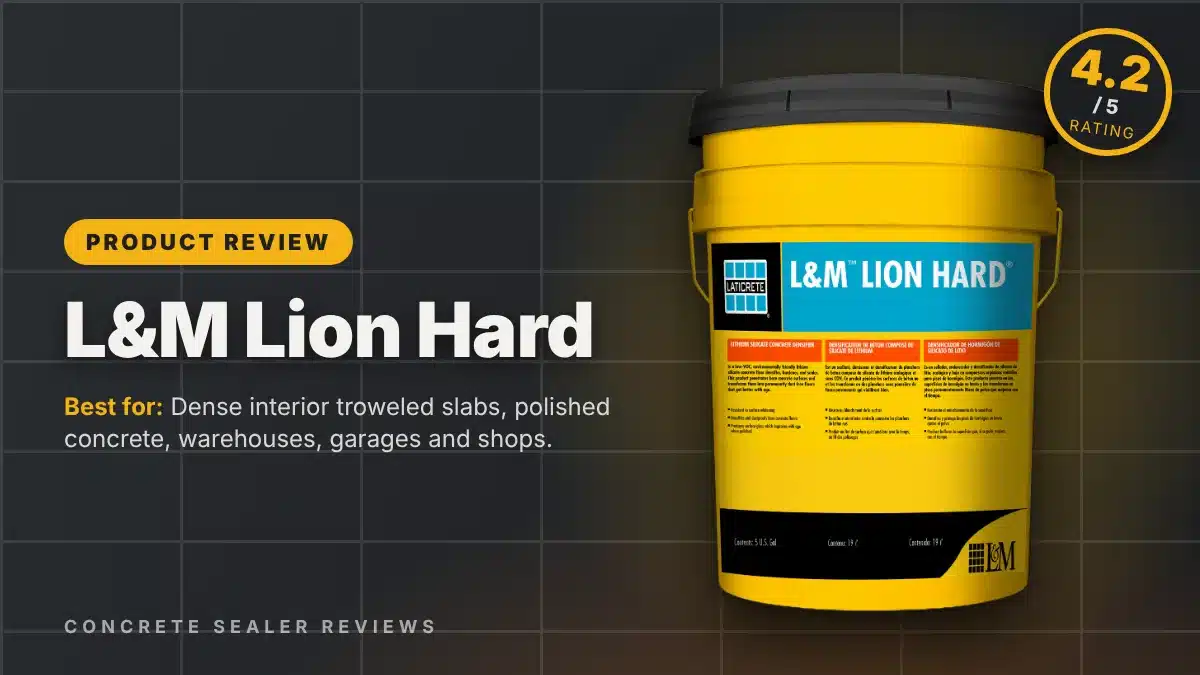
L&M Lion Hard is a lithium silicate densifier, hardener and sealer originally from L&M Construction Chemicals and now sold under the LATICRETE brand as L&M LION HARD. It is used on new and existing interior slabs and in diamond-polished concrete systems, and it suits garage and shop floors as well. The bottom line: it covers a lot of floor per gallon, needs no water flush and will not yellow, but it is a hardener rather than a water repellent, and LATICRETE itself says to run a mock-up before committing.
| Type | Penetrating densifier, hardener and dustproofer |
| Chemistry | Water-based lithium silicate |
| Finish | No film; gloss on polished floors improves with age |
| Coverage | 600–800 sq ft/gal on dense troweled concrete; 400–600 for the first coat on polished floors |
| Coats | One on dense concrete; two on porous or polished concrete |
| Wet time | Keep wet 15–20 minutes; let dry, then remove residue |
| Temperature | Concrete at or above 40°F and rising |
| VOC | Low (no number published); non-flammable, odorless |
| Best for | Interior troweled slabs, polished concrete, warehouses, garages, shops |
| Not for | Use as a curing compound; water or stain repellency on its own |
| New concrete | Minimum 72-hour cure, 7+ days recommended (or applied fresh before a dissipating cure) |
Watch: L&M Lion Hard in 60 seconds
What It Is / How It Works
Lion Hard is still in production. The current data sheet is a LATICRETE document, and the product is listed on LATICRETE's site as L&M LION HARD, in 5-gallon and 55-gallon containers. It is a clear, water-thin lithium silicate solution with a pH of 10.9. Like other silicate densifiers, it soaks into the surface and reacts with the concrete to fill the pores, making the top layer harder, denser and less prone to dusting.
Lion Hard is built with polished concrete in mind. LATICRETE's data sheet gives a full two-coat schedule for diamond-polished floors, says gloss improves with age, and lists ASTM C779 abrasion resistance improvement of 200 to 400%. It also says the treated floor resists surface whitening, will not yellow, flake or discolor under UV, stays breathable and does not contribute to floor "sweating."
Even though LATICRETE calls it a densifier, hardener and sealer, its data sheet does not describe any water-repellent ingredient, so do not expect the water beading you get from a siloxane sealer. LATICRETE warns against acidic or highly alkaline cleaners on treated surfaces.
Where It Works Best (and where it doesn't)
Lion Hard is at its best on dense, steel-troweled interior slabs and polished concrete: warehouses, retail floors, showrooms, garages and basements where you want a harder, less dusty surface that can take a shine. Because it goes on at 600–800 sq ft per gallon on dense concrete, a 5-gallon pail can treat a large floor, and there is no flood-and-flush step to deal with.
It is not a curing compound, and LATICRETE says applying it to concrete under 3 days old reduces long-term effectiveness. It needs a clean, bare surface: sealers, waxes, oil, laitance and other residue must be removed first. Porous or broom-finished concrete will drink more and need a second coat. LATICRETE also requires mock-ups and field tests to confirm performance and appearance, which is good practice but adds a step for homeowners. If you want water and salt protection on a driveway, a penetrating repellent is the better tool; see our best silane/siloxane concrete sealers.
Pros
- High coverage: 600–800 sq ft per gallon on dense concrete
- No water flush; dried residue is broomed or buffed off
- Will not yellow, flake or discolor; resists surface whitening
- Low VOC, non-flammable and odorless
- Built for polished concrete, with a published two-coat schedule
- Breathable; manufacturer cites 200–400% abrasion resistance improvement
Cons
- No built-in water or stain repellency
- Not a curing compound; less effective on concrete under 3 days old
- Porous concrete needs a second coat
- Avoid acidic or highly alkaline cleaners on treated floors
- Sold in 5- and 55-gallon containers through flooring and concrete suppliers
- No numeric VOC or dry time published
How to Apply It
- For new concrete, moist cure or use a clear, non-residual cure for at least 72 hours (7 days or more is recommended), then treat it as existing concrete.
- Remove unsound concrete and fill holes and cracks. Remove all residue, oil, sealers, waxes, contaminants and laitance.
- Apply when the concrete is at or above 40°F and rising. Do a test area first.
- Spray one saturating coat at about 600 sq ft per gallon with a low-pressure sprayer. Keep the surface wet for 15–20 minutes, adding product to porous spots.
- Spread any excess with a soft broom or microfiber pad. Do not broom once the surface begins to dry.
- After it dries, remove any powdery residue with a stiff broom or dry buffer. On porous concrete, apply a second coat once the first is fully dry and the residue is removed.
- Keep traffic off until fully cured. For polished floors, apply the first coat after the 400-grit step (400–600 sq ft per gallon) and the second after the 800-grit step (600–800 sq ft per gallon).
How It Compares
W. R. Meadows Liqui-Hard: a sodium silicate that covers about 200 sq ft per gallon on existing concrete and requires scrubbing and a full water flush. It hardens well but is more work. W. R. Meadows' lithium version, Liqui-Hard Ultra, is closer to Lion Hard in coverage and ease.
Euclid Euco Diamond Hard: a silicate/siliconate blend that adds water repellency on top of densifying, at 200–250 sq ft per gallon. It is the better pick if spill resistance matters most, but leftover product dries to a white residue that has to be ground off.
Epoxy or polyurea coatings: if you want color, chemical resistance and a fully sealed surface, a coating does what a densifier cannot. See our best epoxy floor coatings.
FAQ
Is L&M Lion Hard still made?
Yes. It is sold as L&M LION HARD under the LATICRETE name, with a current LATICRETE technical data sheet.
Do I need to rinse Lion Hard off?
No water flush is called for. Keep it wet for 15–20 minutes, spread out puddles, let it dry, then remove any powdery residue with a stiff broom or dry buffer. On polished floors, the residue is removed by the next polishing step.
Will Lion Hard make my garage floor shiny?
It does not form a glossy film. On polished concrete, LATICRETE says gloss improves with age. On a standard troweled garage floor, expect a harder, less dusty surface with a modest sheen at most.
How do I clean a floor treated with Lion Hard?
LATICRETE recommends its FGS Concrete Conditioner with soft scrubbing pads or brushes. Avoid acidic or highly alkaline cleaners, and avoid black, diamond-impregnated or carbide-impregnated pads, which can dull the gloss.
Verdict
L&M Lion Hard is a well-supported lithium silicate densifier with high coverage, no flush step and a clear polishing schedule. It is a strong pick for interior slabs and polished floors, and an easier DIY option than sodium silicates. It is not a water repellent, so pair it with realistic expectations or a separate sealer where spills and salt are the concern. See the current data sheet on LATICRETE's product page. Our rating: 4.2/5
How we reviewed this product: this is a research-based review built from the manufacturer's technical data sheet and current retail listings. We have not run our own hands-on tests of this product. Details were checked in October 2026; always follow the current label.
Related Guides
Affiliate disclosure: Some links on this page are affiliate links. As an Amazon Associate we earn from qualifying purchases, at no extra cost to you.
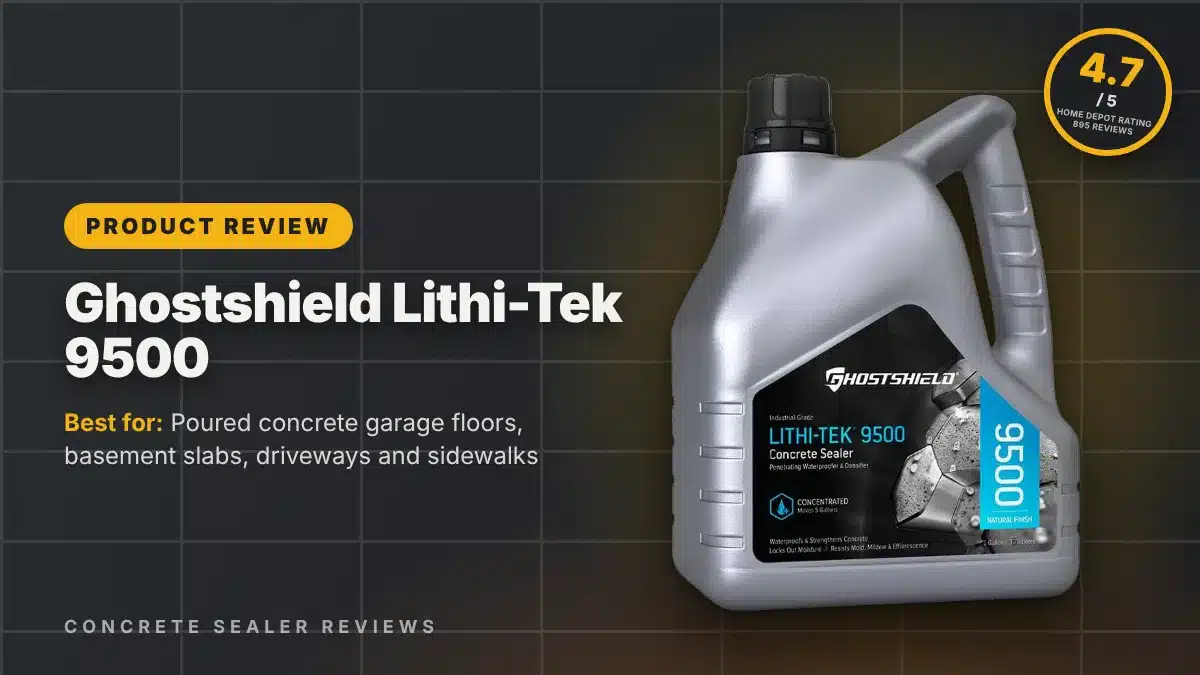
Ghostshield Lithi-Tek 9500 is a water-based, zero-VOC penetrating sealer that combines a densifier with a water repellent in one product. It’s aimed at people sealing poured concrete, such as garage floors, basement slabs, driveways and sidewalks, who want a harder, more water-resistant surface with no visible coating. The bottom line: it’s a convenient two-in-one for dense poured concrete, but it isn’t meant for block or pavers, it doesn’t stop oil stains, and the data sheet’s coverage figures need a careful read.
A note on the name: this product was originally sold as Lithi-Tek LS 9500. It’s now sold as Lithi-Tek 9500, mainly as an “ultra concentrate” gallon that makes 5 gallons.
| Home Depot rating | ★ 4.7/5 (895 Home Depot reviews) |
| Type | Penetrating densifier plus water repellent |
| Chemistry | Water-based proprietary reactive agent; 50% actives |
| VOC | 0 g/L |
| Finish | Clear, natural flat, tack-free, slip-resistant |
| Coverage | 1 gal concentrate (makes 5 gal): about 1,000–1,200 sq ft one coat, 500–600 sq ft two coats |
| Coats | Two, wet-on-wet |
| Dry/traffic | Dries in about 4–6 hours at 70°F and 50% RH; traffic in 24 hours |
| Cure | Water repellency keeps developing for up to 7 days |
| Best for | Poured concrete: garage floors, basements, driveways, sidewalks, loading docks |
| Not for | Cinder/concrete block, pavers, very porous masonry, oil-stain protection |
| New concrete | After proper cure, typically 14–28 days |
Watch: Ghostshield Lithi-Tek 9500 in 60 seconds
What It Is / How It Works
Most concrete sealers do one job. Densifiers react with the concrete to harden and tighten the surface; water repellents make the surface shed water. Lithi-Tek 9500 aims to do both. According to Ghostshield's technical data sheet, its reactive agent forms an insoluble crystalline structure inside the pores and capillaries of the concrete while leaving the surface hydrophobic. The result is a denser surface that also beads water, with no film on top.
The data sheet lists 50% actives and 0 g/L VOC, and the product has no solvent odor, which matters for indoor slabs like basements and attached garages. It dries clear to a natural, flat, slip-resistant finish and is said to work on troweled, cured and honed concrete. The Lowe's listing describes it as strengthening concrete surfaces by up to 50%; that's a manufacturer claim, and the data sheet doesn't give the test behind it.
A practical note on coverage: the data sheet's front page lists 150–400 sq ft per gallon of reconstituted (mixed) product, while its application section and the Lowe's listing describe one gallon of concentrate covering roughly 1,000 sq ft. Because the concentrate makes 5 gallons, those figures overlap, but plan your purchase on the concentrate numbers and test first.
Where It Works Best (and where it doesn't)
It's best on sound poured or cast-in-place concrete, horizontal or vertical, inside or out. Ghostshield lists parking garages, driveways, loading docks, sidewalks, ramps, plazas and parapet caps, and it's a natural fit for garage floors and basement slabs where dusting and moisture are concerns. The data sheet specifically lists troweled and honed concrete as suitable, which matters because smooth, hard-troweled garage floors can be hard for some sealers to penetrate.
Ghostshield is clear about what it's not for: extremely porous masonry such as CMU (cinder or concrete block) and pavers. For those, the company points to Siloxa-Tek 8500. It also doesn't protect against oil or hydraulic fluid, and it won't stop water through cracks, unsound concrete, or failed flashing and caulking. Over-applying can leave a white residue. If you're weighing invisible sealers, our best penetrating concrete sealers guide covers the options.
Pros
- Densifier and water repellent in one product
- Zero VOC and no solvent odor; practical for indoor slabs
- Invisible, flat, slip-resistant finish; nothing to peel
- Concentrate makes 5 gallons, so it's light to ship and store
- Works on troweled and honed concrete as well as broom finishes
- Usable on new concrete once properly cured
Cons
- Not for block, pavers or very porous masonry
- No oil, grease or hydraulic fluid protection
- Over-application can leave white residue or discoloration
- Coverage figures on the data sheet are confusing and need checking
- You have to mix the concentrate (distilled water recommended)
- Few published owner reviews on the current concentrate listing at Lowe's
How to Apply It
- Prep the surface. It must be sound and free of oil, grease, dirt, wax, curing compounds, efflorescence, paint, old sealers and adhesives. Power wash, acid etch or scarify as needed; neutralize and rinse after acid.
- Let it dry. Surface moisture should be no more than 4% by weight, with no standing water.
- Check the weather. Surface and air should be 40–95°F. Don't apply if it may drop below 32°F within 8 hours or rain within 12 hours.
- Mix. Combine 1 part concentrate with 4 parts water, preferably distilled, and stir thoroughly.
- Test. Treat a small area and inspect after 5–7 days.
- First coat. Apply with a roller, brush or low-pressure, non-atomizing sprayer, without exceeding what the surface can absorb. Let it penetrate 5–10 minutes.
- Second coat. Apply a lighter second coat the same way. Roll or broom out puddles so they don't dry white.
- Cure. Allow 24 hours before traffic; water repellency keeps building for up to 7 days. Clean tools with hot, soapy water.
How It Compares
Versus Ghostshield Siloxa-Tek 8500: the 8500 is a silane water and salt repellent without the densifying function, and it's the one Ghostshield recommends for block, pavers and more porous masonry. Choose Lithi-Tek 9500 for dense poured slabs where you also want surface hardening; choose the 8500 for porous masonry or salt-heavy exterior work.
Versus a standalone lithium densifier: traditional lithium silicate densifiers harden and reduce dusting but generally aren't sold as water repellents, so many people follow them with a separate repellent. Lithi-Tek 9500 combines the two steps.
Versus epoxy or polyaspartic coatings: a coating gives stain resistance, color and a cleanable surface, which Lithi-Tek can't, but it costs more, takes more prep and can peel if moisture is trapped. See our best epoxy floor coatings if oil stains on a garage floor are the main concern.
FAQ
Is Lithi-Tek 9500 the same as Lithi-Tek LS 9500?
LS 9500 was the earlier name. The product is now sold as Lithi-Tek 9500. Check the current data sheet for the latest specs.
Is Lithi-Tek 9500 waterproof?
It makes concrete water-repellent and denser, but it won't stop water entering through cracks, unsound concrete or failed joints and flashing.
Can I use it on pavers or cinder block?
No. Ghostshield says it's not for extremely porous materials like CMU block, and the Lowe's listing excludes pavers. Use Siloxa-Tek 8500 instead.
Can I put a coating over it later?
The data sheet doesn't address topcoating. Because it leaves the surface water-repellent, assume coatings may not bond well and check with the coating manufacturer before planning to coat over it.
Verdict
Lithi-Tek 9500 is a sensible choice for poured concrete slabs, especially garage and basement floors, where you want a harder surface and water beading with no odor, no sheen and no film. It's the wrong tool for block, pavers or oil-stain protection, and you'll want to test an area and read the coverage figures carefully before buying. For dense poured concrete, it saves a step over a separate densifier and repellent.
How we reviewed this product: this is a research-based review built from the manufacturer's technical data sheet and current retail listings. We have not run our own hands-on tests of this product. Details were checked in October 2026; always follow the current label.
