
Affiliate disclosure: Some links on this page are affiliate links. As an Amazon Associate we earn from qualifying purchases, at no extra cost to you.
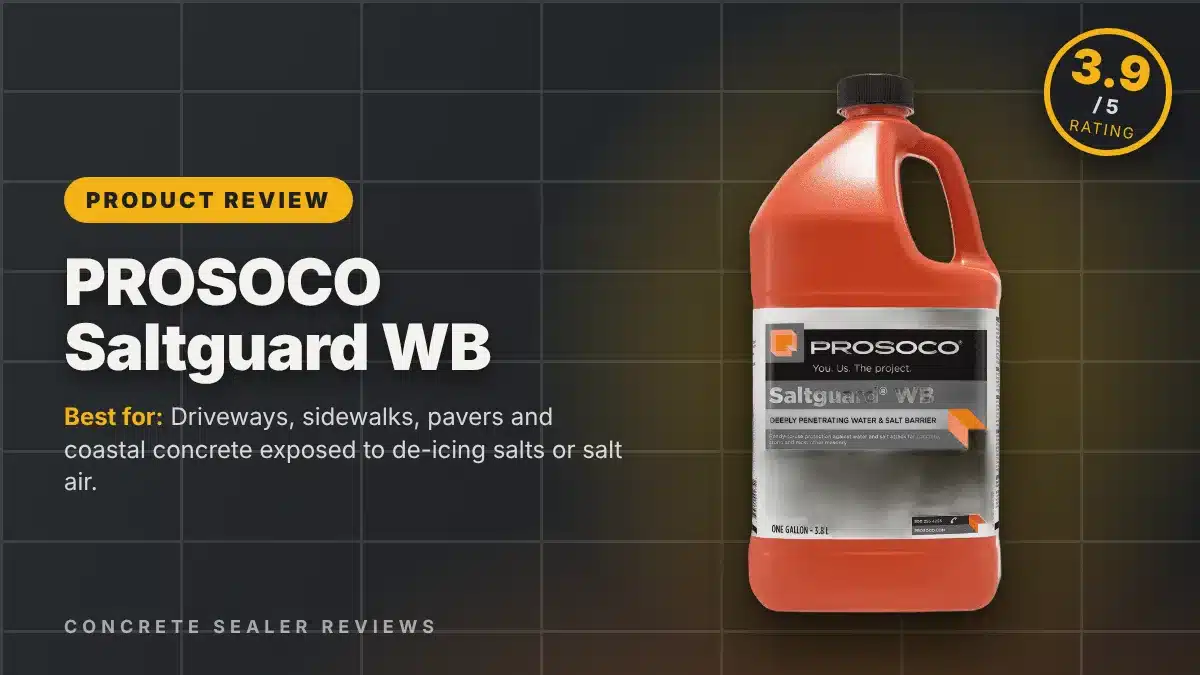
PROSOCO Saltguard WB is a ready-to-use, water-based silane/siloxane water repellent and chloride screen for concrete and masonry. It’s built for driveways, sidewalks, pavers, retaining walls and other surfaces hit by de-icing salts or salt air. The bottom line: it’s a well-documented, low-VOC, invisible penetrating sealer from a respected professional brand, but it’s sold mainly through distributors, its active content is modest, and coverage varies widely, so test first.
A note on the name: older data sheets and some retailers still call it “Consolideck Saltguard WB.” PROSOCO now sells it simply as Saltguard WB (item 46067). It’s the same water-based product, and it’s different from PROSOCO’s solvent-based Saltguard.
| Type | Penetrating water repellent and chloride screen |
| Chemistry | Water-based silane/siloxane, 5% actives |
| VOC | Under 25 g/L |
| Finish | No film; natural look (over-application can darken or mottle) |
| Coverage | 50–300 sq ft per gallon, depending on porosity and texture |
| Coats | One saturating coat on flatwork; two wet-on-wet on vertical surfaces |
| Dry/traffic | Dry to touch in 1 hour; protect from rain 6 hours; traffic after 24 hours |
| Cure | Water repellency keeps building for up to 14 days |
| Best for | Driveways, sidewalks, pavers, retaining walls, coastal concrete |
| Not for | Limestone, marble, travertine, below-grade walls, coated surfaces, car washes |
| New concrete | Can go on concrete 14–28 days old |
Watch: PROSOCO Saltguard WB in 60 seconds
What It Is / How It Works
Saltguard WB is a blend of silane and siloxane carried in water. Silanes are small molecules that soak deep into concrete pores. Siloxanes are slightly larger and help near the surface. Both react inside the substrate to line the pores with a water-repellent layer, without forming a coating on top. Liquid water and dissolved salts bead up and stay out, but water vapor can still escape. That "breathability" is why penetrating repellents don't peel or trap moisture the way films can.
PROSOCO's product data sheet lists 5% actives, VOC under 25 g/L, and alkaline stability, which means it tolerates the high pH of fresh concrete. PROSOCO also says it resists water penetration over shrinkage cracks of 0.02 inch or less. The water base lowers the fire and explosion risk compared with alcohol- or solvent-based repellents.
Where It Works Best (and where it doesn't)
It's a good fit for exterior concrete and masonry exposed to de-icing salts, freeze-thaw cycles or salt air: driveways, sidewalks, brick and concrete pavers, sandstone pavers, retaining walls and coastal structures. It can also go on dense surfaces like tightly troweled garage floors, using one light coat.
PROSOCO is clear about where it doesn't belong. Don't use it on limestone, marble, travertine or other calcareous stone. It's not for surfaces under constant water spray, such as car washes. It shouldn't go over coatings, previously applied repellents or liquid hardeners, and it's not recommended below grade. It also won't stop water coming through structural cracks, defects or open joints. If you're comparing invisible sealers for flatwork, our best silane-siloxane concrete sealers guide covers more options.
Pros
- Penetrating, breathable, film-free; won't peel
- Very low VOC (under 25 g/L), low odor, water-based
- Designed specifically to screen chlorides from de-icing salts and salt air
- Can be used on new concrete as early as 14–28 days
- Ready to use; no mixing
- Detailed, candid data sheet from an established professional brand
Cons
- Modest 5% active content
- Wide coverage range (50–300 sq ft/gal) makes estimating hard without a test
- Mostly sold through distributors and specialty suppliers, not big-box stores
- Not for limestone, marble, travertine or below-grade use
- Freezes at 32°F, so it must be stored and shipped carefully
- No oil or stain repellency, and no color enhancement
How to Apply It
- Prep the surface. Clean thoroughly and remove curing compounds and old sealers, which block penetration. Clean new or repointed masonry before treating. Slightly damp is acceptable, but dry, absorbent surfaces give the best results.
- Check temperatures. Surface and air should be at least 40°F during application and for 8 hours after, and no hotter than 95°F. On hot days, work on shaded surfaces before the afternoon peak. Thaw frozen masonry first.
- Test. Treat a representative area to confirm coverage, penetration and appearance before doing the whole job.
- Horizontal surfaces: apply one saturating coat. Keep the surface wet for 2–3 minutes, broom out puddles until they soak in, and wipe up excess. On dense troweled floors, apply just enough to wet the surface without puddles.
- Vertical surfaces: spray at under 50 psi from the bottom up, with a 4–8 inch rundown. Let it penetrate 5–10 minutes, then apply a second, lighter coat. With brush or roller, saturate evenly and brush out runs.
- Protect and cure. It's dry to the touch in about an hour. Keep rain off for at least 6 hours and traffic off for 24. Repellency keeps improving for up to 14 days.
How It Compares
Versus PROSOCO Saltguard (solvent-based): PROSOCO makes a solvent-based Saltguard alongside the WB version. Saltguard WB is the lower-VOC, lower-odor, lower-fire-risk choice and is better suited where solvent products are restricted or unpleasant to use.
Versus Ghostshield Siloxa-Tek 8500: Siloxa-Tek 8500 is another water-based penetrating repellent, but it's widely sold at big-box stores and online, while Saltguard WB is mostly a distributor product. Siloxa-Tek's data sheet lists a higher maximum VOC (90 g/L) and two wet-on-wet coats as standard.
Versus acrylic sealers: acrylics add gloss, color and stain resistance, but they form a film that wears, can get slippery and may peel if moisture is trapped. Saltguard WB is the better pick when you want protection without changing the look. Our best driveway sealer guide covers both approaches.
FAQ
Is Saltguard WB the same as Consolideck Saltguard WB?
Yes. It was marketed under the Consolideck name and is now sold as PROSOCO Saltguard WB. It's a different product from the solvent-based Saltguard.
Will Saltguard WB change how my concrete looks?
Applied correctly, no. It forms no film and keeps the natural appearance. PROSOCO notes that over-application or poor application can cause slight darkening or mottling, which is why a test area matters.
Can I use it on new concrete?
Yes. The data sheet says it's alkaline stable and suitable for "green" concrete 14–28 days old. Remove any curing compound first.
Can I paint over it later?
Test first. PROSOCO says paint and coating compatibility must be tested, and adhesion of some cementitious coatings may be reduced.
Verdict
Saltguard WB is a solid, low-VOC penetrating repellent with a clear focus on salt and chloride protection, backed by one of the more transparent data sheets in the category. It's best for homeowners or contractors who can buy from a masonry or concrete supplier and are willing to run a test patch. The modest active content and wide coverage range keep it from the top tier, but for invisible, breathable protection on salt-exposed flatwork it's a dependable choice. You can read the details on PROSOCO's Saltguard WB page. Our rating: 3.9/5
How we reviewed this product: this is a research-based review built from the manufacturer's technical data sheet and current retail listings. We have not run our own hands-on tests of this product. Details were checked in October 2026; always follow the current label.
