Affiliate disclosure: Some links on this page are affiliate links. As an Amazon Associate we earn from qualifying purchases, at no extra cost to you.
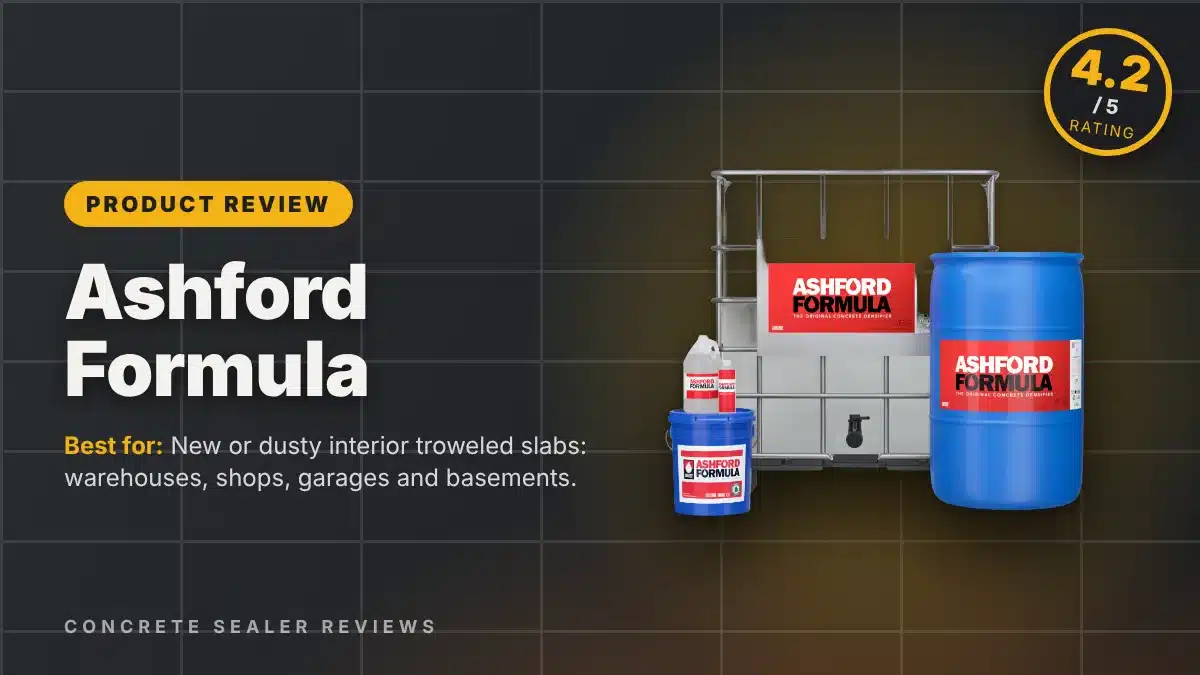
Ashford Formula, made by Curecrete in Springville, Utah, is a water-based, chemically reactive treatment that cures, hardens, densifies and dustproofs concrete. It has been a go-to product for warehouse, plant and commercial floors for decades, and it comes with a 20-year warranty. The bottom line: it’s a proven, zero-VOC densifier with real test data behind it, but it isn’t a sealer or waterproofer, it’s sold through reps rather than stores, and Curecrete prefers qualified applicators.
| Type | Penetrating densifier, hardener, dustproofer and curing aid |
| Chemistry | Water-based, chemically reactive penetrating treatment; zero VOC |
| Finish | No film; troweled floors develop a sheen with traffic and scrubbing over 6–12 months |
| Coverage | About 200 sq ft/gal |
| Coats | One application kept wet for 30 minutes; porous or soft concrete may need more |
| Dry/recoat | Usable once dry to the touch; paint or coverings after 3–7 days (existing) or 30 days (new) |
| Cure | Full benefits typically in 6–12 months |
| Best for | Interior troweled slabs: warehouses, shops, garages, basements, new pours |
| Not for | Sealed or coated concrete, lightweight block, heavy de-icing salt exposure without added protection |
| New concrete | Apply right after finishing (acts as a curing aid) |
Watch: Ashford Formula in 60 seconds
What It Is / How It Works
Ashford Formula penetrates the concrete and reacts with compounds already in the slab, forming crystalline growth that fills pores and voids. According to Curecrete's product data, it also neutralizes alkalis and draws them to the surface, where they're flushed away during application. The result is a denser, harder surface that sheds far less dust.
Curecrete publishes test results that most consumer products don't. These include a 32.5% increase in abrasion resistance (ASTM C779), a 13.3% increase in impact resistance (ASTM C805), 93% greater moisture retention in the first 24 hours of curing, and NFSI High Traction certification for slip resistance. It contains no VOCs, is nonflammable and meets the CDPH indoor air standard.
It leaves no coating, film or membrane. On smooth, steel-troweled floors, a wax-like sheen builds over 6–12 months "strictly as a result of traffic, use and scrubbing," in Curecrete's words. That gradual sheen is one of the things people like most about it, and one reason it's not a quick cosmetic fix.
Where It Works Best (and where it doesn't)
Ashford Formula is at its best on new, structurally sound, steel-troweled interior slabs where dusting and wear are the main problems: warehouses, plants, shops, garages and basements. On new pours, it doubles as a curing aid and can reduce crazing. It also prepares floors for paint, adhesives and floor coverings.
It's a poor match if you want water beading or stain protection on an outdoor slab. Curecrete says areas with heavy de-icer or road salt exposure need extra protection, such as its Salt Slayer product. It can't go over sealed or cured surfaces unless the coatings are fully removed. It won't fix dusting caused by overtroweling, carbonation or a poor water-cement ratio, isn't for lightweight block or highly porous masonry, and won't stop salt migration under heavy moisture or hydrostatic pressure. For water repellency, look at our best penetrating concrete sealers.
Pros
- Permanent hardening and dustproofing backed by a 20-year warranty
- Published ASTM test data for abrasion, impact and slip resistance
- Zero VOC, nonflammable, no film to peel or wear off
- Works as a curing aid on fresh concrete
- Floor gets shinier and easier to clean with use
Cons
- Not a sealer: limited oil, stain and water repellency compared with a topical or siloxane product
- Not sold in home centers; you buy through a Curecrete rep in 5- or 55-gallon containers
- Application is fussy (keep wet 30 minutes, mist, flush, squeegee), and Curecrete recommends qualified applicators on existing concrete
- Sheen and full benefits take 6–12 months
- Can't be used over existing sealers or coatings
How to Apply It
These steps summarize Curecrete's directions for existing concrete. New concrete is treated immediately after finishing, and Curecrete requires a field technician on site when owners apply it to new pours.
- Strip and clean. Remove all coatings, sealers and curing compounds. Sweep or hose the floor. A damp surface is fine if there are no puddles.
- Check the temperature. Don't apply when the slab surface is below 35°F. Mask or protect glass, aluminum and stainless steel.
- Saturate the surface with a low-pressure sprayer, or pour and spread with a soft-bristle broom, at about 200 sq ft per gallon. Never use an airless sprayer.
- Keep it wet for 30 minutes, working it in with the broom. The surface will be slippery during this stage.
- Finish based on absorption. If most of it soaked in after 30–40 minutes, remove the excess from low spots. If most is still on the surface, wait until it gets slippery, then flush with clean water and squeegee dry.
- Return to service. The floor can be used once dry to the touch. Wait 3–7 days before painting or installing coverings.
- Maintain it. Scrub often with water and a pH 9–10 cleaner. Avoid acidic cleaners and sweeping compounds, and don't wax the floor.
How It Compares
Lithium silicate densifiers, sold by many brands, do a similar hardening and dustproofing job, and many are sold online and in home centers in sizes that suit a single garage. Check each product's directions, since application steps vary. Ashford's advantage is its long track record, warranty and published test data.
Silane/siloxane sealers like Rust-Oleum OKON S-40 make concrete repel water and salt, which a densifier alone doesn't do. On exterior slabs in snow country, a siloxane is often the better first choice, or a second step over a densifier.
Epoxy coatings give a garage floor color, chemical resistance and a cleanable surface, but they're a film that can wear and peel. A densifier like Ashford is the opposite: no film, very low maintenance, and the concrete still looks like concrete. Compare options in our best epoxy floor coatings guide.
FAQ
Is Ashford Formula a sealer?
Not in the usual sense. It's a densifier and hardener that leaves no film. Curecrete's warranty says a properly treated surface should stay dustproof, hardened and water resistant, but it doesn't make water bead like a silane/siloxane sealer.
Can I apply Ashford Formula myself?
In the U.S. and Canada, owners can apply it to new concrete with a Curecrete field technician present. For existing concrete, Curecrete recommends a qualified applicator. You can find a local rep through the Ashford Formula website.
How long does it last?
The treatment is permanent. Curecrete warrants that a properly prepared, structurally sound surface will remain dustproof and hardened for 20 years, or it supplies product to re-treat defective areas.
Can I put it on a garage floor that was sealed before?
Only after the old sealer is completely removed. It must penetrate bare concrete to react, so any coating, curing compound or bond breaker has to come off first.
Verdict
Ashford Formula is one of the best-documented concrete densifiers available, with zero VOCs, published test data and a 20-year warranty. It's an excellent choice for dusty or new interior slabs, especially if you can bring in a pro. It's less practical for a DIY homeowner, and it isn't the right product if what you really need is water and salt repellency. Technical documents are on the Ashford Formula website. Our rating: 4.2/5
How we reviewed this product: this is a research-based review built from the manufacturer's technical data sheet and current retail listings. We have not run our own hands-on tests of this product. Details were checked in October 2026; always follow the current label.