Affiliate disclosure: Some links on this page are affiliate links. As an Amazon Associate we earn from qualifying purchases, at no extra cost to you.
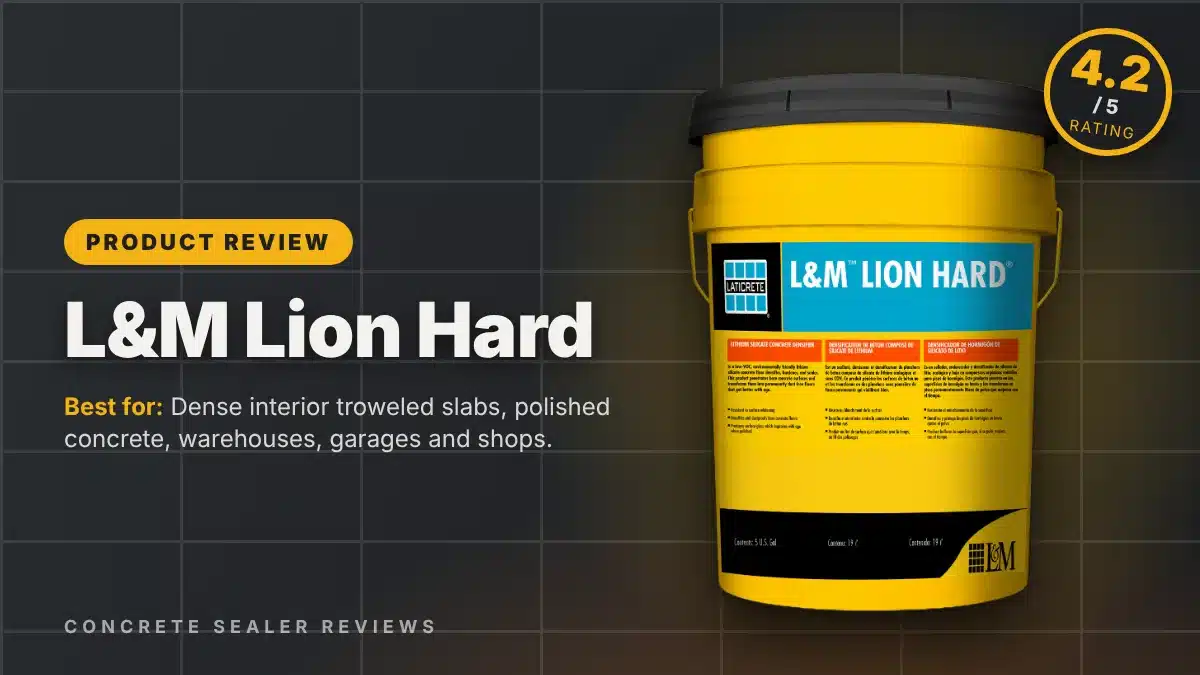
L&M Lion Hard is a lithium silicate densifier, hardener and sealer originally from L&M Construction Chemicals and now sold under the LATICRETE brand as L&M LION HARD. It is used on new and existing interior slabs and in diamond-polished concrete systems, and it suits garage and shop floors as well. The bottom line: it covers a lot of floor per gallon, needs no water flush and will not yellow, but it is a hardener rather than a water repellent, and LATICRETE itself says to run a mock-up before committing.
| Type | Penetrating densifier, hardener and dustproofer |
| Chemistry | Water-based lithium silicate |
| Finish | No film; gloss on polished floors improves with age |
| Coverage | 600–800 sq ft/gal on dense troweled concrete; 400–600 for the first coat on polished floors |
| Coats | One on dense concrete; two on porous or polished concrete |
| Wet time | Keep wet 15–20 minutes; let dry, then remove residue |
| Temperature | Concrete at or above 40°F and rising |
| VOC | Low (no number published); non-flammable, odorless |
| Best for | Interior troweled slabs, polished concrete, warehouses, garages, shops |
| Not for | Use as a curing compound; water or stain repellency on its own |
| New concrete | Minimum 72-hour cure, 7+ days recommended (or applied fresh before a dissipating cure) |
Watch: L&M Lion Hard in 60 seconds
What It Is / How It Works
Lion Hard is still in production. The current data sheet is a LATICRETE document, and the product is listed on LATICRETE's site as L&M LION HARD, in 5-gallon and 55-gallon containers. It is a clear, water-thin lithium silicate solution with a pH of 10.9. Like other silicate densifiers, it soaks into the surface and reacts with the concrete to fill the pores, making the top layer harder, denser and less prone to dusting.
Lion Hard is built with polished concrete in mind. LATICRETE's data sheet gives a full two-coat schedule for diamond-polished floors, says gloss improves with age, and lists ASTM C779 abrasion resistance improvement of 200 to 400%. It also says the treated floor resists surface whitening, will not yellow, flake or discolor under UV, stays breathable and does not contribute to floor "sweating."
Even though LATICRETE calls it a densifier, hardener and sealer, its data sheet does not describe any water-repellent ingredient, so do not expect the water beading you get from a siloxane sealer. LATICRETE warns against acidic or highly alkaline cleaners on treated surfaces.
Where It Works Best (and where it doesn't)
Lion Hard is at its best on dense, steel-troweled interior slabs and polished concrete: warehouses, retail floors, showrooms, garages and basements where you want a harder, less dusty surface that can take a shine. Because it goes on at 600–800 sq ft per gallon on dense concrete, a 5-gallon pail can treat a large floor, and there is no flood-and-flush step to deal with.
It is not a curing compound, and LATICRETE says applying it to concrete under 3 days old reduces long-term effectiveness. It needs a clean, bare surface: sealers, waxes, oil, laitance and other residue must be removed first. Porous or broom-finished concrete will drink more and need a second coat. LATICRETE also requires mock-ups and field tests to confirm performance and appearance, which is good practice but adds a step for homeowners. If you want water and salt protection on a driveway, a penetrating repellent is the better tool; see our best silane/siloxane concrete sealers.
Pros
- High coverage: 600–800 sq ft per gallon on dense concrete
- No water flush; dried residue is broomed or buffed off
- Will not yellow, flake or discolor; resists surface whitening
- Low VOC, non-flammable and odorless
- Built for polished concrete, with a published two-coat schedule
- Breathable; manufacturer cites 200–400% abrasion resistance improvement
Cons
- No built-in water or stain repellency
- Not a curing compound; less effective on concrete under 3 days old
- Porous concrete needs a second coat
- Avoid acidic or highly alkaline cleaners on treated floors
- Sold in 5- and 55-gallon containers through flooring and concrete suppliers
- No numeric VOC or dry time published
How to Apply It
- For new concrete, moist cure or use a clear, non-residual cure for at least 72 hours (7 days or more is recommended), then treat it as existing concrete.
- Remove unsound concrete and fill holes and cracks. Remove all residue, oil, sealers, waxes, contaminants and laitance.
- Apply when the concrete is at or above 40°F and rising. Do a test area first.
- Spray one saturating coat at about 600 sq ft per gallon with a low-pressure sprayer. Keep the surface wet for 15–20 minutes, adding product to porous spots.
- Spread any excess with a soft broom or microfiber pad. Do not broom once the surface begins to dry.
- After it dries, remove any powdery residue with a stiff broom or dry buffer. On porous concrete, apply a second coat once the first is fully dry and the residue is removed.
- Keep traffic off until fully cured. For polished floors, apply the first coat after the 400-grit step (400–600 sq ft per gallon) and the second after the 800-grit step (600–800 sq ft per gallon).
How It Compares
W. R. Meadows Liqui-Hard: a sodium silicate that covers about 200 sq ft per gallon on existing concrete and requires scrubbing and a full water flush. It hardens well but is more work. W. R. Meadows' lithium version, Liqui-Hard Ultra, is closer to Lion Hard in coverage and ease.
Euclid Euco Diamond Hard: a silicate/siliconate blend that adds water repellency on top of densifying, at 200–250 sq ft per gallon. It is the better pick if spill resistance matters most, but leftover product dries to a white residue that has to be ground off.
Epoxy or polyurea coatings: if you want color, chemical resistance and a fully sealed surface, a coating does what a densifier cannot. See our best epoxy floor coatings.
FAQ
Is L&M Lion Hard still made?
Yes. It is sold as L&M LION HARD under the LATICRETE name, with a current LATICRETE technical data sheet.
Do I need to rinse Lion Hard off?
No water flush is called for. Keep it wet for 15–20 minutes, spread out puddles, let it dry, then remove any powdery residue with a stiff broom or dry buffer. On polished floors, the residue is removed by the next polishing step.
Will Lion Hard make my garage floor shiny?
It does not form a glossy film. On polished concrete, LATICRETE says gloss improves with age. On a standard troweled garage floor, expect a harder, less dusty surface with a modest sheen at most.
How do I clean a floor treated with Lion Hard?
LATICRETE recommends its FGS Concrete Conditioner with soft scrubbing pads or brushes. Avoid acidic or highly alkaline cleaners, and avoid black, diamond-impregnated or carbide-impregnated pads, which can dull the gloss.
Verdict
L&M Lion Hard is a well-supported lithium silicate densifier with high coverage, no flush step and a clear polishing schedule. It is a strong pick for interior slabs and polished floors, and an easier DIY option than sodium silicates. It is not a water repellent, so pair it with realistic expectations or a separate sealer where spills and salt are the concern. See the current data sheet on LATICRETE's product page. Our rating: 4.2/5
How we reviewed this product: this is a research-based review built from the manufacturer's technical data sheet and current retail listings. We have not run our own hands-on tests of this product. Details were checked in October 2026; always follow the current label.