
Affiliate disclosure: Some links on this page are affiliate links. As an Amazon Associate we earn from qualifying purchases, at no extra cost to you.
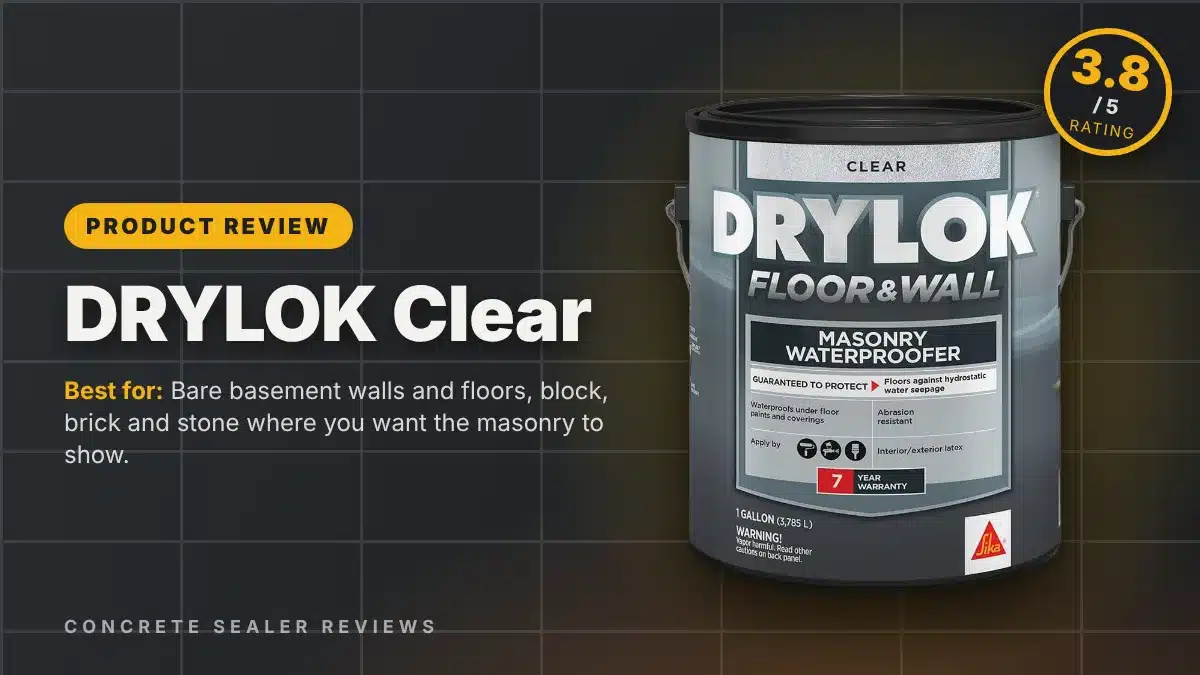
DRYLOK Clear is a clear latex waterproofer for bare concrete and masonry floors and walls. The original name was DRYLOK Clear Masonry Waterproofer, and it’s now sold as DRYLOK Floor & Wall Masonry Waterproofer, still in the 1-gallon (20913) and 5-gallon (20915) sizes. If you want to waterproof a basement wall or floor without hiding the masonry, it’s a solid choice. Keep in mind that it builds a high-gloss film, so it isn’t an invisible penetrating sealer, and it isn’t made for driveways or garage floors that see car traffic.
| Type | Clear film-forming masonry waterproofer |
| Chemistry | Water-based latex, about 30% solids, VOC 100 g/L (retail listing) |
| Finish | Clear, high gloss, non-yellowing |
| Coverage | About 90 sq ft/gal first coat, about 114 sq ft/gal second coat |
| Coats | Two coats required |
| Dry/recoat | Touch dry 2 hours; recoat walls after 2 hours |
| Cure | Light foot traffic 4 hours; heavy foot traffic and floor coverings 24 hours |
| Best for | Basement walls and floors, block, brick, stone, stucco, precast pieces |
| Not for | Vehicle traffic, previously painted or sealed surfaces, a “no-change” look |
| New concrete | Concrete must be dry. Use the plastic-sheet test on the label and let new concrete cure fully first. |
Watch: DRYLOK Clear in 60 seconds
What It Is / How It Works
DRYLOK Floor & Wall is made by United Gilsonite Laboratories (UGL), which is now a Sika company. It's a clear, non-pigmented version of the latex waterproofing chemistry DRYLOK is known for. You roll or brush on two coats, and they dry into a continuous clear film on the surface. That film is what keeps water out, so it works differently from a silane or siloxane repellent, which soaks in and leaves almost nothing on top.
The data sheet says that at the recommended film thickness, the coating resists 4 psi of hydrostatic pressure (ASTM D7088), roughly a 9-foot wall of water. It also resists 98 mph wind-driven rain (ASTM D6904). That 4 psi rating is well below the 10 psi DRYLOK claims for its pigmented Original waterproofer, so the clear version is the lighter-duty option. You choose it because you want the masonry to show through. The film also contains a biocide that resists mold and mildew on the dried coating.
Where It Works Best (and where it doesn't)
It works best on bare interior basement walls and floors where you want to keep the concrete or block look, stop dampness from wicking through and get a surface that's easy to wipe clean. It also suits exterior split-face block, brick, stone and stucco walls that take driving rain, plus decorative precast pieces.
Skip it for driveways and garage floors. DRYLOK says it's not recommended for vehicle traffic, and the glossy film can be slippery when wet. The label offers an optional non-skid additive at 2–4 oz per gallon for that. It's also a poor fit if you want the concrete to look untouched, because it leaves a visible gloss. Active leaks, open cracks and walls with recurring efflorescence need repairs first, and the warranty excludes failures caused by cracked substrates or recurring efflorescence. If you want a penetrating product for outdoor flatwork instead, see our best penetrating concrete sealers.
Pros
- Clear waterproofing film that shows off natural block, brick and stone
- Hydrostatic pressure rating of 4 psi (ASTM D7088) and wind-driven rain rating of 98 mph (ASTM D6904)
- Fast turnaround: recoat in 2 hours, light foot traffic in 4 hours
- Water-based, cleans up with soap and water
- Can serve as a moisture barrier under water-based flooring adhesives or as a base for latex paint
- Transferable 7-year waterproofing warranty when applied per directions
Cons
- Low coverage (about 90–114 sq ft per gallon per coat), so large areas take a lot of product
- High-gloss film changes the look of the surface and can be slippery when wet
- Not for vehicle traffic
- Smooth or troweled floors must be acid-etched or abraded first (ICRI CSP 3–4)
- Lower hydrostatic rating than pigmented DRYLOK waterproofers
- Screws, nails or anchors driven through the coating void the waterproofing
How to Apply It
- Clean. Remove dirt, dust, grease, oil, form release and any paint. If you're removing old paint, follow lead-safety practices.
- Repair. Patch holes and cracks, especially the floor/wall joint. DRYLOK suggests its Fast Plug hydraulic cement.
- Remove efflorescence and open the surface. Use DRYLOK Etch or muriatic acid, then rinse and let it dry. Etch or grind smooth, troweled concrete to roughly medium-grit sandpaper texture. If a drop of water doesn't soak in, etch again.
- Check dryness. Tape a 1 ft x 1 ft piece of plastic to the surface for 24 hours. If moisture shows up under it, keep drying.
- Watch the weather. Air and surface temperatures should be at least 50°F, with no rain coming. Cool, damp or humid conditions slow drying.
- Apply two coats. Stir well and don't thin. Use a brush, roller or sprayer, and don't over-apply. On floors, apply the second coat at a right angle to the first. You can recoat after 2 hours.
- Let it cure. Allow light foot traffic after 4 hours and heavy foot traffic or floor coverings after 24 hours. If a wall still leaks, look for pinholes and add a coat there.
How It Compares
DRYLOK Original Masonry Waterproofer is the pigmented, flat-sheen latex. DRYLOK rates it for 10 psi of hydrostatic pressure, and it comes with a 10-year warranty, but it's white or gray, so it hides the masonry. It's also not made for floors that get foot traffic. Pick Original for leaky walls where looks don't matter and Floor & Wall when you want a clear finish.
Silane/siloxane water repellents soak into the concrete and leave little or no visible film, so they're the better pick for driveways, patios and other exterior flatwork that takes car traffic and freeze-thaw cycles. They aren't built to resist the kind of hydrostatic pressure DRYLOK's film is tested for. Our silane-siloxane sealer guide covers the main options.
Epoxy floor coatings make more sense if you want a durable, cleanable basement or garage floor that can take heavier wear. See our epoxy floor coating picks.
FAQ
Is DRYLOK Clear the same as DRYLOK Floor & Wall?
Yes. DRYLOK's current data sheet lists Floor & Wall Masonry Waterproofer as "formerly Clear Masonry Waterproofer," and retailers still sell it under the 20913 (1 gallon) and 20915 (5 gallon) item numbers.
Is DRYLOK Clear waterproof?
Yes, as long as you reach the recommended film thickness. Two coats, about 16 wet mils in total, are rated to resist 4 psi of hydrostatic pressure. If the coats are thin, or if the substrate is cracked or holding efflorescence, you won't get that rating.
Can you use DRYLOK Clear on a garage floor or driveway?
DRYLOK doesn't recommend it for vehicle traffic. For a garage, a coating made for tires holds up better. For a driveway, a penetrating repellent is the better choice.
Can you put DRYLOK Clear over paint or an old sealer?
No. It's made for bare masonry, and the prep instructions say to remove paint first. Remove the old coating or choose a different product.
Verdict
DRYLOK Floor & Wall, formerly DRYLOK Clear, is a good clear waterproofer for basement walls, floors and exterior masonry, as long as a glossy film is fine with you. It recoats quickly and has real ASTM ratings behind it. The drawbacks are low coverage, a finish that can get slippery, no vehicle traffic and the need for careful etching and dryness checks. You can see the current specs on the DRYLOK product page. Our rating: 3.8/5
How we reviewed this product: this is a research-based review built from the manufacturer's technical data sheet and current retail listings. We have not run our own hands-on tests of this product. Details were checked in October 2026; always follow the current label.

