
Affiliate disclosure: Some links on this page are affiliate links. As an Amazon Associate we earn from qualifying purchases, at no extra cost to you.
Looking for BEHR’s clear sealer instead? This review covers No. 875, a paint-like coating for damp basement and masonry walls. For the clear, no-sheen water repellent for driveways, patios and pavers, see our BEHR Protector & Waterproofer (No. 980) review.
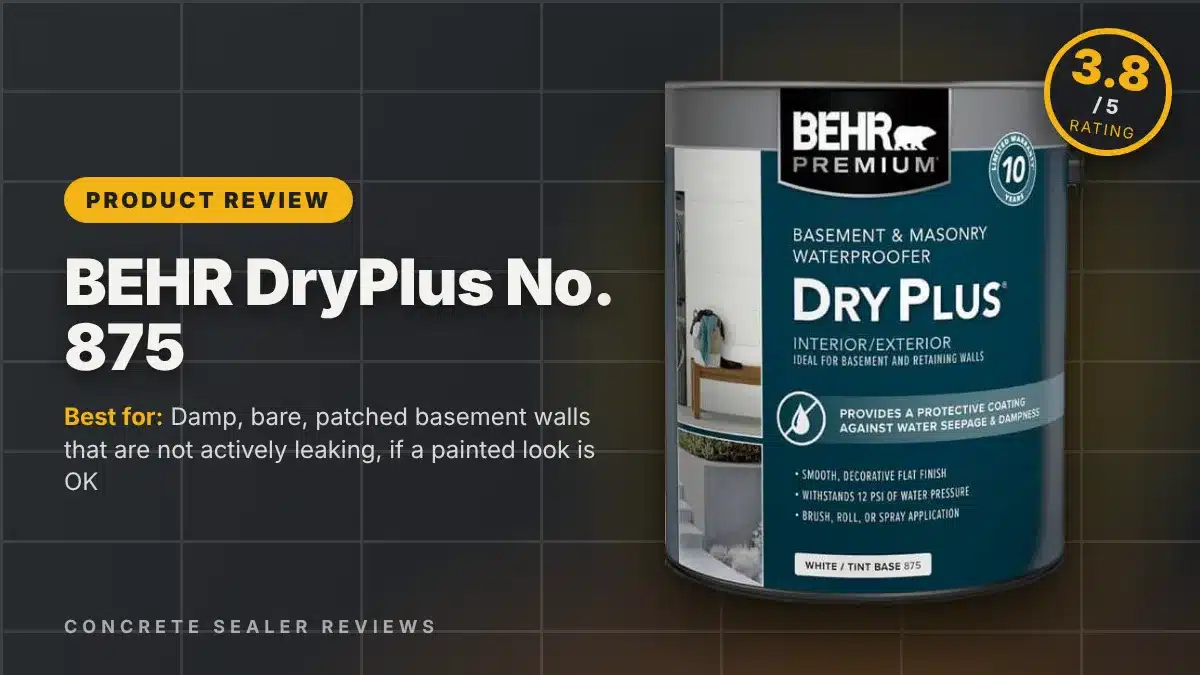
The BEHR waterproofer most homeowners mean when they talk about sealing a damp basement wall is the BEHR PREMIUM Basement & Masonry Waterproofer No. 875, now sold as BEHR DryPlus Masonry Waterproofer (still No. 875). Unlike BEHR’s clear No. 980 Protector & Waterproofer, this is a thick, paint-like acrylic coating for basement walls, retaining walls, block and stucco. The bottom line: it is a solid DIY option for walls that get damp or see minor seepage, but it is not a fix for active leaks or floors, and it hides the masonry under a flat painted finish.
| Type | Film-forming waterproofing coating (paint-like) |
| Chemistry | 100% styrene acrylic latex, about 45% solids by volume |
| Finish | Flat; white, Basement Gray or tinted colors |
| Coverage | 75–125 sq ft per gallon, depending on porosity and method |
| Coats | Two (first heavier, about 75 sq ft/gal; second about 125 sq ft/gal) |
| Dry/recoat | Touch dry 1 hour; recoat 4 hours (77°F, 50% RH) |
| Cure | 7–14 days; wait two weeks before washing |
| VOC | Under 100 g/L |
| Best for | Interior or exterior basement and retaining walls, block, brick, stucco, cement board |
| Not for | Floors; walls with active leaks; over existing oil or latex paint |
| New concrete | Wait at least 30 days |
Watch: BEHR DryPlus No. 875 in 60 seconds
What It Is / How It Works
This product has gone by a few names. Older cans read BEHR PREMIUM Basement & Masonry Waterproofer, later versions added "with NANOGUARD Technology," and today it is sold as BEHR DryPlus Masonry Waterproofer. The product number, No. 875, has stayed the same, and a pre-mixed Basement Gray version is sold as No. 876.
It is a high-build styrene acrylic coating. Behr's data sheet lists about 45% solids by volume and a first coat that goes on at roughly 21 mils wet. Behr says nano-sized particles fill the gaps between larger coating particles to create a tighter film. That film is what stops water: the data sheet lists 12 psi of hydrostatic pressure resistance (ASTM D7088), a pass on wind-driven rain testing and a water vapor permeance under 1 perm, which means it can act as a vapor barrier.
That last point is the key difference from a penetrating sealer. A clear repellent such as BEHR No. 980 lets the wall breathe and stays invisible. DryPlus sits on the surface, changes the look of the wall and blocks vapor. That is useful on the inside of a basement wall, but it also means moisture in the wall has to go somewhere, so outside drainage still matters. If you are comparing clear options for exterior concrete, see our best waterproofing concrete sealer guide.
Where It Works Best (and where it doesn't)
Behr rates it for masonry, poured concrete, concrete block, cement board siding, brick and stucco, above or below grade, inside or outside. The typical use is the interior side of a poured or block basement wall that feels damp, shows efflorescence after rain or seeps a little at the bottom. It also works on exterior retaining walls and foundations, and it doubles as a block filler and primer on masonry with a pH up to 13.
It is not for floors, and Behr says not to use it on floors or walls with active water leaks. Holes and cracks below grade need to be patched with fast-setting hydraulic cement first. It also should not be applied over oil- or latex-based paint, so a previously painted basement wall usually needs the old paint removed. A coating can only resist so much: if water is pouring through a crack or the wall is pushing in, deal with grading, gutters, drainage or a structural repair before you paint anything.
Pros
- Rated to resist 12 psi of hydrostatic pressure
- High-build film fills pores in block and rough concrete
- Water-based, VOC under 100 g/L, water cleanup
- Tintable and mildew-resistant, with a flat decorative finish
- Fast recoat (4 hours) so two coats fit in one day
- Works as its own primer and block filler on masonry
Cons
- Low coverage (75–125 sq ft per gallon), so you need a lot of it
- Not for floors or walls with active leaks
- Cannot go over existing oil or latex paint
- Covers the masonry with a painted look; not invisible
- Acts as a vapor barrier, so it does not let the wall breathe like a penetrating sealer
- Full cure takes 7–14 days
How to Apply It
- Let new concrete cure at least 30 days. Press tape onto the wall and pull it off; if it lifts concrete, remove loose material down to a sound surface.
- Below grade, patch all holes and cracks with fast-setting hydraulic cement. Above grade, remove mildew with a mildew remover.
- Clean off dirt, dust, efflorescence and oil, using an acid etcher such as muriatic acid or mechanical cleaning. Remove old loose paint; do not apply over oil- or latex-based paint.
- Apply between 50°F and 90°F, out of direct sun and not on hot surfaces. Ventilate well indoors.
- Do not thin. Brush with a nylon/polyester brush, roll, or spray with an airless sprayer. Work the first coat into pores and pinholes at about 75 sq ft per gallon.
- After 4 hours (at 77°F and 50% humidity), apply the second coat at about 125 sq ft per gallon. Allow longer in cool or humid conditions.
- Let it cure 7–14 days, and wait two weeks before washing the surface.
How It Compares
BEHR PREMIUM Protector & Waterproofer No. 980: the clear, water-based silane/siloxane from the same brand. It soaks in and leaves no film, but Behr says it is not for areas under hydrostatic pressure. Use No. 980 for exterior flatwork and above-grade walls; use DryPlus for basement walls.
Other masonry waterproofing paints: several brands sell similar thick latex or cement-based basement coatings. Compare the hydrostatic pressure rating, coverage per gallon and whether the product can go over existing paint, since those are the specs that vary most.
Penetrating sealers for basements: silicate densifiers and silane/siloxane repellents work inside the concrete and do not peel, but they leave the wall looking bare. They suit owners who want to treat dampness without painting. Our guide to the best penetrating concrete sealers covers those.
FAQ
Is BEHR DryPlus the same as BEHR Basement & Masonry Waterproofer?
Yes. It carries the same No. 875 product number. Behr's literature has used both names, and the current name is BEHR DryPlus Masonry Waterproofer.
Will it stop a leaking basement wall?
Not an active leak. Behr says not to use it on walls with active water leaks and to patch holes and cracks with hydraulic cement first. It is rated for 12 psi of hydrostatic pressure once properly applied over a sound, patched wall.
Can I put it on my basement floor?
No. Behr lists it as not for floors. Use a floor-rated coating, such as an epoxy or a penetrating sealer, instead.
Can I paint over it?
It is tintable, so most people simply pick a color and use it as the finish. Behr's data sheet does not list a topcoat requirement. If you want a different color later, check the current label for compatible products.
Verdict
BEHR DryPlus No. 875 is a capable, widely available basement and masonry waterproofing paint with a published 12 psi rating, low VOC and easy water cleanup. It is a coating, not a cure-all: it needs bare, patched, clean masonry, it uses a lot of product, and it will not hold back active leaks. For a damp basement wall where you are fine with a painted finish, it is a reasonable DIY choice. Check the current label on Behr's product page. Our rating: 3.8/5
How we reviewed this product: this is a research-based review built from the manufacturer's technical data sheet and current retail listings. We have not run our own hands-on tests of this product. Details were checked in October 2026; always follow the current label.