
Affiliate disclosure: Some links on this page are affiliate links. As an Amazon Associate we earn from qualifying purchases, at no extra cost to you.
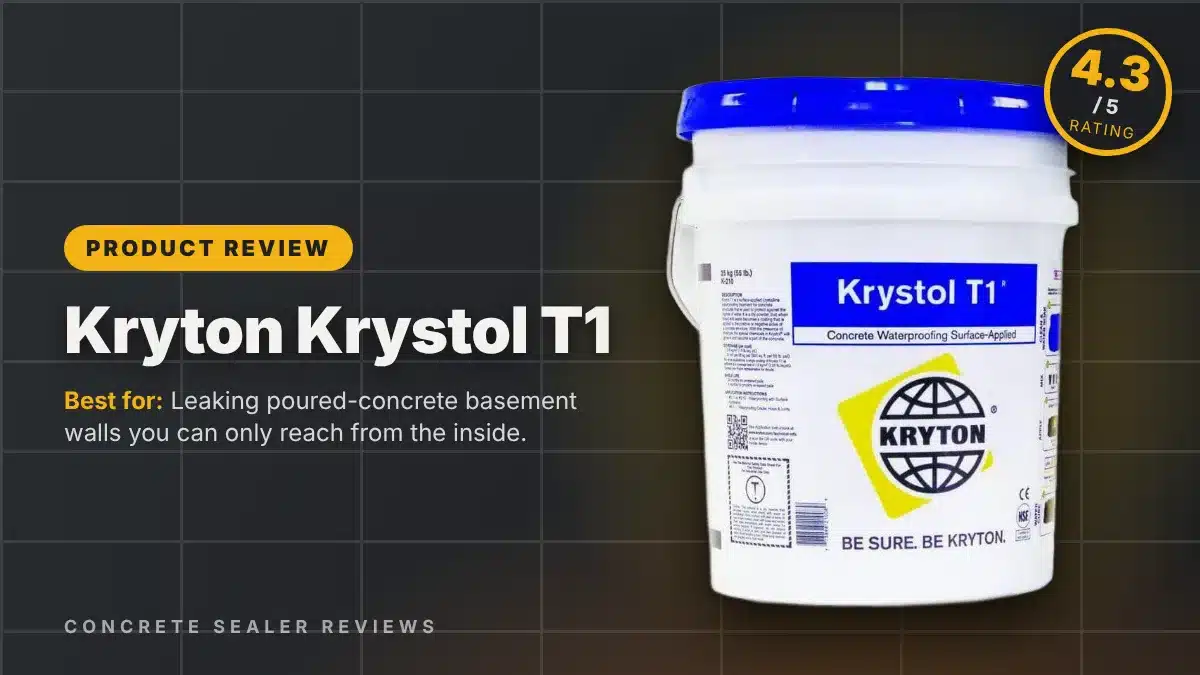
Kryton Krystol T1 is a surface-applied crystalline waterproofing slurry: a gray or white cement-based powder you mix with water and brush onto concrete. It’s built for basements, foundations, pits, tanks and other structures that face water pressure, and it can go on either the wet or the dry side of a wall. It’s one of the better-documented products of its type, but it’s a professional-grade, caustic material that takes careful prep and curing.
| Type | Crystalline waterproofing slurry coating (cementitious) |
| Chemistry | Cement-based powder with Krystol crystalline chemicals; zero VOC |
| Finish | Thin gray or white cement coating |
| Coverage | Up to 225 sq. ft. per 55 lb pail; up to 45 sq. ft. per 11 lb pail (one standard coat) |
| Coats | One or two; second coat within 48 hours after the first sets hard |
| Working/set time | About 30 minutes working time; hardens in about 5 hours (68°F, 50% RH) |
| Cure | Wet cure at least 3 days (7 for potable water tanks) |
| Application temp | Air and surface at least 40°F |
| Best for | Basement walls, foundations, elevator pits, tanks, pools, retaining walls |
| Not for | Moving cracks or joints; flexible or non-concrete surfaces |
| New concrete | Works on new or existing concrete |
Watch: Kryton Krystol T1 in 60 seconds
What It Is / How It Works
Krystol T1 (the older "Krystol T-1" spelling still shows up on some listings) is still sold by Kryton International, which updated its application instructions in April 2026. Unlike a liquid sealer, it's a thick cement slurry. Once applied to damp concrete, its crystalline chemicals migrate into the pores and react with water and cement byproducts to grow insoluble crystals. Those crystals block the pores and capillaries water would otherwise travel through. Kryton lists a crystal growth rate of 2–10 mm per week.
Kryton publishes more test data than most products in this category. Per its data sheet, Krystol T1 resisted 140 m (460 ft) of hydrostatic head in a U.S. Army Corps of Engineers CRD-C48 test, reduced water penetration depth by about 90% versus untreated concrete in another CRD-C48 test, and self-seals hairline cracks up to 0.5 mm (about 0.02 in). It's also NSF/ANSI/CAN 61 certified for contact with drinking water. These are lab results under controlled conditions; Kryton itself notes it can't warrant field results because site conditions and workmanship vary.
Where It Works Best (and where it doesn't)
Kryton lists basements and foundations, elevator and equipment pits, parking structures, pools, reservoirs and tanks, tunnels, manholes, bridge decks and retaining walls. The standout feature for homeowners is that it works from the negative (inside, dry) side. If you can't dig out a leaking foundation, you can apply it to the interior face of a poured concrete wall.
It's limited to rigid concrete. Kryton says it may not be reliable on moving cracks or joints, so active cracks, cold joints and pipe penetrations need repair first using Kryton's repair procedures. It's also not a decorative finish. On floors subject to wear or where appearance matters, Kryton recommends a Krystol T2 topcoat. If your problem is surface water rather than water under pressure, a penetrating sealer from our best waterproofing concrete sealers guide may be simpler.
Pros
- Works on either the positive (wet) or negative (dry) side of a wall
- Extensive published test data, including high hydrostatic resistance
- Self-seals hairline cracks up to about 0.5 mm
- Zero VOC and certified for potable water contact
- Becomes part of the concrete rather than a membrane that can tear
- Can be painted, plastered or tiled over with the right prep
Cons
- Professional-use product that is caustic when wet; needs gloves, goggles and long sleeves
- Demanding prep: open-pore concrete, saturated-surface-dry condition, leaks and cracks repaired first
- Must be wet cured for at least 3 days
- Not for moving cracks or joints
- Low coverage per pail compared with liquid sealers
- Surface bloom must be washed off before painting
How to Apply It
- Stop active leaks and repair cracks, faulty joints, pipe penetrations and honeycombing first, following Kryton's repair instructions.
- Open the surface by high-pressure water blasting (3,000 psi or more), scarifying, shot blasting or sandblasting. Remove paint, sealers, form release, dirt and laitance. Avoid acid etching; if you must use it, neutralize and rinse thoroughly.
- Soak the concrete, then remove standing water so it's saturated-surface-dry (damp, no sheen). Rewet ahead of your work as needed.
- Apply only when air and surface are at least 40°F. Mix about 3.5 parts powder to 1 part water by volume to a thick, spreadable slurry, and mix only what you can use in about 20 minutes.
- Brush, broom or spray it on at 2.2–3 lb per square yard.
- For a second coat, wait until the first sets hard (usually 6–24 hours) and apply within 48 hours. Rinse off surface bloom and keep the first coat damp.
- Cover with plastic or tarps, then wet cure for at least 3 days. Protect from rain, frost and traffic for 24 hours.
How It Compares
Kryton Krystol T2 contains the same crystalline chemistry with fewer actives but a more durable finish. Kryton recommends T2 as a topcoat over T1 on floors and visible surfaces.
Super-Krete S1300 Pene-Krete is a spray-on liquid that's easier to apply and is marketed for reducing moisture vapor and priming slabs for coatings. It publishes far less test data, and it isn't positioned for active water pressure the way Krystol T1 is.
Silane/siloxane penetrating sealers are liquid water repellents for exterior concrete. They're much easier to apply and keep a natural look, but they're not designed to resist hydrostatic pressure from the negative side. See our best silane siloxane concrete sealers for that category.
FAQ
Does Krystol T1 work on the inside of a basement wall?
Yes. Kryton says it can be applied from the positive (wet) or negative (dry) side. Leaks and cracks still need repair first, and moving cracks may not stay sealed.
Can you paint over Krystol T1?
Yes. Wash and rinse off the surface bloom, roughen loose particles and use a paint suitable for new concrete. Kryton's FAQ recommends priming with a penetrating primer, such as a non-pigmented 100% acrylic latex, because the surface can leave a dusty residue.
Will Krystol T1 seal cracks?
It self-seals hairline cracks up to about 0.5 mm (0.02 in). Larger or moving cracks need separate repair.
How soon can I backfill?
After the coating has set hard. Kryton's FAQ suggests about 24 hours, then inspect and touch up. If backfilling within 3 days, use damp backfill material.
Verdict
Krystol T1 is a serious, well-tested crystalline waterproofer and one of the few products that can treat a leaking poured-concrete wall from the inside. It's backed by more published data than most competitors. The catch is the work: aggressive prep, saturated-surface-dry application, three days of wet curing and careful handling of a caustic material. Done right, it's a strong option. Our rating: 4.3/5
How we reviewed this product: this is a research-based review built from the manufacturer's technical data sheet and current retail listings. We have not run our own hands-on tests of this product. Details were checked in October 2026; always follow the current label.