
Affiliate disclosure: Some links on this page are affiliate links. As an Amazon Associate we earn from qualifying purchases, at no extra cost to you.
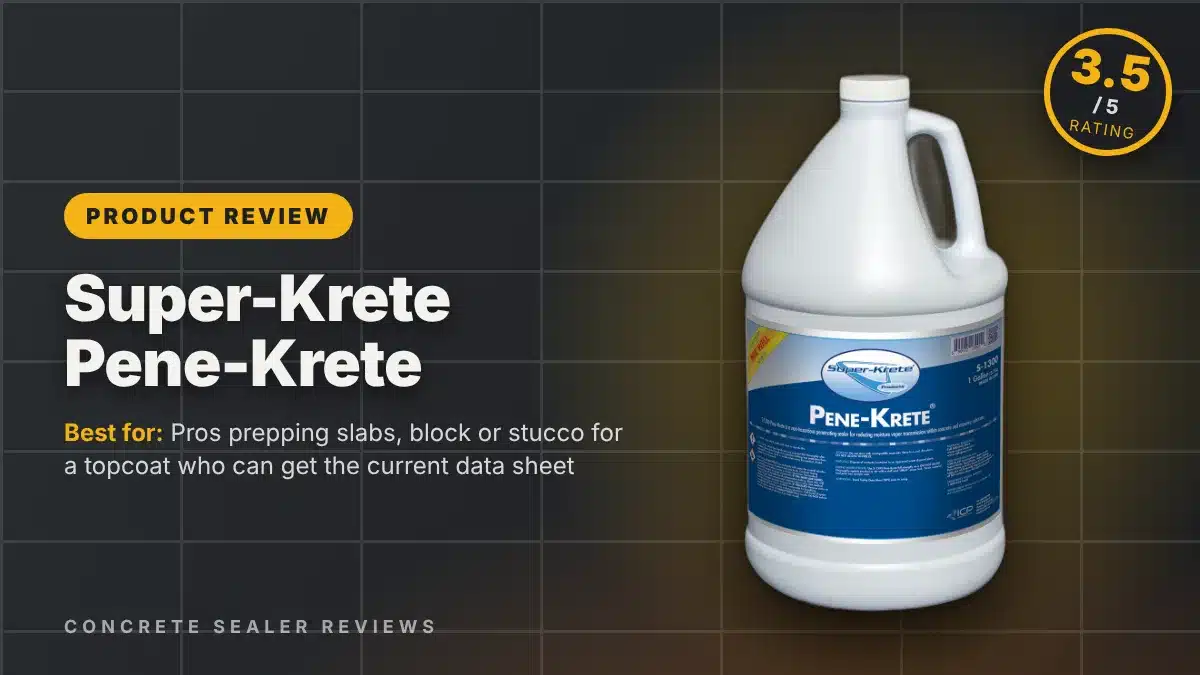
Super-Krete S1300 Pene-Krete is a spray-applied, zero-VOC penetrating densifier for concrete and masonry, sold mainly to contractors as a slab treatment and coating primer. It’s aimed at people who want to reduce moisture vapor, dusting and freeze-thaw damage before a topcoat goes down. Its marketing claims are bold, but its published technical data is thin, so it’s best for buyers who can get the current data sheet from a Super-Krete dealer.
| Type | Penetrating reactive densifier / sealer |
| Chemistry | Not named; reacts with alkali and free lime in cement to form an internal crystal-like shield |
| Finish | Penetrating; no film described |
| Coverage | About 300 sq. ft. per gallon (dealer listing) |
| Application | Spray only |
| VOC | Zero VOC |
| Dry/recoat | Not published in the sources we found; check the TDS |
| Best for | Basement walls and floors, retaining walls, stucco, block and slabs before coating |
| Not for | Sealed or contaminated surfaces it can’t penetrate; a substitute for moisture testing |
| New concrete | Labeled for new and existing concrete |
| Packaging | 1 gallon, 5 gallon, 55 gallon, 275-gallon tote |
Watch: Super-Krete Pene-Krete in 60 seconds
What It Is / How It Works
Pene-Krete is one of Super-Krete's long-running products and is still sold through decorative concrete and flooring distributors under the S1300 (or S-1300) part number. Super-Krete describes it as a non-hazardous penetrating densifier that reacts with alkali and free lime in cement to form an internal, crystal-like shield inside the pores.
Super-Krete doesn't name the active ingredient in the materials we found. The way it's described, a reactive treatment that builds inside the concrete rather than on top, puts it in the same general family as silicate densifiers and crystalline treatments. The company says it penetrates up to 8.5 inches, can raise the compressive strength of concrete by up to 23%, reduces permeability, moisture vapor and radon transmission, and can extend the life of coatings by "as much as 300%." Those are manufacturer claims, and we didn't find independent test data to back up the specific numbers.
Super-Krete also sells a Pene-Krete Additive for fresh concrete, which keeps cement hydrating longer and improves workability. That's a separate product from the S1300 surface treatment reviewed here.
Where It Works Best (and where it doesn't)
The product is pitched for any portland cement-based surface: new or existing slabs, industrial floors, foundations, parking structures, fire-damaged slabs, block, stucco, precast, plaster and gunite. Super-Krete's original launch notes singled out wet areas such as retaining walls, basement walls and floors, and stucco. Super-Krete also lists it as a step in its own decorative finish recipes.
It only works if it can get into the concrete. Super-Krete says surface prep must be "sufficient to allow Pene-Krete to penetrate," so sealed, painted, oily or very dense troweled surfaces need to be opened up first. Distributors also include an important warning: slabs poured without an effective vapor retarder can still pass enough moisture vapor to blister and fail a coating. The coating applicator should run ASTM F1869 (calcium chloride) or ASTM F2170 (relative humidity probe) tests before coating. In other words, don't treat Pene-Krete as a guaranteed fix for a damp slab.
Pros
- Zero VOC and labeled non-hazardous
- Works on a wide range of cement-based surfaces, new and old
- Penetrating treatment with no film to peel
- Doubles as a slab primer that readies surfaces for topcoats
- Marketed to reduce dusting, moisture vapor and freeze-thaw damage
- Sold in sizes from 1 gallon to totes
Cons
- Very little public technical data (dry times, coats, temperatures)
- Big performance claims without independent test data in the sources we found
- Spray application only
- Mostly sold through pro distributors; some sizes show as back-ordered
- Doesn't replace moisture testing before a coating goes down
- Active chemistry isn't named
How to Apply It
Super-Krete's full instructions are on its technical data sheet, which we couldn't access directly. The steps below cover what distributor listings state, plus standard prep for reactive penetrants. Follow the current TDS for dry times, coats and temperature limits.
- Get the current TDS from your Super-Krete dealer and confirm temperature limits and number of coats for your surface.
- Prepare the surface so the product can penetrate. Remove sealers, paint, curing compounds, oil and laitance. Water should darken the surface when sprinkled on it.
- If a coating will follow, run ASTM F1869 or F2170 moisture tests on the slab.
- Protect glass, metal and landscaping from overspray.
- Spray evenly at roughly 300 sq. ft. per gallon, adjusting for porosity. Don't let puddles sit.
- Allow the drying and reaction time on the label before applying any coating or overlay.
How It Compares
Euclid EUCOSIL is a sodium silicate densifier with a full data sheet: 150–600 sq. ft. per gallon, 4–6 hours to foot traffic and 5 g/L VOC or less. It's better documented and can be brushed or scrubbed in, but it's aimed at dustproofing and densifying floors rather than coating prep.
Kryton Krystol T1 is a cementitious crystalline slurry for serious below-grade waterproofing. It's harder to apply but comes with published hydrostatic and crack-sealing test data. If your basement wall actually leaks, it's the more proven option.
Silane/siloxane water repellents don't densify, but they're the better choice when your main goal is keeping rain and deicing salts out of exterior concrete. See our best penetrating concrete sealers for options.
FAQ
Is Pene-Krete waterproof?
Super-Krete markets it as reducing water and vapor passage and originally said it "waterproofs any portland cement-based substrate." But it also warns that slabs without a vapor retarder may still pass enough vapor to damage coatings. Treat it as a moisture-reducing treatment, not a membrane. For leaking walls, see our best waterproofing concrete sealers.
Can you put epoxy or paint over Pene-Krete?
Yes. Super-Krete sells it partly as a primer that readies surfaces for topcoats. Moisture-test the slab first and follow the coating maker's requirements.
Is S1300 Pene-Krete still sold?
Yes. Distributors list it under part numbers like 02-MRPK1300-1G in gallon, pail, drum and tote sizes, though some sizes show as back-ordered. Check current price and stock with a dealer.
Does it change the look of concrete?
It's a penetrating treatment with no film described, so it shouldn't add gloss. Test a small area first if appearance matters.
Verdict
Pene-Krete is a long-standing, zero-VOC penetrating treatment that fits well as a densifier and primer under coatings and overlays, especially inside the Super-Krete system. What holds it back is how little technical data is public and how far its marketing claims go beyond what we could verify. Get the current TDS, moisture-test your slab and it can be a useful prep step. Our rating: 3.5/5
How we reviewed this product: this is a research-based review built from the manufacturer's technical data sheet and current retail listings. We have not run our own hands-on tests of this product. Details were checked in October 2026; always follow the current label.