
Affiliate disclosure: Some links on this page are affiliate links. As an Amazon Associate we earn from qualifying purchases, at no extra cost to you.
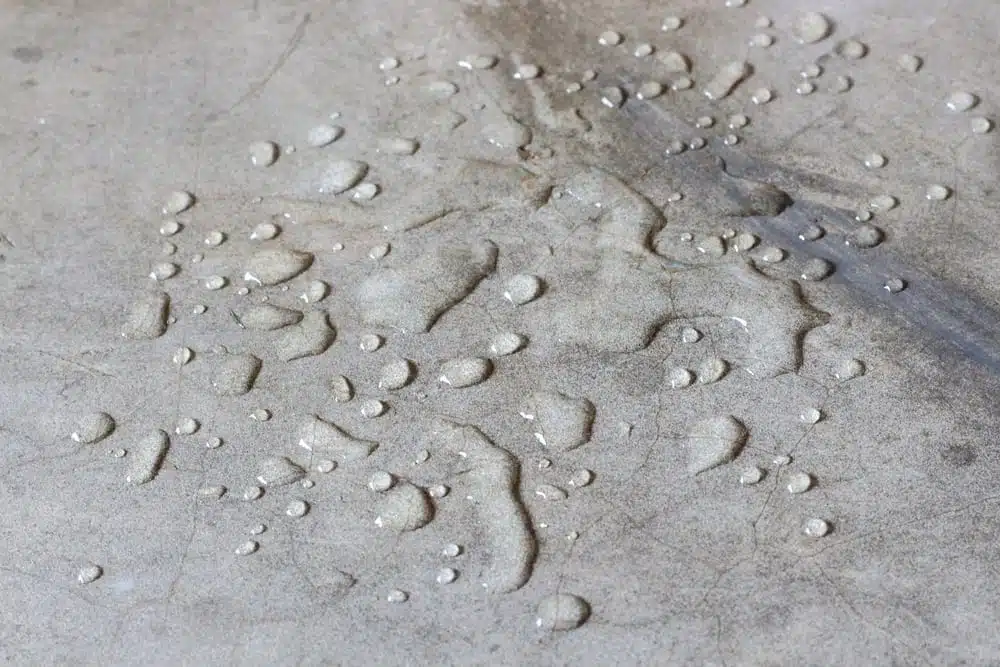
While many concrete sealers claim to offer protection from water damage, most only offer some degree of water resistance. If you are looking for a true water repellent sealer, for instance, an acrylic will not really give you the protection you have in mind. Water repellent sealers are different from penetrating sealers because they are surface sealers. A good example to picture the protection offered by a water repellent would be that they act like a raincoat does. When applied to the concrete, the water visibly beads before sliding off, keeping the concrete dry underneath.
Just like penetrating sealers, water repellent sealers are appropriate for certain types of projects. A delicate piece of concrete cannot be treated with a concrete densifier or any other type of penetrating concrete sealer. Instead, a water repellent sealer is more appropriate, as these types of sealers feature large particles of sealant that cannot penetrate past the tiny surface pores natural to concrete. In order to ensure the concrete sealer is applied properly, you just need to pour out the sealer onto the concrete before spreading it out across the surface of the material.
If you are looking for a sealer that repels water, your best choice would be a silane/siloxane type of sealer. Be sure to look for a water-based variety that offers comparable levels of protection to solvent-based counterparts. Silane/siloxane sealers are made up of a blend of penetrating silane particles combined with surface-level siloxane particles. These two types of particles of chemical sealant function in concert to create a hydrophobic barrier that will block out water and excessive moisture from entering the concrete. The two types of sealant particles ensure that the surface of the concrete retains the most thorough possible protection, while the concrete itself is also protected in case any water seeps through the primary surface level of protection.
Our Take: Water repellents we recommend are Okon S-40 or Siloxa-Tek 8500
Check Price on Amazon
Related Guides
Affiliate disclosure: Some links on this page are affiliate links. As an Amazon Associate we earn from qualifying purchases, at no extra cost to you.
Valspar Solid Color Concrete Stain is a water-based, tintable, opaque coating that covers concrete and masonry in a solid color, much like a thin floor paint. It’s aimed at homeowners refreshing a patio, walkway, pool deck or basement floor who want to hide stains and patches. It’s easy to apply and widely sold, but as a film-forming coating it needs good prep, and Valspar says not to use it on garage floors.
| Type | Opaque (solid) film-forming concrete stain |
| Chemistry | Water-based acrylic (per distributor listing); about 99–100 g/L VOC |
| Finish | Flat to low gloss (Valspar lists both) |
| Coverage | 200–500 sq. ft. per gallon |
| Coats | Two recommended |
| Dry/recoat | Dry to touch in 2–24 hours; recoat after 24 hours (77°F, 50% RH) |
| Cure | About 72 hours (retail listing) |
| Application temp | 50°F to 90°F (retail listings) |
| Best for | Patios, walkways, pool decks, breezeways, basement and laundry floors |
| Not for | Garage floors, asphalt, surfaces treated with water repellents |
| Colors/sizes | Tintable (Ultra White and Base 4) plus ready-mixed colors such as Concrete Gray; 1 and 5 gallon |
What It Is / How It Works
Despite the name, a solid color concrete stain works more like paint than a penetrating stain. It’s pigmented (titanium dioxide is listed among its ingredients) and forms a colored film on top of the concrete that hides what’s underneath. Valspar credits “heavy-duty resin technology” and says the coating resists hot tire pickup, flaking and peeling, and protects against sun, water and household chemicals. Distributor listings identify the resin as acrylic.
It’s ready to use and doesn’t need a topcoat. You can tint the white and Base 4 versions to many colors at the paint counter, or buy ready-mixed shades like Concrete Gray. Valspar also sells a Semi-Transparent Concrete Stain if you want some of the concrete’s texture and color variation to show through.
One small inconsistency: Valspar’s spec section lists the sheen as flat, while its product overview and several retail listings call it low gloss. Expect a mostly flat finish with a slight sheen.
Where It Works Best (and where it doesn’t)
Valspar lists properly prepared interior or exterior concrete and masonry: patios, walkways, breezeways, laundry rooms, basement floors, pool decks, sidewalks and privacy walls. It’s a good fit for stained, patched or mismatched concrete that a clear sealer can’t fix, since the solid color covers it all.
Valspar’s directions state, “Do not use on garage floors,” even though the marketing copy mentions driveways and hot tire pickup. Lowe’s also notes it’s not for asphalt or surfaces previously treated with water-repellent sealers, because the film won’t bond well over them. For a garage, a two-part coating from our best epoxy floor coatings list is the better choice. Like any film-forming coating on concrete, it depends on clean, dry, porous concrete; poor prep or moisture coming up through a slab can cause peeling.
Pros
- Hides stains, patches and discoloration with a solid color
- Tintable to a wide range of colors
- Water-based with soap-and-water cleanup
- Goes on with a brush or roller; no topcoat needed
- Interior and exterior use on concrete and masonry
- Easy to find at Lowe’s and hardware stores
Cons
- Not for garage floors, per Valspar
- Film-forming, so it can peel if prep is poor or moisture comes up through the slab
- Covers the natural look of concrete completely
- Two coats and 24 hours between them make it a multi-day project
- Won’t bond over water-repellent sealers
- Specs differ slightly between Valspar’s page and retail listings
How to Apply It
- Check the surface. If water beads on it, an old sealer or repellent is still there and must be removed. The product won’t bond over water-repellent treatments.
- Clean thoroughly so the concrete is dry and free of loose or peeling paint, dirt, grease and other contaminants.
- Patch cracks and voids with a suitable concrete patch, and level low spots where water ponds.
- Apply when temperatures are between about 50°F and 90°F, with dry weather in the forecast.
- Mix well before and during use. If you have several cans of the same color, intermix them for consistent color.
- Apply with a high-quality polyester brush or a 1/4″ to 3/8″ nap roller, using long, even strokes in one direction.
- Wait 24 hours, then apply the second coat. Allow about 72 hours for full cure before heavy use.
How It Compares
Valspar Semi-Transparent Concrete Stain is the choice if you want color while keeping some of the concrete’s natural variation. It hides less, but it’s a lighter look that many people prefer on newer concrete.
BEHR Premium Solid Color Concrete Stain is the closest competitor at Home Depot: a similar tintable, opaque, water-based concrete stain for patios, walks and other masonry. Compare current labels for coverage and use limits before deciding.
Clear penetrating sealers don’t change color, but because they soak in rather than forming a film, they can’t peel. If your concrete looks fine and just needs protection, see our best concrete sealers for 2026.
FAQ
Does Valspar Solid Color Concrete Stain need a sealer?
No. Lowe’s listing describes it as ready to use with no topcoat required.
Can I use it on my garage floor?
Valspar’s directions say not to use it on garage floors. Use a garage-rated epoxy or polyaspartic coating instead.
Can you put it over previously sealed concrete?
Not over water-repellent sealers, per Lowe’s listing. Do a water test: if water beads, remove the old sealer first or the stain may not bond.
How many gallons do I need?
Valspar lists 200–500 sq. ft. per gallon per coat. Rough or porous concrete lands near the low end. Plan for two coats, so a 400 sq. ft. patio may need two to four gallons.
Verdict
Valspar Solid Color Concrete Stain is a practical, easy-to-find way to give tired patios, walks and basement floors a uniform color. It’s tintable, water-based and simple to roll on. As with any solid concrete stain, prep decides how long it lasts, and Valspar’s own ban on garage floors limits where it fits. Our rating: 3.4/5
How we reviewed this product: this is a research-based review built from the manufacturer’s technical data sheet and current retail listings. We have not run our own hands-on tests of this product. Details were checked in October 2026; always follow the current label.
Related Guides

Related Guides

Related Guides

Related Guides
Affiliate disclosure: Some links on this page are affiliate links. As an Amazon Associate we earn from qualifying purchases, at no extra cost to you.
Glaze ‘N Seal Multi-Purpose Sealer is a clear, water-based acrylic that dries to a medium gloss on concrete, unglazed tile, brick, stone and stucco. It’s aimed at homeowners who want light stain protection and a little extra color on decorative surfaces without handling a solvent product. The bottom line: it’s an easy, low-odor, budget-friendly topical sealer, but it’s a thin film that needs multiple coats and periodic reapplication, and it isn’t a heavy-duty waterproofer.
| Type | Topical, film-forming sealer |
| Chemistry | Water-based acrylic copolymer, about 16% solids |
| Finish | Medium gloss; milky in the can, dries clear and non-yellowing |
| Coverage | 100–400 sq ft per gallon, depending on porosity |
| Coats | Two or more thin coats |
| Dry/recoat | Usually 1–3 hours between coats (dry to the touch) |
| Cure | Keep off heavy moisture for 72 hours; keeps hardening for up to a week |
| Best for | Stamped, colored and exposed-aggregate concrete, unglazed tile, brick, slate, flagstone |
| Not for | Driveways with hot-tire traffic, below-grade leaks, surfaces where you want zero sheen |
| Application temp | 55–80°F |
What It Is / How It Works
This is an acrylic copolymer emulsion. You brush, wipe or spray it on, the water evaporates, and the acrylic particles fuse into a thin, clear film on top of the surface and in the upper pores. That film is what blocks spills. The manufacturer’s data sheet says it resists organic stains such as cooking oil, grease and beverages, and it’s sold for both indoor and outdoor use. It’s still sold today in quarts, gallons, 5-gallon pails and drums; Home Depot lists the 5-gallon pail as “Glaze ‘N Seal Multi-Purpose Waterproofing Sealer” (model 134).
At roughly 16% solids, it’s a light-bodied product. That’s why the label calls for two or more coats: each pass adds a thin layer, and building it up gradually avoids puddles and cloudy spots. The finish is a medium gloss, so expect a noticeable sheen and some darkening or richening of color, especially on stamped or colored concrete and natural stone.
Glaze ‘N Seal also positions it as a primer coat before painting concrete and masonry, a protective coat over painted or stained surfaces, and a base under its own indoor floor polish.
Where It Works Best (and where it doesn’t)
It makes the most sense on decorative surfaces that see light to moderate foot traffic: a stamped patio, a colored concrete walkway, a brick or slate entry, unglazed quarry or Mexican tile, or a terrazzo floor. On those surfaces the gloss and color boost are part of the appeal, and a water-based acrylic is easy to touch up later.
It’s a weaker choice when you mainly want long-term water and salt protection with no change in look. A thin acrylic film wears away in high-traffic lanes and needs to be reapplied, and any film-forming sealer can get slick when wet. If you have an unsealed driveway in a freeze-thaw climate, a penetrating silane/siloxane is usually the better tool. See our best penetrating concrete sealers guide. It also won’t stop water pushing through a basement wall or a cracked slab.
Pros
- Water-based, low odor, and cleans up with water
- Works on a wide range of surfaces: concrete, unglazed tile, brick, stone, stucco
- Resists common organic stains like grease, oil and drinks
- Dries clear, non-yellowing, with a medium-gloss enhancement
- Recoatable, so maintenance coats are simple
- Quick recoat window (usually 1–3 hours)
Cons
- Low solids means you need two or more coats
- Thin film wears in traffic areas and needs periodic reapplication
- Narrow application window (55–80°F)
- Adds sheen and changes the look; not for people who want an invisible finish
- Can be slippery when wet, like most glossy topical sealers
- Not a solution for hydrostatic pressure, active leaks or salt damage on driveways
How to Apply It
- Clean thoroughly. Remove efflorescence, dirt, oil, wax, grease and any failing paint or sealer. If you used muriatic acid, rinse away all residue and neutralize (Glaze ‘N Seal sells a Neutralizing Rinse) before sealing.
- Let it dry. Allow the surface to dry fully. In humid climates, give it extra time.
- Check the weather. Apply between 55°F and 80°F. On warm, sunny days, lightly mist the surface with water first so the sealer doesn’t flash dry.
- Test a small area. Confirm how much it absorbs and how much it darkens or shines.
- Apply a thin first coat. Use a brush, wax applicator or sprayer, depending on how porous and rough the surface is. Don’t let it puddle.
- Recoat. When the first coat is dry to the touch (usually 1–3 hours), apply a second thin coat. Add more coats on very porous surfaces.
- Protect while it cures. Keep heavy moisture and standing water off for 72 hours. The film keeps gaining strength for up to a week.
How It Compares
Versus solvent-based acrylic “wet look” sealers (including Glaze ‘N Seal’s own Wet Look lacquer line): solvent acrylics usually give a deeper, glossier color boost. They also bring stronger fumes and more flammability. The Multi-Purpose Sealer trades some of that depth for easy water cleanup and indoor-friendly odor.
Versus penetrating silane/siloxane sealers: penetrating sealers leave no film, don’t change the look, don’t get slippery and typically last much longer on exterior flatwork. They don’t block oil stains the way a film does, and they give no gloss. If your priority is freeze-thaw and salt protection on a driveway or sidewalk, start with our best concrete sealers roundup.
Versus floor polishes and epoxy coatings: for an indoor concrete floor that gets real wear, a thin acrylic won’t hold up like a two-part coating. The Multi-Purpose Sealer is better seen as a light protective coat, or a base under a sacrificial floor polish.
FAQ
Is Glaze ‘N Seal Multi-Purpose Sealer waterproof?
It makes surfaces water-resistant and helps keep spills from soaking in. It is not a waterproofing system: it won’t stop water coming through cracks, joints or a below-grade wall under pressure.
Will it make my concrete or tile shiny?
Yes. The manufacturer lists a medium-gloss finish, and it slightly enhances color. Test a small area first if you’re unsure about the look.
How many coats do I need?
The label calls for two or more thin coats. Very porous surfaces like rough brick or open-textured stone may need more. Several thin coats are better than one heavy coat, which can puddle.
Can I apply it over a previously sealed surface?
The data sheet says to remove defective paint or sealer before applying, and it’s recoatable over itself. Over an unknown older sealer, test a small area for adhesion and clarity first.
Verdict
Glaze ‘N Seal Multi-Purpose Sealer is a sensible, inexpensive pick for decorative concrete, unglazed tile and masonry where you want a medium-gloss look, stain resistance and easy water cleanup. Its low solids and thin film mean more coats and more frequent touch-ups than heavier sealers, and it isn’t built for driveways or real waterproofing. Buy it for looks and light protection, not for heavy-duty durability. Our rating: 3.6/5
How we reviewed this product: this is a research-based review built from the manufacturer’s technical data sheet and current retail listings. We have not run our own hands-on tests of this product. Details were checked in October 2026; always follow the current label.
