

Affiliate disclosure: Some links on this page are affiliate links. As an Amazon Associate we earn from qualifying purchases, at no extra cost to you.
One of the most sought after concrete sealing products is a waterproofing sealer that is also able to repel deicing salts. Deicing salts and calcium chlorides are some of the most corrosive elements that concrete can be exposed to. They result in spalling, pitting, cracking and cause the concrete to erode all the way down to the rebar if left untreated. Because concrete has the appearance of being strong and indestructible, sealing it is not something that comes to mind – that is until you have active salt damage. Even if you do not salt your driveway, state and town roads are treated, you drive your car up the driveway into your garage and the salt drips off. Over time the concrete becomes damaged.
It is hard to fix existing salt damage with a sealer; however, it is entirely preventable if a penetrating water repellent with saltguard sealer is used. We review the Ghostshield 8500 product quite frequently on this site because it is one of the products we have used that has had the best, longest lasting results. Backed by a 100 year warranty, if reapplied every 10 years, concrete will remain looking new with out any spalls, pits or cracks. This is extremely important because the cost of replacing an existing concrete pad or driveway is about 14x the cost of the actual sealer itself!
Our Take: The 8500 product is a great option if you have a lot of square footage. The product is available in an ultra concentrated gallon; you take the 1 gallon you purchase and mix it with 4 additional gallons of water. When mixed you are left with a 5 gallon bucket which covers up to 625 sq. ft. (the 625 sq. ft. is for both recommended coats or 1250 sq. ft. for 1 coat). The ready to use version that does not require mixing and can be special ordered through Home Depot and Lowes. Whereas the ultra concentrated version can be ordered through Lowes.
Check Price on Amazon
Related Guides

If you have watched HGTV lately you will realize that concrete countertops are trending. Not only do they look amazing when installed but they are so economical in comparison to your typical granite and marble options. What is also trending is feather finish countertops, which is essentially using Ardex or Henry’s Feather Finish concrete mixes and applying them right on top of existing laminate countertops. You can even add pigments to the concrete mixes to make the countertops a color other than gray; we’ve seen white versions, and black versions that look awesome!
Since concrete countertops are extremely porous it is very important to seal them 28 days after the countertops have been cured to prevent staining, scratches and heat damage.
Popular products:
StoneLok E3 2K complete countertop kit includes everything you need to seal 40 sq. ft of concrete countertops. The sealer is applied via a multi-step process, you first apply a surface conditioner, than an epoxy primer and finally a super heat resistant and abrasion resistant polyurethane top coat. One of the most durable products available for use on a concrete countertop if applied correctly. Available in an extra low gloss, low gloss or gloss finish. Does require precise, skilled application and is recommend for use only by trained professionals. The end result is an extremely durable sealer that can resist coffee, wine, citrus, vinegar and Clorox.
If you are looking for a product that doesn’t require such skilled application but will also give excellent abrasion and chemical resistance we recommend the Polyaspartic 745 kit for concrete countertops. Although it has a short pot life (once part A and part B are mixed you must apply it within 20 minutes) it has an extremely fast cure time (24 hours) in comparison to typical epoxy products that need up to a week of cure time. Sold as a countertop kit, you mix part A with part B (already pre-measured) and roll right onto the countertops. Once cured the surface will leave a high gloss finish, acceptable for use on Ardex or Henrys feather finish countertops or regular poured concrete countertops.
Related Guides

When new concrete is poured curing methods are used to retain moisture and delay shrinkage while the concrete gains its full strength. Curing methods include water curing, curing blankets or cure and seal sealers. If a cure and seal sealer is used, over time it will wear away leaving the concrete exposed and susceptible to salt damage, spalling and cracking. In order to prevent this you would then apply a penetrating sealer after the cure and seal is stripped or worn away. Applying a cure and seal initially and then a penetrating sealer afterwards is costly, time consuming and labor intensive.
Enter a new hybrid that brings the world of cure and seals and penetrating sealers together: penetrating cure and seals. Penetrating cure and seals are typically acrylic silane blends which are film forming to hold moisture to help concrete fully hydrate and penetrating to protect against water, salt penetration and freeze-thaw cycles. Penetrating cure and seals must be applied as soon as all bleed water has dissipated within three hours of the final finishing. Using a penetrating cure and seal eliminates the 28 day three step process into a single step.
Ahead of the curve penetrating cure and seal products:
Vexcon CertiVex Guard AIM: Clear, innovative one step silane water repellent and cure all-in-one. Meets NCHRP Series II and Series IV.
Iso-Cure 8525: A water based, low VOC product incorporating nano-technology allowing for a deep penetration and long lasting finish. Meets ASTM C-309 and NCHRP Series II and Series IV.
Related Guides
Affiliate disclosure: Some links on this page are affiliate links. As an Amazon Associate we earn from qualifying purchases, at no extra cost to you.
Use muriatic acid or another acid etching material such as Klean Strip Green Muriatic Acid, a safer muriatic acid or Hydro-Etch 1000 which is a modified phosphoric acid which is not as harmful as traditional muriatic acids. Muriactic acid is one of the most dangerous chemicals you can buy for home use and it can damage nearly everything it touches. We really like the Hydro-Etch 1000 product since in most cases it does just as good of a job as muriatic acid but with less danger. It is also an excellent choice when you are looking to remove efflorescence from concrete and masonry substrates.
Acid Etching Process:
Remove all furniture, equipment and objects from the concrete floor you are going to be etching, sweep up or shop vacuum any dust and dirt.
Remove all oils and greases prior to etching, this can be done by using a degreaser, laundry detergent or Dawn concentrated dish soap.
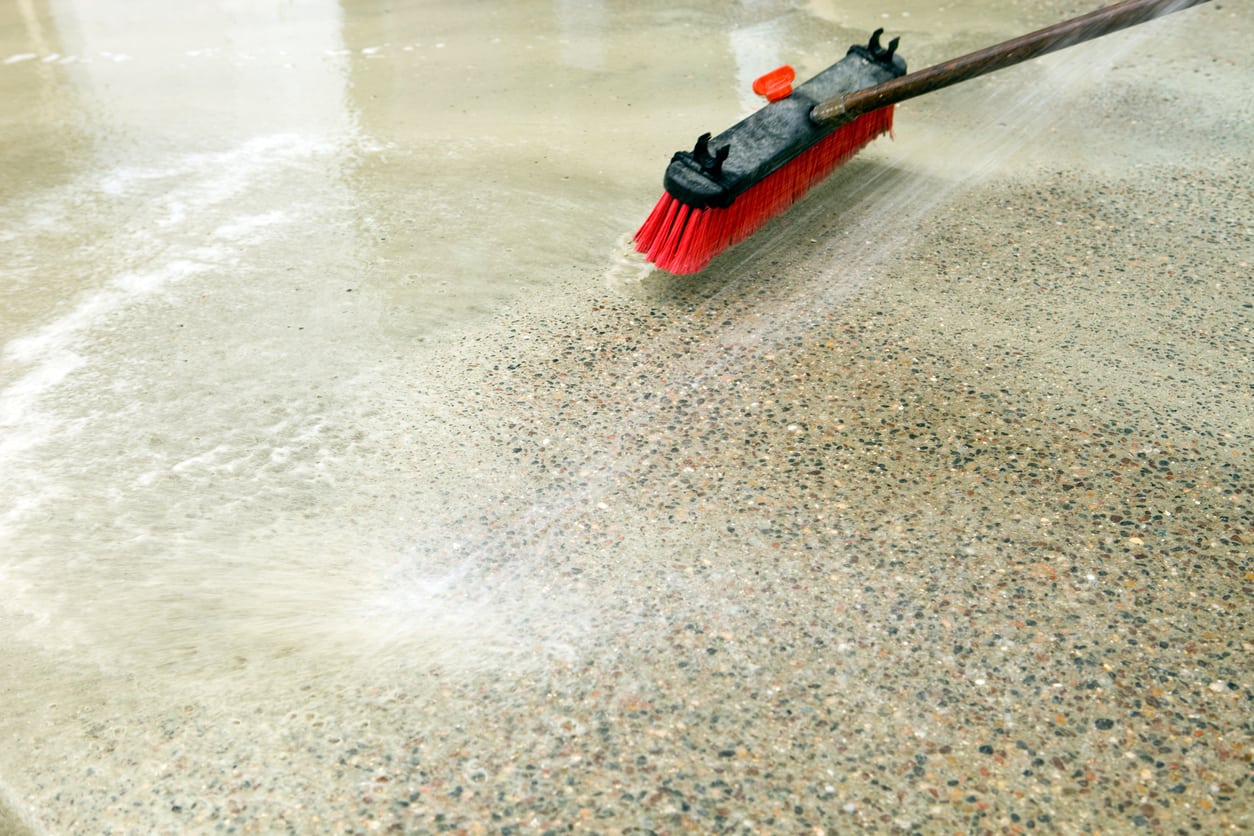
Hose down the entire area you are going to be etching. Spread the water and make sure it is not pooling or puddling, the concrete should remain this wet throughout the acid etching process.
The usual dilution ratio is 3 to 4 parts water to 1 part acid. Do not use a metal container to mix the acid and water. Important: Always pour acid into water, never pour water into acid since the acid can splash back into your face and lead to injury. During the mixing stage wear long sleeves, gloves, eye protection and a face mask to protect against fumes.
After the acid is mixed with water test in a small area to make sure the ratio is accurate, you will be able to tell since the concrete will begin to bubble and react. If you don’t see bubbles when the acid first comes into contact with the concrete the mixture is not strong enough.
It is easiest to use a sprayer or watering can to apply the mixed acid to the floor. After spraying acid on the floor you can use a squeegee or floor machine to spread the acid mixture. Remember that the floor needs to stay wet throughout the entire acid etching process. Do not let the acid dry on the floor, if you notice that it is starting to dry you will need to hose down the areas.
After the acid has been applied wait about 2-15 minutes for the floor to stop bubbling. Throughout this process the acid is reacting with the floor, opening up the pores of the concrete preparing it to accept a sealer. If there are spots where the acid is not reacting with the concrete there could be residual oil or grease left on the floor and you may need to use a floor grinder to prepare the floor in these areas.
After the 2-15 minutes rinse off the acid from the floor. The next step is to neutralize the surface and reduce the pH of the concrete. You can neutralize the concrete using 1 cup baking soda dissolved in 1 cup water or 4 ounces of household ammonia mixed into 1 gallon of water. Let the neutralizing solution sit for a minimum of 10 minutes. You can then rinse off the neutralizing solution and drain it or shop vacuum it up.
The concrete should now have a cleaner, brighter appearance and it should have the texture of medium grit sandpaper. Rinse the concrete twice and suck up the excess with a shop vacuum. If the concrete is not rinsed enough a white powdery residue will be left on the floor when it dries. This can be removed by rinsing the concrete again.
Helpful Tips:
- Wear protective clothing such as safety googles, gloves, long sleeves and close toe shoes.
- Do not breathe fumes, and use a face mask respirator
- ALWAYS POUR ACID INTO WATER, NOT water into acid.
- Effective pH levels prior to applying a sealer or coating are 6.0-9.0. If the range is below 6.0 there may still be acid residue in the pores of the concrete.
- Use a plastic drop cloth to protect anything you don’t want to get splashed.
- Don’t acid etch in weather below 50 degrees F.
- After etching make sure the floor has dried out before applying a concrete sealer or coating.
The post is based on a very informative article on wikiHow.com titled, How to Acid Etch Concrete.
Check Price on Amazon
Related Guides
Affiliate disclosure: Some links on this page are affiliate links. As an Amazon Associate we earn from qualifying purchases, at no extra cost to you.
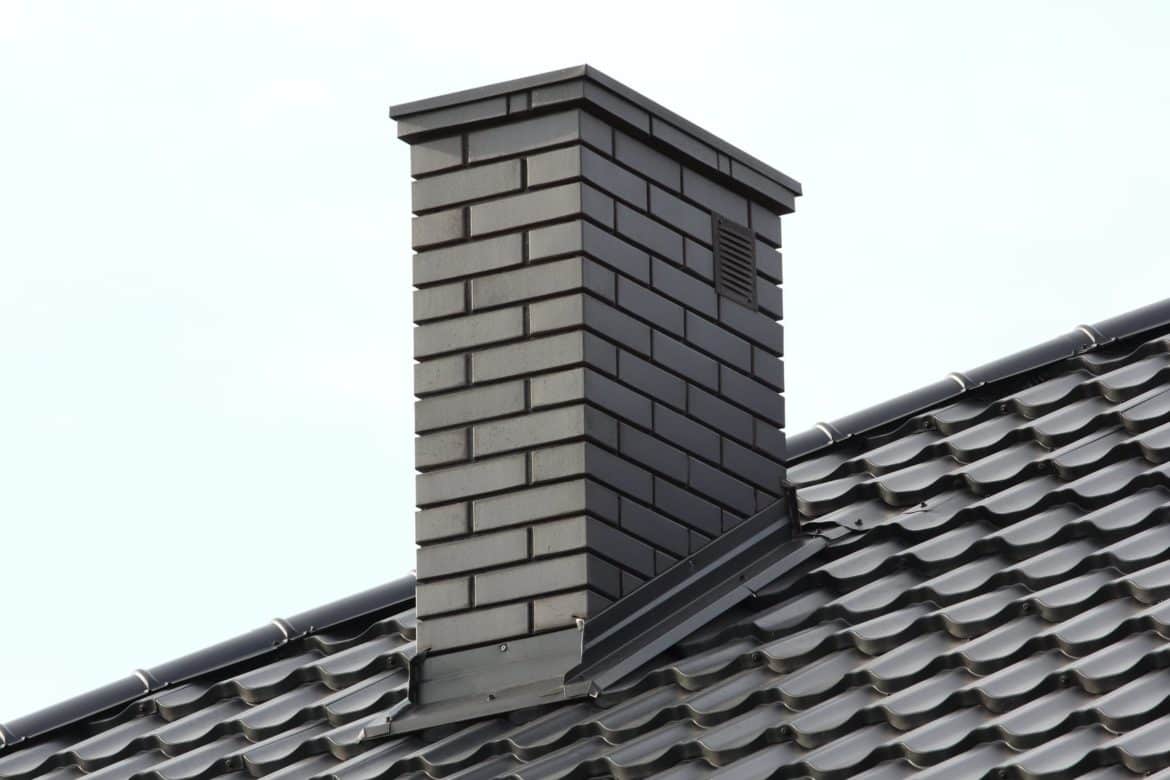
When it comes to sealing, chimneys tend to be more of a forgotten application. That is until you come home one day to find the chimney leaking! Since chimneys are constantly exposed to the elements like wind driven rain, sun, snow, sleet and hail, they are at risk. In comparison to the cost of replacing a chimney, using a waterproofing sealer will pay off dividends in the long run. The best type of sealer to use on a chimney, both brick, stone or masonry based, is of a silane/siloxane chemistry. Silane/Siloxane products are penetrating and will leave no visible sheen or gloss. They are excellent at repelling water, preventing mold and mildew build up and preventing unsightly efflorescence. And the best part is after treatment you do not need to worry about your chimney ever leaking!
One of our favorite silane/siloxane products that we typically recommend on this site is the Ghostshield Siloxa-Tek 8500. We love this product because it is available in an ultra concentrated formulation which saves on shipping cost and it is a lot easier to move around and manage in comparison to a five gallon bucket. The price point is also on par when broken down it comes in around $40 dollars a gallon.
Related Guides

Affiliate disclosure: Some links on this page are affiliate links. As an Amazon Associate we earn from qualifying purchases, at no extra cost to you.
Pool decks are typically stamped concrete, aggregate or paver based substrates that greatly benefit from a wet look decorative sealer. Wet look sealers are typically solvent based acrylics that will immediately bring to life the appearance of a pool deck. The only negative to wet look sealers is that they are often reapplied on a yearly or biannual basis. When shopping for a wet look sealer for a pool deck look for one that is a non yellowing, pure acrylic sealer.
Most Popular Wet Look Pool Deck Sealers:
Ghostshield 5505: This product is a non yellowing, high gloss, wet look pure acrylic decorative sealer that will enhance, brighten and bring to life the colors and textures of any stamped concrete pool deck surface. Readily available at The Home Depot.
Eagle Seal Gloss Coat : This product is a high gloss, durable acrylic film. It can be used on all types of decorative concrete and will never yellow. Readily available at The Home Depot.